

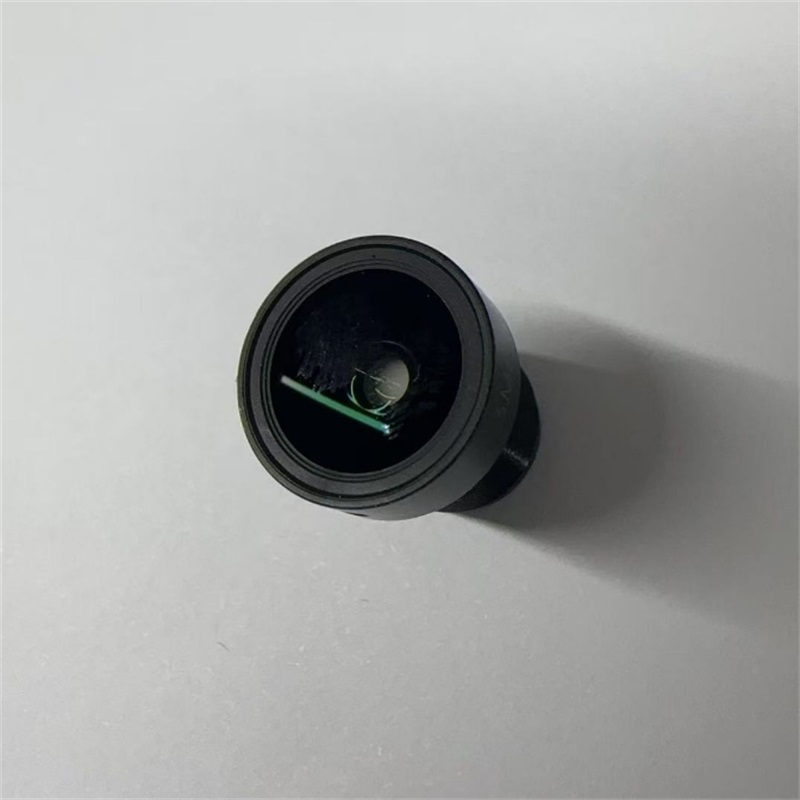
Guide OEM buyers beyond a brighter lens; compare STARVIS 2, micro thermal USB, thermal CVBS and visible+thermal+TOF custom modules for real low-light vision projects
A low-light F1.0 M12 lens can improve visible-light sensitivity for compact camera modules, but OEM projects requiring true night detection, heat-signature recognition, edge AI vision or high-quality low-light imaging usually need a complete STARVIS 2 USB camera, micro thermal imaging module or multi-sensor camera solution
Many product teams search for:
But the real question is not only which lens has the largest aperture.
The real question is:
What must your device see when light becomes weak or disappears?
A low-light lens can help when some visible light still exists.
A STARVIS 2 camera module can provide better visible-image quality under weak light.
A thermal camera module is needed when your product must detect heat signatures in darkness.
A multi-sensor module may be required when your device needs visible image, thermal detection and depth sensing together.
This page is not intended for low-cost FPV hobby lens buyers, DIY camera modders or consumer drone users.
It is designed for OEM engineers, product managers and system integrators developing:
A 2.8mm F1.0 M12 lens sounds attractive because it allows more light to reach the image sensor.
That can help in dusk, indoor low light, weak ambient light or starlight scenes.
But an F1.0 lens cannot solve every night-vision problem.
It cannot detect heat signatures.
It cannot see a person in complete darkness without light.
It cannot identify overheated equipment by thermal contrast.
It cannot replace a thermal camera for fire-risk detection.
It cannot turn an old low-sensitivity sensor into a modern STARVIS 2 imaging system.
If your project only needs a brighter visible image for an existing analog or USB camera, a low-light M12 lens may be useful.
If your product must perform in extreme low light, total darkness, smoke, fog, industrial safety scenes, drone inspection, robot navigation or AI monitoring, you should evaluate a complete camera module architecture instead.
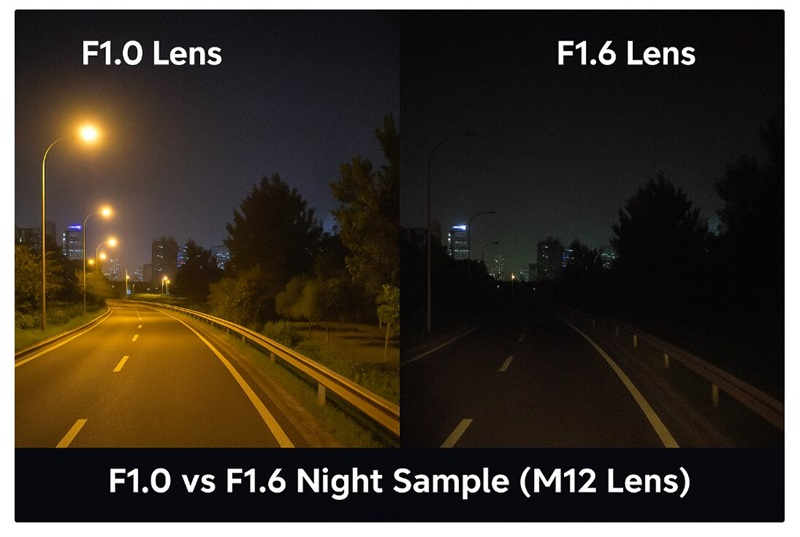
Choose a low-light F1.0 M12 lens when your existing camera module already meets most requirements, but the visible image is too dark.
This path may fit:
This is the lowest-change path, but also the most limited.
A brighter lens can improve light intake, but it cannot create thermal detection or replace a better sensor.
Choose a STARVIS 2 USB camera module when your project needs better visible-light image quality, higher sensitivity and stronger long-term product positioning than a simple lens upgrade.
This path is better when your device needs:
Goobuy can discuss IMX585 USB camera modules, IMX678 STARVIS 2 USB camera modules and customized lens/cable/housing configurations for OEM applications.
Choose a high-sensitivity Sony STARVIS camera module when your device still needs visible imaging, but the lighting condition is poor.
This path can be considered for:
Depending on the project, Goobuy can discuss IMX462, IMX385, IMX585, IMX678 or other Sony STARVIS / STARVIS 2 camera configurations.
Choose a thermal CVBS module when your system must detect heat but still depends on analog video output.
This path may fit:
A thermal CVBS module can help OEM products move beyond visible-light night vision while keeping analog compatibility.
Choose a micro thermal USB camera module when your product needs digital thermal data, software processing or edge AI integration.
This path is better for systems using:
Goobuy can discuss compact thermal module options including:
Choose a visible + thermal camera architecture when your product needs both visual confirmation and heat detection.
A visible camera helps show:
A thermal camera helps show:
This direction is suitable for:
Some advanced OEM products need more than one sensor.
A STARVIS 2 camera provides low-light visible detail.
A thermal camera detects heat signatures.
A TOF camera can add distance, depth or presence sensing.
For qualified OEM projects, Goobuy can discuss feasibility of a 3-in-1 architecture:
STARVIS 2 USB camera + thermal USB camera module + TOF USB camera module
This path may be considered for:
Important note: synchronization, calibration, housing design, firmware behavior and software interface must be defined project by project.
| Your Project Need | Better Direction |
|---|---|
| Existing camera is slightly too dark | F1.0 low-light M12 lens |
| Need better visible image in weak light | STARVIS 2 IMX585 / IMX678 USB |
| Need strong visible low-light sensitivity | IMX462 / IMX385 / STARVIS camera |
| Need heat detection with analog output | Thermal CVBS module |
| Need digital thermal data for software or AI | Micro thermal USB module |
| Need visual confirmation + heat detection | Visible + thermal dual-camera |
| Need heat + visible image + distance sensing | STARVIS 2 + thermal + TOF |
| Need custom housing, cable, lens or firmware | OEM / ODM custom camera module |
Solution Maturity & Project Discussion
| Solution Path | Project Status | Best For | What to Confirm |
|---|---|---|---|
| F1.0 M12 lens | Existing optical component | Existing camera designs needing more light | Sensor size, mount, FOV |
| STARVIS USB camera | Existing / customizable | Low-light visible imaging | Lens, case, firmware, UVC profile |
| STARVIS 2 IMX585 / IMX678 USB | Customizable OEM option | Better low-light visible image quality | Lens, cable, housing, interface |
| Thermal CVBS | Project-based custom option | Analog systems needing heat detection | Resolution, palette, output |
| Micro thermal USB | Existing or semi-custom direction | Digital thermal data / edge AI | Radiometric data, SDK, interface |
| Visible + thermal | Custom integration | Detection + visual confirmation | Mechanical layout, sync, software |
| STARVIS 2 + thermal + TOF | Qualified custom project | Advanced multi-sensor products | Calibration, interface, NRE, MOQ |
If your project needs true no-light detection, heat signature recognition or compact thermal sensing, review Goobuy’s micro thermal camera module options for OEM industrial and embedded applications.
Micro thermal imaging camera module for OEM devices
Explore Goobuy’s STARVIS and thermal camera module family, including IMX678 STARVIS 2, IMX462 low-light camera, thermal CVBS, IMX291, IMX335 and IMX385 options.
STARVIS and thermal camera modules for low-light OEM vision
Choose IMX678 STARVIS 2 when your device needs better visible imaging under weak light instead of thermal detection.
IMX678 STARVIS 2 USB camera for edge AI and low-light vision
Choose IMX585 when your product roadmap needs a newer low-light visible camera platform with stronger image quality and long-term upgrade potential.
IMX585 STARVIS 2 USB camera module for custom OEM devices
If your project requires a custom lens, housing, cable, connector, firmware profile, thermal module, TOF module or multi-sensor integration, contact Goobuy for OEM / ODM camera development.
Custom thermal, STARVIS 2 and multi-sensor camera module development
To help Goobuy recommend the right path, please send:
For custom thermal or multi-sensor projects, MOQ, NRE and development timeline depend on mechanical, firmware and interface requirements.
This page starts with a low-light lens, but Goobuy is not limited to selling optical components.
We help OEM engineers and product managers decide whether their real project needs:
If a lens upgrade is enough, we can support it honestly.
If your project needs true thermal detection, better low-light image quality, USB data output, edge AI compatibility or multi-sensor fusion, we can help you evaluate a better architecture.
Our value is helping you turn a vague “night vision lens” or “low-light camera” request into a practical camera module configuration that matches your detection target, interface, host platform, size limit and production quantity.
Not sure whether your product needs a low-light lens, STARVIS 2 USB camera, micro thermal USB module, thermal CVBS module or multi-sensor camera?
Send us your real application and the problem your current image system cannot solve.
Tell us:
Goobuy will help you decide whether to use a low-light lens, upgrade to STARVIS 2 IMX585 / IMX678 USB, choose micro thermal USB, develop thermal CVBS, or build a visible + thermal + TOF custom solution.
Contact Goobuy to discuss your low-light, thermal or multi-sensor OEM camera project.
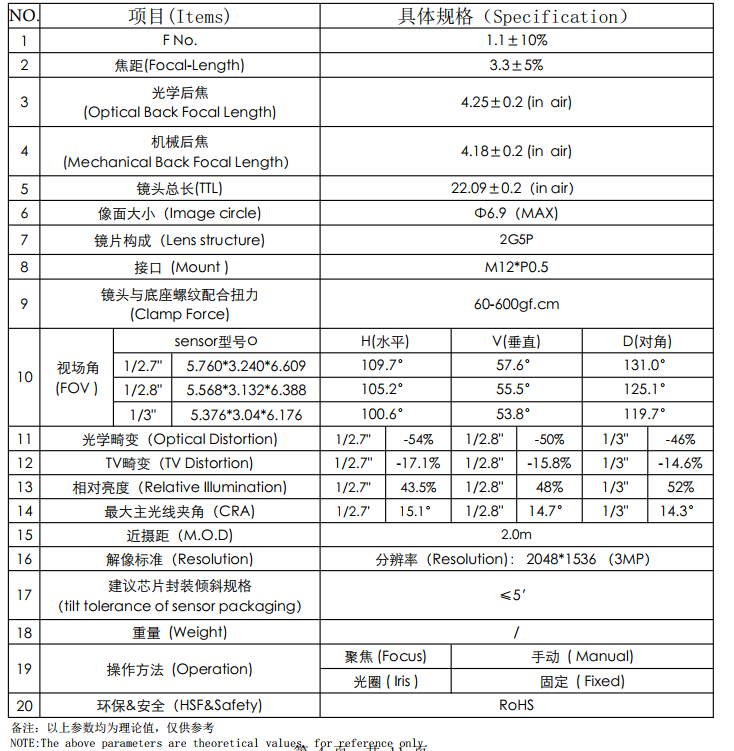
Main Technical Specification of blacklight F1.0 wide angle m12 lens
Possibly. A brighter lens can improve visible-light intake, but it cannot solve sensor noise, poor dynamic range, total darkness or thermal detection. If your product still cannot see enough after lens tuning, you may need a STARVIS 2 USB camera module, micro thermal USB camera module or visible + thermal camera solution.
No. An F1.0 lens helps the sensor receive more light, but the final image still depends on sensor sensitivity, ISP tuning, exposure, noise control and real lighting. For high-quality low-light imaging, OEM projects often need Sony STARVIS / STARVIS 2 sensors such as IMX585, IMX678, IMX462 or IMX385.
Choose STARVIS 2 when your device needs better low-light color image, USB output, higher image quality, AI-ready video input or long-term product positioning. A lens upgrade is useful for small improvements; a STARVIS 2 USB camera module is better when the entire imaging chain must improve.
Choose thermal when your product must detect heat signatures, people, animals, overheated equipment, fire risk or no-light targets. Choose STARVIS 2 when your product needs visible scene detail, color, texture or object identity under weak light. Many advanced systems use both visible and thermal modules.
Yes. Goobuy can discuss micro thermal USB modules for digital thermal data and thermal CVBS modules for analog video systems. Please specify resolution, output interface, host platform, lens FOV, size limit, power budget and whether you need thermal video only or temperature data access.
Yes, for qualified OEM projects. Goobuy can discuss STARVIS 2 visible camera plus micro thermal camera integration for industrial safety, inspection robots, drone payloads, smart security devices and edge AI terminals. Mechanical layout, synchronization and software behavior must be confirmed by project.
Yes, for serious OEM projects with clear requirements. This architecture can combine low-light visible imaging, thermal detection and distance/presence sensing. Please send your application, host platform, size limits, synchronization needs, interface requirement and expected annual quantity.
Please send your application, lighting condition, detection target, current camera or lens problem, interface requirement, host platform, field of view, working distance, size/weight/power limits and expected quantity. Also tell us whether your pain point is low-light noise, no-light detection, heat signature, lens mismatch, USB data output or multi-sensor fusion.
Follow Me
Address:A615, 6F, Huachuangda Building, No107 Xinghua 1st Road, 43 District, Xinan street, Baoan, shenzhen, China 518101