
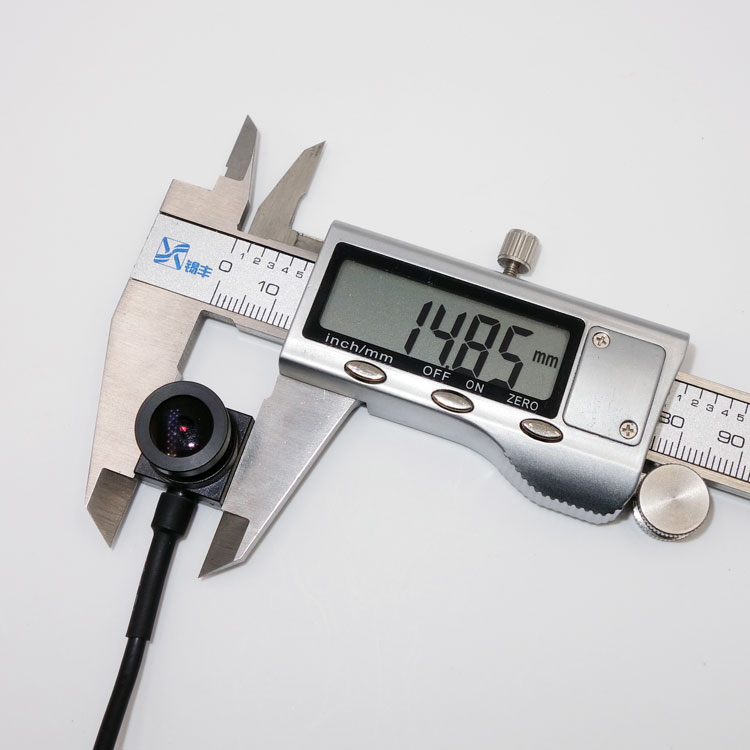
Goobuy UC-501 15×15mm micro USB camera for robotics vision is a compact UVC camera module designed for robotics developers who already have a host platform and need a small camera head for auxiliary visual input, fast sample testing, and project-based customization. Goobuy’s UC-501 series is suitable for U.S. and German robotics OEMs building AMRs, AGVs, cobots, inspection robots, mobile platforms, and embedded AI vision systems that need compact USB video input without starting a camera design from zero.
Goobuy UC-501 is not a complete robotics perception system, certified safety camera, SLAM solution, or high-speed machine vision camera. Its value is practical: it helps robot teams quickly evaluate image quality, lens angle, working distance, cable routing, mechanical placement, USB UVC compatibility, and custom configuration before moving to pilot builds, NRE discussion, or batch production.
Robotics vision projects often fail for practical reasons before they fail for AI reasons.
A robotics team may already have a Jetson host, x86 edge computer, embedded Linux board, industrial PC, Android controller, or robot control platform. The robot may already be moving, docking, gripping, carrying payloads, or performing inspection tasks. But the team may still need one more compact camera view from a specific physical position.
Typical problems include:
This is where Goobuy’s UC-501 15×15mm micro USB camera platform can help.
UC-501 is designed for robotics developers and OEMs who need a compact USB camera module that can be tested quickly with an existing host. It gives engineering teams a practical way to validate lens angle, working distance, image quality, cable routing, mounting position, software capture path, and host compatibility before committing to a final custom camera design.
This page focuses especially on the United States and Germany, because these two markets represent different but important robotics buying behaviors.
U.S. robotics teams often value fast validation, pilot deployment, flexible customization, and speed from sample to customer demo.
German robotics buyers often require technical clarity, mechanical fit, defined limitations, stable documentation, and reliable small-to-medium batch integration.
UC-501 is not for every robot vision task. But for the right auxiliary camera position, it can reduce early development uncertainty and help the robot team move faster.
Core Decision Snapshot
| Question | UC-501 Fit |
|---|---|
| Do you already have a robot host such as Jetson, Linux, x86, Android, or industrial PC? | Good fit |
| Do you need a compact auxiliary camera, not a full robot perception system? | Good fit |
| Do you want USB UVC instead of MIPI driver development? | Good fit |
| Do you need gripper viewing, docking support, payload monitoring, cabinet viewing, or maintenance video? | Good fit |
| Do you need fast samples before deciding on lens, cable, or housing customization? | Good fit |
| Do you need certified safety vision? | Not suitable |
| Do you need deterministic multi-camera synchronization? | Not suitable |
| Do you need global shutter for fast motion or moving barcode capture? | Use a global shutter USB camera instead |
| Do you need thermal anomaly detection? | Use a thermal camera module instead |
| Do you need MIPI-only PCB-level integration? | UC-501 may not be the right path |
Many robotics teams already have the computing platform but still struggle to place a camera in the right location. A standard webcam may be too large. A housed industrial camera may be too expensive or mechanically difficult. A MIPI camera may require deeper board-level integration.
UC-501 offers a compact 15×15mm class USB camera platform that can be evaluated for robot chassis, gripper areas, payload bays, docking zones, service panels, and inspection heads.
MIPI cameras can be excellent for deeply embedded high-volume designs, but they often require sensor driver work, device tree changes, ISP tuning, FPC routing, and SoC-specific support.
For early validation, a USB UVC camera can reduce integration risk when the robot already has a USB-compatible host.
UC-501 is especially useful when the buyer wants to test real camera performance before deciding whether deeper camera integration is necessary.
Many AMRs already use LiDAR, depth cameras, 3D cameras, safety sensors, or main navigation cameras. UC-501 does not need to replace these systems.
Instead, it can serve as an auxiliary camera for:
This is often enough for a real robot support function.
For cobot end-effectors, the camera position is often more important than camera marketing specs. The camera may need to fit close to a gripper, toolhead, bracket, or small inspection point.
UC-501 can be evaluated for:
If the application needs calibrated measurement, high-speed capture, or deterministic trigger timing, another machine vision camera may be required. But for compact visual confirmation, UC-501 can be a practical starting point.
Many robotics OEMs do not want to pay NRE before they know the camera works in their real environment.
Goobuy recommends a practical path:
Existing UC-501 sample → robot host testing → lens/FOV validation → cable and mounting check → customization discussion → NRE if required → pilot batch → batch production
This approach helps both sides reduce risk before deeper development.
The UC-501 series is a compact USB camera module platform for OEM and embedded vision applications. It is designed for projects where the buyer already has a host device and needs a compact camera head that can be tested quickly.
Typical UC-501 options can include:
UC-501 is not intended to be the main perception solution for every robot. It is best understood as a compact USB camera platform for auxiliary robot vision, physical integration testing, and project-based customization.
Many robotics engineers compare USB, MIPI, GigE, GMSL, IP cameras, and other interfaces. Each interface has its place.
USB remains valuable because many robotics projects are built around existing compute platforms:
A UVC USB camera can often be tested faster than a MIPI camera that requires sensor driver bring-up, device tree work, ISP tuning, and close cooperation with the SoC platform.
For robotics developers, early testing usually needs to answer practical questions:
USB helps answer these questions quickly.
AMRs are widely used in U.S. warehouses, logistics centers, factories, hospitals, commercial facilities, and fulfillment operations. Germany also has strong AMR demand in factories, automotive plants, logistics centers, and intralogistics automation.
UC-501 can support AMR applications such as:
An AMR may already have a main perception stack. UC-501 can be used where the robot needs one additional visual angle without redesigning the entire sensing system.
Examples include:
This is suitable for AMR teams that already have a USB-compatible host and need fast sample testing before deciding on lens, cable, housing, or connector customization.
AGVs and factory transport robots are still important in automotive, electronics, machinery, warehouse, and production logistics environments.
For Germany, AGV applications are especially relevant in industrial automation, automotive supply chains, and factory transport systems. For the U.S., AGVs and mobile platforms are commonly used in factories, warehouses, and logistics environments that need reliable internal transport.
UC-501 can support AGV applications such as:
UC-501 should not be used as a certified safety camera unless the final system is separately designed and certified for that purpose.
It is better positioned as an auxiliary visual confirmation camera, not as a safety-rated vision system or primary navigation sensor.
German automation buyers often want clear technical boundaries. A page that honestly states “not safety-certified” and “not a full navigation system” can increase trust because it shows engineering discipline.
Cobots and robot arms are used in assembly, machine tending, packaging, testing, lab automation, small-part handling, and manufacturing support.
UC-501 can be evaluated for:
A robot arm often has limited space near the gripper or end effector. A 15×15mm class USB camera can be mounted where a larger camera is difficult to install.
The USB interface also supports fast testing when the robot team already uses a PC, industrial controller, Jetson host, or embedded Linux system.
If the application requires calibrated 3D guidance, high-speed tracking, deterministic triggering, or high-accuracy measurement, UC-501 may not be enough. In that case, a dedicated machine vision camera, depth camera, global shutter camera, or calibrated vision system may be more suitable.
UC-501 is strongest for compact visual input, close-range viewing, operator confirmation, and fast validation.
Inspection robots and mobile service platforms are increasingly used in factories, equipment rooms, warehouses, utilities, infrastructure, data centers, and industrial service environments.
UC-501 can be used in inspection robots for:
Inspection robots may need several camera positions. Not every position needs an expensive industrial camera. Some positions only require compact visual confirmation.
UC-501 can be a practical camera head when:
If the inspection robot works in low light, consider a STARVIS USB camera.
If the robot needs heat anomaly detection, consider a thermal camera module.
If the robot must capture fast motion without rolling-shutter distortion, consider a global shutter USB camera.
Not every camera on a robot is for AI inference. Many cameras are for human operators, service teams, remote troubleshooting, or maintenance review.
UC-501 can help operators see:
For U.S. buyers, this supports fast troubleshooting and customer demo readiness.
For German buyers, it supports engineering documentation, service workflow, and operational reliability.
Many robotics developers use host platforms such as NVIDIA Jetson, industrial PCs, embedded Linux boards, x86 edge computers, or Android robotics terminals.
UC-501 can be useful when the project needs:
Use UC-501 when the priority is fast visual validation and compact camera placement.
Use a higher-end USB 3.0 camera when the project needs higher bandwidth or uncompressed video.
Use a global shutter camera when motion blur or rolling shutter distortion is the real problem.
Use a STARVIS low-light camera when the robot works in dim or high-contrast environments.
Use MIPI when the final product is deeply integrated into a custom SoC board and the engineering team can handle driver and ISP development.

For many U.S. robotics companies, especially startups, system integrators, warehouse automation teams, field robotics developers, and service robot builders, speed matters.
They often need to test the camera on a real robot quickly.
UC-501 is a good fit when the U.S. buyer asks:
This is where USB has strong commercial value: it reduces early development friction.
German robotics buyers often care deeply about mechanical fit, technical clarity, reliable supply, and clearly stated limitations.
UC-501 is a good fit when the German buyer asks:
For German robotics projects, Goobuy should not overclaim. A clear statement of what UC-501 can and cannot do will improve trust.
UC-501 allows robotics developers to test image quality, lens angle, cable routing, mounting position, and host compatibility before designing a fully custom camera solution.
The 15×15mm class camera board helps the camera fit into robot arms, mobile platforms, gripper modules, inspection heads, payload compartments, docking areas, and tight chassis locations.
USB UVC output can reduce driver development compared with MIPI projects that may require sensor drivers, device tree configuration, ISP tuning, and SoC-specific integration.
Robotics applications need different visual fields. UC-501 can be configured with wide-angle, low-distortion, narrow-angle, pinhole, fisheye, or close-focus lens options depending on the project.
Robotics teams do not always need a camera designed from zero. They can start with an existing UC-501 platform and then customize lens, cable, connector, housing, firmware descriptor, or mounting method after sample validation.
UC-501 is especially useful when a robotics team wants to validate a sample first and then move to small or medium batch production after confirming host compatibility and image performance.
| Custom Option | Example Choices |
|---|---|
| Lens / FOV | Wide-angle, low-distortion, narrow-angle, pinhole, fisheye, close-focus |
| Focus Type | Fixed focus, manual focus, autofocus depending on model |
| Resolution | 2MP, 5MP, 8MP, 12MP options by project |
| Interface | USB 2.0, USB-C, Micro USB, project-specific cable |
| Cable | Custom length, direction, shielding, routing, connector type |
| Mechanical Design | Board-level, metal housing, bracket, semi-embedded camera head |
| IR Filter | IR-cut, no IR filter, IR-sensitive configuration by project |
| Firmware Descriptor | Camera name, PID, VID, UVC parameters by project |
| Packaging | Labeling, private packaging, batch supply support |
| Sample Support | Existing platform sample before customization discussion |
For robotics OEM projects, Goobuy recommends a practical step-by-step path.
The buyer tests an existing UC-501 sample on the real robot host.
Validation focus:
After sample testing, the buyer and Goobuy review what needs to change.
Possible changes:
If the request goes beyond existing options, Goobuy can evaluate whether NRE is needed.
NRE may apply to:
After validation and configuration approval, the project can move toward pilot batch or small-to-medium OEM production.
This path helps robotics buyers avoid paying for full customization before they know the camera works on the real robot.
UC-501 vs Other Camera Choices in Robotics
| Requirement | Better Camera Type |
|---|---|
| Fast sample testing with existing host | UC-501 USB camera |
| Compact auxiliary robot camera | UC-501 USB camera |
| Gripper or payload viewing | UC-501 USB camera |
| Low-light robotics vision | STARVIS USB camera |
| Fast moving-object capture | Global shutter USB camera |
| High-bandwidth uncompressed video | USB 3.0 camera |
| Deep PCB-level embedded design | MIPI camera |
| Long-distance industrial networking | GigE / IP camera |
| Heat anomaly detection | Thermal camera module |
| Certified safety function | Safety-rated sensor system |
UC-501 should be selected when compact size, fast USB integration, and flexible mounting matter more than advanced synchronization or certified machine vision functions.
UC-501 is a good fit when the project needs:
UC-501 may not be the best fit when the project requires:
This page is written mainly for robotics OEMs, integrators, industrial automation teams, and developers who already have a host system and need a compact USB camera module to complete a real project.
If your robot already has a host device and you need a compact USB camera for auxiliary vision, docking confirmation, gripper viewing, payload monitoring, inspection support, or maintenance viewing, please send a project-based RFQ instead of only asking for price.
To help Goobuy evaluate the right UC-501 configuration, please include:
This information helps us recommend whether UC-501 is suitable, or whether another Goobuy USB camera platform is a better technical fit.
UC-501 should not be described as the universal solution for robot vision.
Its real value is more specific:
Goobuy UC-501 USB camera gives U.S. and German robotics developers a compact USB camera platform that can be quickly tested on existing robot hosts and then configured for real mechanical, optical, and software requirements.
For AMRs, AGVs, cobots, inspection robots, mobile service platforms, operator-viewing cameras, and embedded AI host testing, UC-501 can help teams validate image quality, lens angle, cable routing, mounting space, working distance, and host compatibility before committing to custom development.
If the project requires low-light performance, global shutter motion capture, thermal sensing, USB 3.0 bandwidth, MIPI PCB-level integration, or certified safety vision, Goobuy can recommend another camera direction instead of forcing UC-501 into the wrong application.
Yes. UC-501 can be a good fit for AMR docking confirmation, rear-view monitoring, payload bay viewing, and auxiliary robot vision when your AMR already has a USB-compatible host such as Jetson, Linux, x86, Android, or an industrial PC.
Usually no. UC-501 is better for auxiliary visual confirmation, operator viewing, gripper observation, docking support, and maintenance video. Primary navigation may require LiDAR, depth cameras, SLAM sensors, safety sensors, or higher-end vision systems.
Yes. If your robot already supports USB video, a UVC USB camera can reduce early driver bring-up work compared with MIPI cameras that may require sensor drivers, device tree changes, ISP tuning, and SoC-specific support.
Yes. UC-501 can be evaluated for cobot gripper-area viewing, part presence checking, close-range observation, and operator confirmation. The final choice depends on working distance, lens/FOV, cable routing, mounting space, and lighting.
Do not assume UC-501 is global shutter unless the exact sensor version confirms it. If your project has motion blur, rolling-shutter distortion, moving barcode reading, or trigger-based inspection, a global shutter USB camera may be better.
UC-501 can be tested with many Jetson, Linux, x86, and embedded host systems that support USB UVC camera input. Final compatibility should be validated with the exact OS, camera format, cable, power, and software pipeline.
Use wide-angle lenses for area viewing, low-distortion lenses for object shape or alignment, narrow-angle lenses for focused targets, pinhole lenses for hidden mounting, and close-focus lenses for gripper or small-part inspection.
Yes, when the AGV needs a compact auxiliary USB camera for docking support, operator visual confirmation, payload viewing, or service diagnostics. It should not be used as a safety-certified vision device unless the final system is separately certified.
Yes. Depending on project quantity and feasibility, Goobuy can discuss lens, FOV, cable length, connector, metal housing, bracket, camera name, PID/VID, UVC parameters, labeling, and packaging after sample validation.
Yes. For robotics OEM projects, a practical path is to test existing UC-501 samples first, then discuss project-based customization. If the requested design requires new tooling, firmware, cable, housing, or mechanical work, Goobuy can evaluate NRE.
Yes. UC-501 can be used as a compact payload bay camera or internal compartment camera when the robot needs visual confirmation of cargo, trays, bins, lift modules, or service access areas. Lens, FOV, cable routing, and lighting should be tested on the real robot.
Yes. A small USB camera can help remote operators or service engineers see docking areas, grippers, payload spaces, internal mechanisms, or failure events. This is often useful for AMRs, AGVs, inspection robots, and mobile service platforms.
Please send robot type, host platform, OS, application, viewing distance, FOV, lighting condition, motion speed, cable length, connector, mounting space, focus requirement, sample quantity, batch quantity, and customization needs.
Choose STARVIS USB for low-light robots, global shutter USB for motion blur, USB 3.0 for higher bandwidth, thermal camera for heat detection, and MIPI only if your robot is built around a custom SoC with driver resources.
This Article is updated recently in May 22th,2026 by Shenzhen novel electronics limited
Follow Me
Address:A615, 6F, Huachuangda Building, No107 Xinghua 1st Road, 43 District, Xinan street, Baoan, shenzhen, China 518101