
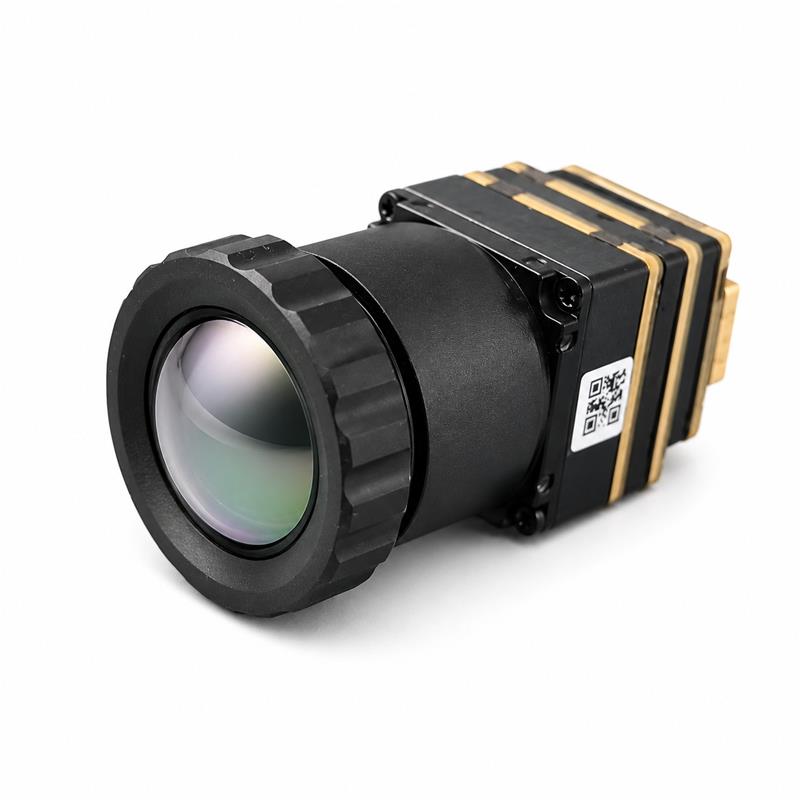
Ultra-wide 640 thermal vision for compact mobile systems with CVBS analog output, 90.3° HFOV and low SWaP design. Supports UART configuration, pilot evaluation and platform-based integration.
Goobuy CVBS-640-90 is a 640×512 uncooled VOx thermal imaging core with a custom 4.8mm F1.0 ultra-wide lens, 90.3° horizontal FOV, CVBS analog video output, UART control, ≤23g weight, and ≤0.8W power consumption, built for compact mobile platforms that require near-field thermal awareness and fast integration into an existing host system
The Goobuy CVBS-640-90 is a 640×512 uncooled VOx thermal imaging core with a custom 4.8mm F1.0 ultra-wide lens, 90.3° horizontal field of view, CVBS analog video output, UART control, ≤23g weight, and ≤0.8W power consumption. It is designed for professional compact mobile platforms that need wide near-field thermal awareness, low-complexity video integration, and fast configuration into an existing host system.
Goobuy CVBS-640-90 is not a long-range identification camera, a radiometric temperature-measurement sensor, or a complete end-user camera system. It is a compact thermal core for integrators who already have a host platform, power budget, video path, mechanical envelope, evaluation schedule, and pilot project plan.
Goobuy CVBS-640-90 is best for professional non-U.S. mobile platform integrators who need a 640×512 ultra-wide CVBS thermal core under 25g for near-field operator-viewing thermal awareness
Core Decision Snapshot
| Decision Factor | Goobuy CVBS-640-90 Configuration |
|---|---|
| Thermal Detector | Uncooled VOx microbolometer |
| Resolution | 640 × 512 |
| Pixel Pitch | 12μm |
| Spectral Range | 8–14μm |
| Sensitivity | NETD ≤40mK @25°C, F#1.0 |
| Lens | Custom 4.8mm F1.0 ultra-wide thermal lens |
| Field of View | 114.16° diagonal / 90.3° horizontal / 72.6° vertical |
| Minimum Focus Distance | 2m |
| Video Output | CVBS analog video |
| Output Resolution | 720 × 576 |
| Control Interface | UART_TXD / UART_RXD, 3.3V |
| Power Input | DC 6–16V |
| Power Consumption | ≤0.8W |
| Size | 37.82mm × 20mm × 20mm |
| Weight | ≤23g |
| Operating Temperature | -40°C to 80°C |
| Best Fit | Compact UAV, UGV, robotic gimbal, remote observation, perimeter awareness, regulated mobile equipment |
| Poor Fit | Long-range identification, radiometric thermography, RAW digital AI capture, full gimbal camera systems |
Best Match vs. Poor Match
| Best Match | Poor Match |
|---|---|
| Wide near-field thermal awareness | Long-range identification |
| Existing CVBS analog video chain | USB / MIPI / Ethernet / RTSP requirement |
| Compact host platform with strict SWaP limits | Large stabilized long-range camera payload |
| Operator-viewing thermal feed | RAW thermal data for AI training |
| Non-radiometric visual thermal awareness | Calibrated temperature measurement |
| Fast platform configuration | Undefined from-zero concept project |
| Pilot batch and configuration freeze | Casual sample request without timeline |
Many 640-class thermal cores are configured for mid-range or long-range viewing. That can be useful when distance is the main requirement, but it often creates a narrow “thermal tunnel” on compact mobile platforms operating in close-range, low-visibility, or operator-controlled environments.
The Goobuy CVBS-640-90 takes a different approach.
Its custom 4.8mm F1.0 ultra-wide thermal lens provides 90.3° horizontal thermal coverage, helping integrators capture more side context, nearby heat signatures, scene edges, and thermal boundaries from a single lightweight node.
This makes the module suitable when the platform does not need a heavier long-focal thermal camera, a larger gimbal, or a multi-camera thermal array, but instead needs a wider thermal scene for real-time operator viewing.
CVBS is not selected for AI training data, RAW image processing, or high-bandwidth digital analytics. It is selected for projects where a simple, predictable, encoder-free analog video path is more valuable than compressed IP streaming.
For operator-viewing thermal systems, CVBS can help simplify:
If your system already accepts CVBS analog video, JS-MINI640-48 can reduce integration complexity. If your host requires USB, MIPI, Ethernet, RTSP, RAW, YUV, GMSL, or FPD-Link output, this module is not the right configuration.
The Goobuy CVBS-640-90 is designed for professional integrators who already understand their platform constraints.
It is a strong fit if:
Common Engineering Questions This Page Answers
This page is relevant if your team is asking:
“Which 640×512 thermal camera core has around 90° horizontal FOV for compact UAV or UGV integration?”
“We need a CVBS thermal imaging module under 25g for an existing analog video chain.”
“Our current 640 thermal core is too narrow for near-field operator viewing.”
“Is there a non-radiometric thermal core for wide thermal awareness, not temperature measurement?”
“Can a supplier support cable, connector, palette, mirror, UART, sample evaluation, and pilot-batch configuration?”
“Can we configure an existing thermal core platform instead of starting a long from-zero development project?”
This module is not recommended if:
JS-MINI640-48 is supplied only for lawful, non-weaponized, professional integration projects in selected non-U.S. destinations, subject to project and compliance review.
A standard 640 thermal camera may have enough resolution but not enough scene width. On compact UAVs, UGVs, robotic gimbals, mobile observation systems, and remote inspection platforms, a narrow thermal view can hide nearby heat signatures, side obstacles, or scene boundaries.
The JS-MINI640-48 uses a 90.3° HFOV lens to increase peripheral thermal awareness from a single compact core.
At ≤23g and ≤0.8W, this module is designed for SWaP-constrained platforms where every gram, watt, and cubic millimeter matters.
It can help reduce the need for larger thermal camera heads, heavier gimbal assemblies, multi-camera thermal arrays, larger batteries, additional heat dissipation, or major enclosure redesign.
CVBS output allows the module to connect into existing analog video systems without redesigning the full video architecture.
For many compact field platforms, a stable analog thermal feed is more practical than a high-bandwidth digital stream that requires extra encoding, decoding, software, and processor resources.
it is based on an existing thermal core platform. For most qualified projects, integration can focus on practical configuration:
For selected projects with a confirmed timeline and budget, paid NRE development can also be evaluated.
For qualified project evaluation, we can provide actual CVBS output images or test videos. These materials help engineering teams judge:
Website sample images may be compressed for web display. Final image quality should be evaluated through the customer’s own display, transmission, DVR, or host video chain.
Goobuy CVBS-640-90 is optimized for near-field and mid-close thermal awareness, not long-range identification.
The 4.8mm ultra-wide lens increases scene width but reduces target pixel density at distance. This is the correct trade-off when the goal is to see more thermal context around the platform rather than identify small distant targets.
Actual observation performance depends on target size, temperature contrast, humidity, weather, background thermal complexity, display quality, operator criteria, transmission chain, and enclosure window material.
If your project requires long-range identification, a narrower thermal lens may be more suitable.
The module outputs CVBS analog video with 720 × 576 output resolution. Before sample evaluation, please confirm with our engineering team:
We recommend confirming the video format before mechanical freeze or pilot-batch planning.
The module provides UART_TXD and UART_RXD at 3.3V. For qualified integrators, UART-related information can be discussed for:
Detailed UART command documentation can be provided to qualified customers after project review or NDA when required.
Goobuy CVBS-640-90 supports automatic correction, manual correction, and background correction.
This matters for mobile platforms because correction timing may affect the viewing experience during movement. During integration, the customer should evaluate:
We recommend validating correction behavior during real platform testing, not only on a bench display.
For serious integration projects, mechanical information can be used to evaluate:
If the module is installed inside a sealed enclosure, the integrator should evaluate window material, thermal transmission, internal heat path, sealing, vibration, and serviceability.
The module uses a 5-pin interface: POWER, GND, CVBS, UART_TXD, and UART_RXD.
For platform projects, cable and connector decisions should consider:
CVBS video performance should be validated at the system level, especially when long cables, compact wiring spaces, or high-interference environments are involved.
Most projects should begin with platform-based configuration. Paid NRE may be considered only when the requirement cannot be solved by standard configuration and the customer has:
We do not recommend from-zero development for concept-only inquiries, hobby projects, unclear end users, or projects without a defined schedule.
Goobuy CVBS-640-90 is available only for lawful, non-weaponized, professional integration projects in selected non-U.S. destinations.
Before sample supply or project development, we may request:
Requests involving restricted destinations, unclear end users, prohibited applications, weaponized platforms, or unlawful use will be declined.
For compact UAV payload integrators, Goobuy CVBS-640-90 thermal core provides a wide thermal view from a lightweight core. The 90.3° HFOV helps capture more near-field scene context without adding a larger gimbal or multiple thermal modules.
It is suitable for professional platforms that require low-power thermal viewing in darkness, smoke, dust, haze, or low-visibility field conditions.
For UGVs, robotic platforms, and remotely operated mobile systems, the module can provide wide thermal context when visible-light cameras are limited.
Its low weight, low power, CVBS output, and wide operating temperature range make it suitable for compact equipment where the host platform already has a display, recorder, or operator-viewing path.
The small 37.82mm × 20mm × 20mm body makes Goobuy CVBS-640-90 thermal core suitable for compact gimbals, pods, or sensor-head integration.
Where the system already has mechanical stabilization or a multi-sensor structure, this module can serve as the wide-angle thermal channel inside the platform.
For regulated public-sector mobile equipment, the module can serve as a compact thermal viewing node where wide FOV, low power, and analog video compatibility are more important than radiometric temperature measurement.
It is suitable for professional observation, field safety, remote-area monitoring, perimeter-awareness, and low-visibility viewing systems.
For energy sites, ports, mining areas, industrial perimeters, and remote facilities, Goobuy CVBS-640-90 can be integrated into compact inspection systems that require wide-area thermal awareness from a small module.
It is especially relevant when the platform already has its own enclosure, power supply, video routing, and field deployment plan.
Typical application directions for Goobuy CVBS-640-90 thermal core include compact UAV thermal awareness payloads, UGV and remote mobile platform integration, robotic gimbal and compact pod integration, regulated public-sector mobile observation equipment, and critical infrastructure or remote-site inspection
Application collage of Goobuy CVBS-640-90 640×512 ultra-wide CVBS thermal core for compact UAV thermal awareness, UGV integration, robotic gimbal pods, public-sector mobile observation and remote-site inspection

Application Image Note:
The Goobuy CVBS-640-90 thermal core is intended for professional compact mobile platforms that need wide near-field thermal awareness from a lightweight 640×512 thermal core. Its 90.3° HFOV, CVBS analog video output, UART control, ≤23g weight and ≤0.8W power consumption make it suitable for UAV, UGV, robotic gimbal, mobile observation and remote-site inspection projects where the host system already has a defined power, video and mechanical interface
Goobuy CVBS-640-90 thermal core supports practical image functions for integration projects:
These functions help integrators adapt the thermal image to different display chains, operator preferences, mounting orientations, and field environments.
The module uses a 5-pin interface:
| Pin | Definition | Description |
|---|---|---|
| 1 | POWER | DC 6–16V power input |
| 2 | GND | Ground |
| 3 | CVBS | CVBS analog video signal |
| 4 | UART_TXD | Module UART transmit, 3.3V |
| 5 | UART_RXD | Module UART receive, 3.3V |
Custom cable and connector discussions are available for qualified integration projects.
Technical Specifications
| Category | Specification |
|---|---|
| Model | Goobuy CVBS-640-90 thermal core |
| Detector Type | Uncooled VOx microbolometer |
| Maximum Image Size | 640 × 512 |
| Pixel Pitch | 12μm |
| Spectral Range | 8–14μm |
| NETD | ≤40mK @25°C, F#1.0 |
| MRAD | 1.2 |
| Lens Focal Length | 4.8mm |
| Aperture | F1.0 |
| Field of View | 114.16° D × 90.3° H × 72.6° V |
| Minimum Focus Distance | 2m |
| Video Output | CVBS analog video |
| Output Resolution | 720 × 576 |
| Electronic Zoom | ×1, ×2, ×4, ×8 |
| Correction Modes | Automatic, manual, background correction |
| Image Functions | Noise reduction, defective pixel correction, detail enhancement, AGC |
| Pseudo-Color Modes | 15 modes |
| Mirror | Off, vertical, horizontal, center |
| Power Input | DC 6–16V |
| Power Consumption | ≤0.8W |
| Size | 37.82mm × 20mm × 20mm |
| Weight | ≤23g |
| Operating Temperature | -40°C to 80°C |
| Storage Temperature | -45°C to +75°C |
| Storage Humidity | <90% RH |
| Vibration | Sine vibration, 10m/s², 3 axes |
| Shock | Half-sine wave, 15g/11ms, 3 axes, 6 directions |
| Frame Rate | Confirm before sample evaluation |
| CVBS Format | Confirm PAL / NTSC compatibility before integration |
Before sample shipment or pilot planning, please confirm:
This step helps both teams avoid sample mismatch, video-chain incompatibility, mechanical interference, and unnecessary project delay.
We review your host platform, available power, video input path, mechanical space, operating environment, project timeline, and destination information.
We confirm whether JS-MINI640-48 is suitable as a direct configuration, minor customization, or paid NRE project.
Qualified customers can evaluate samples for video compatibility, field of view, mounting, thermal image quality, power consumption, correction behavior, and operating temperature.
Once the interface, cable, palette, mirror setting, structure, and video format are confirmed, we freeze the configuration for pilot production.
For approved projects, we support pilot batches and stable repeat delivery based on the confirmed configuration.
If your current thermal camera is too narrow, too heavy, too power-consuming, or too complex for your compact mobile platform, send us your integration constraints.
Our engineering team can evaluate whether JS-MINI640-48 can be configured as a fast-fit thermal imaging node for your existing host system.
Please include:
For qualified projects, we can support sample evaluation, configuration freeze, pilot batch planning, and paid NRE discussions when a project has a real timeline and budget.
A: Yes. Goobuy CVBS-640-90 thermal core is designed for compact mobile platforms that need wide near-field thermal awareness rather than narrow long-range viewing. Its custom 4.8mm F1.0 lens provides 90.3° horizontal FOV and 114.16° diagonal FOV, helping the platform capture more side context, nearby heat signatures, and scene boundaries from a single lightweight thermal core.
This is useful when a standard 640 thermal camera feels too narrow, but the platform cannot accept a larger gimbal, additional thermal cameras, or a major payload redesign.
A: The practical advantage is scene width, not longer detection distance. A 90.3° HFOV thermal module helps reduce “thermal tunnel vision” on compact UAVs, UGVs, robotic gimbals, mobile observation systems, and remote-area platforms.
Instead of focusing only on a narrow center area, the operator can see more peripheral thermal context. This can help with close-range awareness, obstacle context, scene orientation, and wide-area viewing from a single lightweight thermal node.
A: No. This is an important engineering trade-off. A 4.8mm ultra-wide lens provides wider thermal coverage but reduces target pixel density at longer distances.
Goobuy CVBS-640-90 is best for near-field thermal awareness, wide-area operator viewing, compact mobile platform integration, and low-complexity analog thermal video. If your project requires long-range identification or high pixel density on distant objects, a narrower thermal lens would be more suitable.
A: CVBS is suitable when the project needs a simple analog thermal video path for operator viewing. Many professional mobile platforms already have analog displays, DVRs, transmitters, or control units.
Compared with compressed IP video, CVBS can reduce encoder-related complexity, simplify wiring, and avoid additional software or decoding dependency. Goobuy CVBS-640-90 thermal core is not intended for RAW digital AI training data. It is intended for platforms where low-complexity analog thermal viewing is more important than digital analytics.
A: CVBS output is a trade-off. It is not selected for maximum digital image preservation. It is selected for compatibility with analog operator-viewing systems.
For projects that require AI analytics, RAW thermal data, or digital post-processing, this module is not the correct output architecture. For projects that need a practical 640 thermal core feeding an existing analog display or transmission chain, CVBS can be a strong fit. We recommend evaluating actual CVBS output samples or test videos through your own display chain before configuration freeze.
A: The module outputs CVBS analog video with 720 × 576 output resolution. Before sample evaluation, please confirm the required video format, frame rate, PAL / NTSC compatibility, and display chain with our engineering team.
This is a necessary step before mechanical freeze because different host platforms may have different display, DVR, transmitter, or video-decoder requirements.
A: Yes. The Goobuy CVBS-640-90 thermal module provides UART_TXD and UART_RXD at 3.3V. Depending on the project, UART communication can be discussed for correction behavior, pseudo-color mode, mirror / flip orientation, brightness, contrast, image detail enhancement, and electronic zoom.
Detailed UART command documentation can be provided to qualified integrators after project review or NDA when required.
A: Goobuy CVBS-640-90 thermal core supports automatic correction, manual correction, and background correction. This is important for mobile platforms because correction timing may affect operator viewing during movement.
During sample evaluation, your team should test whether automatic correction is acceptable, whether manual correction is preferred, and how correction commands should be handled through UART. We recommend validating correction behavior on the actual host platform, not only on a bench monitor.
A: Yes, for selected projects with a clear specification, confirmed budget, defined timeline, and realistic production path.
We first evaluate whether your requirement can be solved by standard platform configuration. If not, paid NRE development can be discussed for cable harness, connector definition, firmware setting, mechanical adaptation, or other project-specific requirements. We do not recommend NRE for concept-only projects without a host platform, schedule, or expected quantity.
 office@okgoobuy.com
Follow Me
Address:A615, 6F, Huachuangda Building, No107 Xinghua 1st Road, 43 District, Xinan street, Baoan, shenzhen, China 518101