
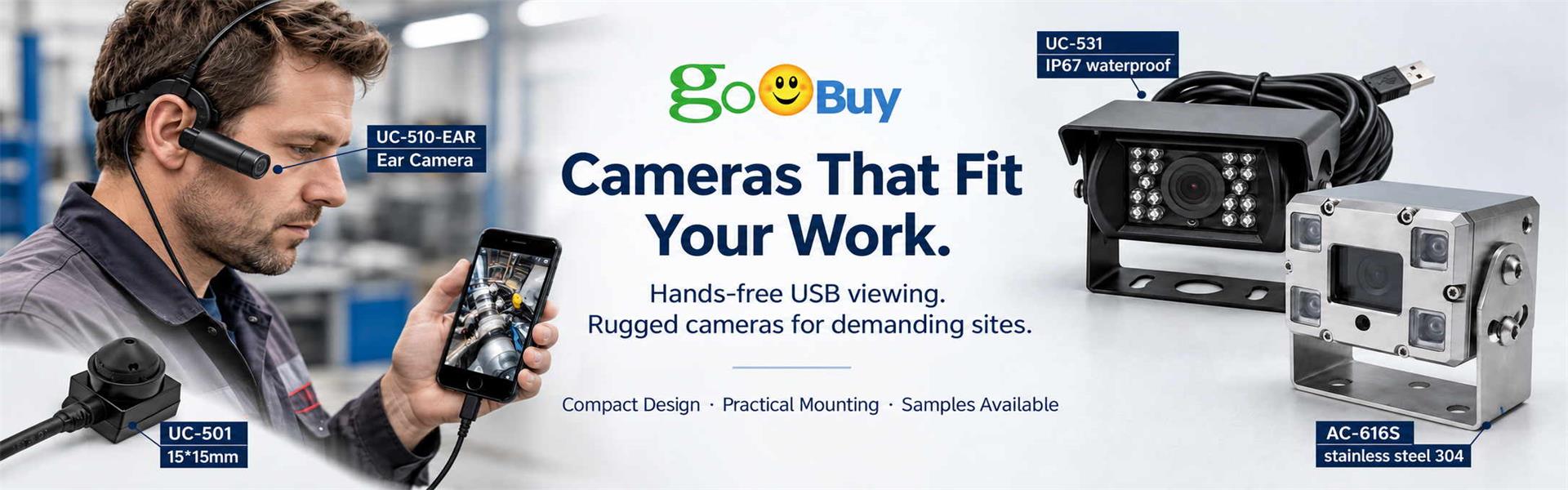
A camera module is the imaging core of a camera, while a rugged camera adds the housing, sealing, lens, cable, connector and mounting needed for real equipment. Goobuy uses proven USB, AHD and PoE imaging platforms as the foundation for finished rugged cameras designed for marine, heavy-equipment and other harsh-site environments.
A camera module is the imaging core, but a rugged camera must solve everything around it—from the lens and housing to sealing, cable, connector, mounting and environmental exposure. Goobuy now focuses on turning proven USB, AHD and PoE imaging platforms into finished camera solutions for marine, heavy equipment and other harsh-site applications.
Goobuy began with compact camera modules and embedded imaging hardware. That experience remains valuable because the sensor, ISP, interface and lens determine whether the imaging core can deliver the required video.
But a camera module working correctly on a test bench does not mean it is ready for a workboat, harbor machine, loader or wet industrial site.
For harsh-site applications, the bigger question is:
Can the complete camera remain useful where the equipment actually works?
That requires much more than a PCB and image sensor.
The three stages solve different problems.
Camera Module
Sensor + ISP + PCB + video interface
It answers:
Can the imaging core produce the required image?
Finished Camera
Imaging core + lens + housing + cable + connector + mounting
It answers:
Can the camera be installed and connected to the customer's equipment?
Rugged / Harsh-Site Camera
Finished camera + environmental protection + application validation
It answers:
Can the complete assembly operate at the required camera position under the actual site conditions?
This distinction is especially important when water, washdown, salt exposure, mud, low light, vibration or cold becomes part of the application.
Moving from an imaging core to a rugged camera requires decisions around the complete installation:
Housing material and construction
Ingress protection and sealing
Lens and viewing window
Working distance and field of view
Cable exit and cable protection
Connector selection
Mounting method
Power and video architecture
Temperature and vibration exposure
Corrosion risk
Host-system compatibility
For this reason, Goobuy increasingly starts with the equipment and viewing problem, rather than asking which camera sensor the customer wants.
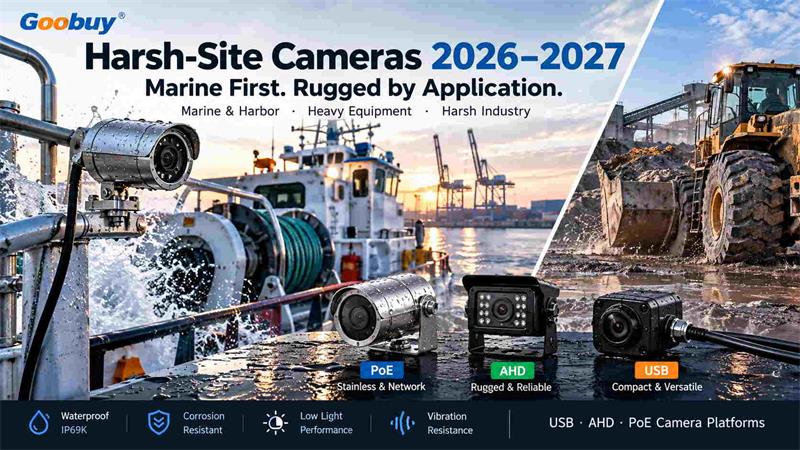
Our current rugged-camera work is concentrated around three established architectures.
USB is practical when the customer already has a PC, Android device or compatible embedded computer.
Goobuy uses existing USB platforms to create compact, waterproof, low-light, stainless-steel and tight-space camera configurations.
The host already exists. Our job is to put the camera viewpoint where it is needed.
AHD is well suited to equipment using a local monitor or MDVR.
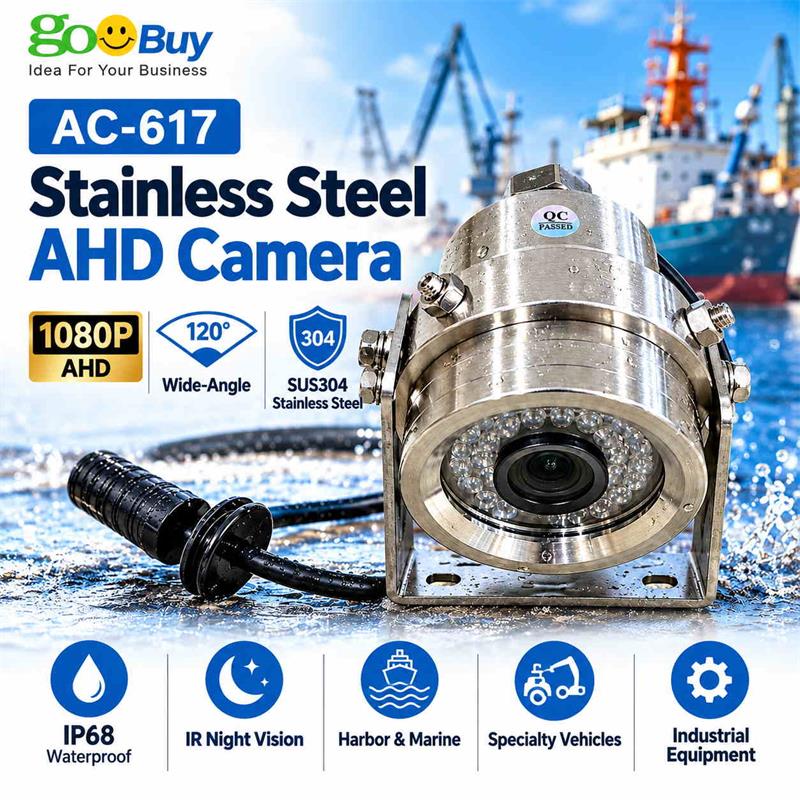
Current Goobuy rugged AHD directions include IP69K camera-and-monitor systems, low-light cameras, stainless-steel camera heads and cold-weather/heated configurations for selected heavy equipment, workboats and other machinery.
PoE is the preferred direction when cameras need to connect to Ethernet networks, NVRs, VMS platforms or industrial computers.
This is becoming particularly important in our marine, workboat and harbor equipment roadmap.
A 5MP PoE camera core may already provide high-resolution H.265 network video in the lab.
That alone does not make it a marine camera.
For our future marine-focused 5MP PoE platform, the imaging electronics are only the starting point. The complete product direction adds a SUS316 stainless-steel housing and requires attention to the front window, seals, cable exit, connector, mounting and corrosion exposure.
The goal is a finished network camera for demanding harbor, waterfront, workboat and selected underwater applications after complete-camera validation.
This illustrates how Goobuy now uses camera-module knowledge:
not as the final product, but as the imaging foundation for a more application-ready rugged camera.
Goobuy is no longer positioning itself as a general-purpose camera-module development house.
We do not focus on open-ended MIPI board development, sensor-by-sensor PCB projects or custom imaging R&D without a clear path to a finished camera application.
Our priority is a smaller set of proven USB, AHD and PoE camera platforms that can be configured repeatedly for real equipment.
This reduces unnecessary development while allowing practical changes to the lens, cable, connector, housing and interface.
For a new harsh-site application, the most useful questions are:
What must the camera see?
Where will it be installed?
What environmental exposure will it face?
What host or video architecture already exists?
What working distance and field of view are required?
Goobuy then evaluates whether an existing USB, AHD or PoE platform provides a practical starting point.
Our camera-module experience remains part of our engineering foundation.
Our business focus, however, has moved beyond the module—to finished rugged cameras designed around real equipment, real environments and real viewing problems.
Follow Me
Address:A615, 6F, Huachuangda Building, No107 Xinghua 1st Road, 43 District, Xinan street, Baoan, shenzhen, China 518101