
Sony STARVIS IMX415 cameras are trusted in industrial vision because they combine 4K visible detail, mature STARVIS low-light performance and practical USB + HDMI integration for systems that need both local operator viewing and software-side review.
In U.S. and European extreme industrial environments, IMX415 is not usually selected as the newest or most advanced low-light sensor. It is selected because it is a proven 4K STARVIS camera platform that can help engineering teams build practical vision devices without starting from a raw sensor or full custom camera program.
For many industrial OEMs, machine builders and system integrators, that matters more than sensor hype.
Industrial vision does not always mean high-speed factory automation or precision measurement.
In many real projects, industrial vision means:
This is where Sony STARVIS IMX415 can still be valuable.
It is not the best answer for every industrial camera project. But it is a practical answer when a system needs 4K visible detail, low-light support and dual-output integration.
Engineers trust Sony STARVIS cameras because the technology has been widely used in low-light imaging applications for years. In industrial systems, trust does not come only from a sensor name. It comes from repeatable performance, stable supply direction, known image behavior and easier integration.
For product managers and engineers, the real questions are usually:
Sony STARVIS does not remove all optical and system-design problems. But it gives engineers a more reliable imaging foundation than many generic camera sensors.
Newer STARVIS2 sensors such as IMX678 and IMX585 may offer stronger real-world low-light and dynamic range performance in many applications. Engineers should not pretend IMX415 is always the best low-light sensor.
The reason IMX415 still matters is different.
IMX415 is useful when the project needs:
In simple words:
IMX415 is not always the “best sensor.” It can be the right engineering compromise.
That is why it remains relevant for industrial review stations, protected equipment monitoring, gate-entry terminals, energy monitoring boxes, parking lane systems, access control devices and local operator display products.
Many industrial camera modules force product teams to choose one workflow.
A USB-only camera is convenient for software processing, but it normally needs a host device, application, driver stack or video pipeline.
An HDMI-only camera is convenient for direct monitor output, but it may not feed the software system easily.
A USB + HDMI camera can support two different users at the same time:
This dual-output architecture is one of the strongest reasons engineers choose an IMX415 camera module for industrial vision.
It is especially useful when the device needs:
Energy facilities often need visual confirmation around gates, cabinets, access points, pump rooms, compressor stations, battery areas and remote equipment yards.
A Sony IMX415 STARVIS camera can be used inside a protected field review box or monitoring device where the system needs both local viewing and video capture.
Typical tasks include:
For energy sites, the camera should normally be protected inside a proper enclosure. IMX415 is the imaging module, not the complete weatherproof field system.
The right structure is:
protected enclosure + IMX415 camera module + local monitor or recorder + customer host system.
This gives engineers a practical camera layer without turning the project into a full custom imaging program.
European machine builders often need compact cameras inside equipment, test stands, inspection benches or service tools.
The camera may need to observe:
In these applications, 4K detail can be useful because one camera may cover a wider internal scene while still preserving enough image detail for review.
HDMI output can give the technician a direct monitor view. USB output can feed the machine software, recorder or edge system.
This is the type of practical dual-output workflow where IMX415 makes sense.
It should not be marketed as a magic “distortion-free” sensor. Distortion depends on the lens, FOV, optical design and calibration. A better engineering message is:
IMX415 provides a mature 4K STARVIS imaging platform that can be configured with suitable lens, cable, housing and output workflow for the machine device.
Mining and conveyor environments are difficult because of dust, vibration, low light, long equipment lines and hard-to-access transfer points.
A directly exposed mining camera must be rugged, sealed and protected. IMX415 by itself should not be treated as a complete mining camera.
However, IMX415 can be useful inside protected mining-related devices, such as:
The camera can help provide 4K visible evidence of:
For roller, bearing or belt friction heat risk, thermal cameras may be required. IMX415 is a visible camera, not a thermal sensor.
The strongest mining use is not “IMX415 replaces all conveyor monitoring.”
The stronger use is:
IMX415 provides 4K low-light visible review inside a protected conveyor monitoring or troubleshooting device.
Parking lanes, gate-entry systems and industrial access points often operate in mixed light:
A 4K STARVIS camera can help preserve more scene detail for event review.
Typical uses include:
IMX415 should not be confused with a complete license plate recognition camera. LPR performance depends on lens, distance, shutter, angle, lighting, IR, vehicle speed, exposure control and software.
But for lane context, gate review and 4K visual evidence, IMX415 remains a practical camera direction.
This is also one of the strongest commercial applications for Goobuy UC-415.
Heavy industry often needs visual tools that help technicians see what is happening in low-light or difficult-to-access positions.
Examples include:
A USB + HDMI IMX415 camera can support these devices by giving:
For harsh conditions, the final device must handle vibration, dust, cable strain, sealing, heat and serviceability. The camera module is one part of the full engineering design.
Environmental monitoring and wastewater facilities often have low-light pump rooms, remote cabinets, water treatment equipment, access points and maintenance zones.
A 4K STARVIS camera can be used in protected devices to support:
Moisture, corrosion and condensation are real risks in environmental sites. The camera should not be installed directly in a wet or corrosive area without suitable enclosure, window and cable protection.
For protected terminals and monitoring boxes, IMX415 can offer a useful balance of detail and integration simplicity.
Many industrial edge AI products do not need a new camera architecture from zero.
They need a mature camera that can plug into an existing box and support both:
This is where an IMX415 USB + HDMI camera can help.
Potential products include:
The value is not just “AI camera.” The value is that one camera can support two workflows:
HDMI for people. USB for software.
That is a concrete system-design benefit.
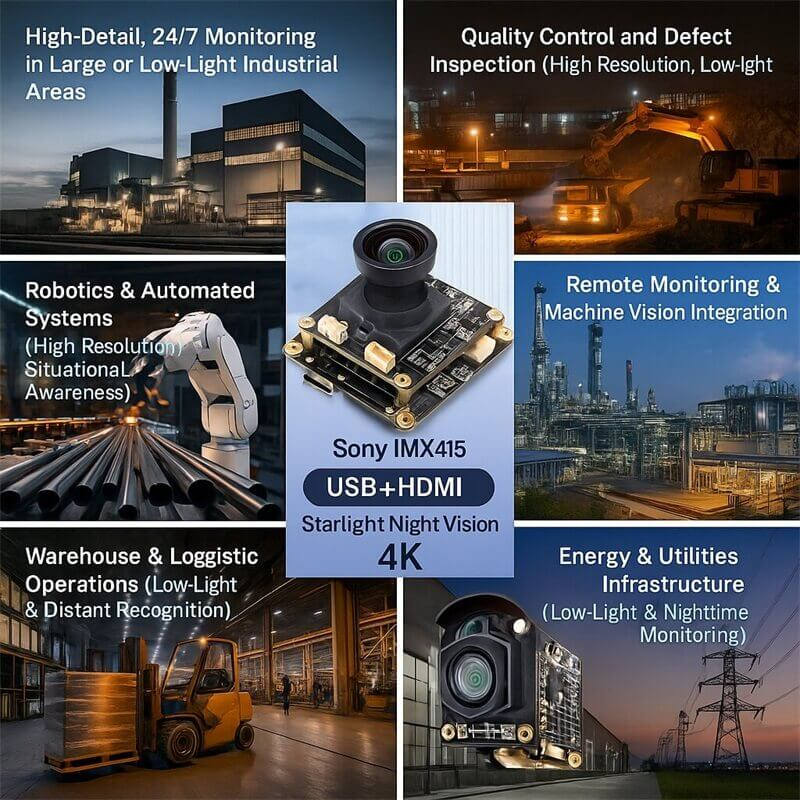
Choose IMX415 when your project needs:
IMX415 is especially suitable when one camera must support both operator review and software capture.
IMX415 is not the best camera for every extreme environment.
It may not be the right choice if the project mainly needs:
For these applications, the project may need IMX678, IMX585, thermal camera modules, global shutter cameras, rugged IP-rated camera heads or a different optical system.
A serious engineering supplier should help the customer choose the correct camera, not force one model into every project.
A common question is whether engineers should still choose IMX415 when IMX678 and IMX585 are available.
The answer depends on the project.
| Camera Direction | Best Fit |
|---|---|
| IMX415 USB + HDMI | Mature 4K STARVIS platform for dual-output operator display + software review |
| IMX678 | Newer 4K STARVIS2 direction for stronger modern low-light / HDR platform flexibility |
| IMX585 | Larger-sensor 4K low-light camera-head direction for higher-value field video systems |
| IMX385 | Mature 1080P STARVIS direction when 4K is not required |
| Thermal camera | Heat-risk detection, hotspot monitoring and fire-risk applications |
| Global shutter camera | Motion-critical robotics, conveyor, machine vision and fast-moving objects |
IMX415 remains useful when the project values mature 4K detail and dual-output integration more than having the newest sensor generation.
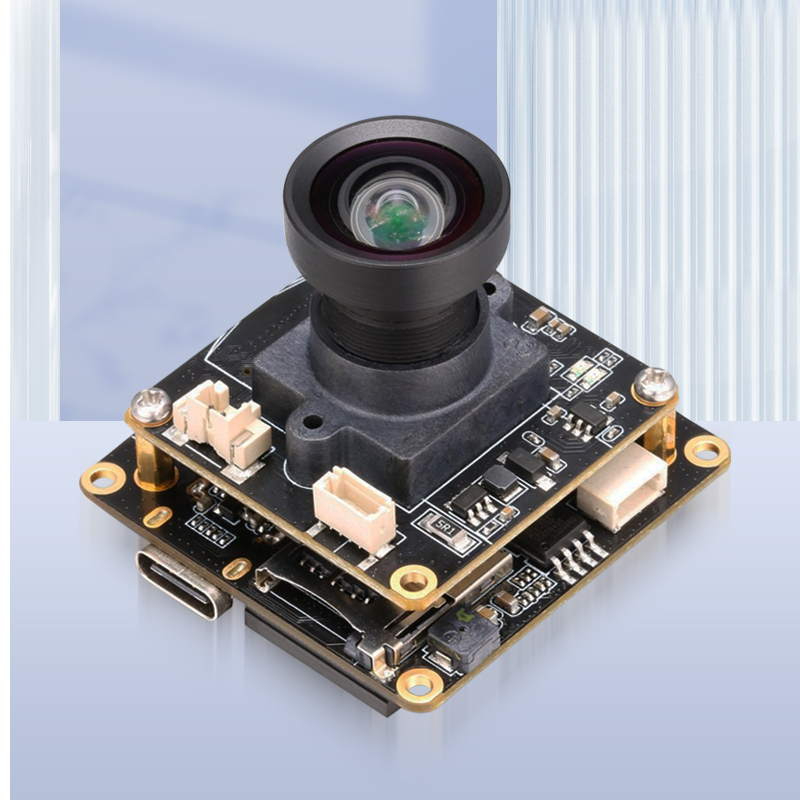
Goobuy UC-415 is a Sony IMX415 4K USB + HDMI camera module for OEM and system integration projects that need one camera platform for local viewing and software-side review.
Recommended product link:
Sony IMX415 4K USB + HDMI STARVIS Camera Module
It is suitable for evaluating:
For OEM projects, Goobuy can discuss:
Before requesting an IMX415 sample, please prepare:
A clear deployment brief helps confirm whether IMX415 is the right platform or whether IMX678, IMX585, thermal, global shutter or rugged camera hardware would be better.
Engineers trust Sony STARVIS for industrial vision because it gives them a more reliable low-light imaging foundation than generic camera modules.
They trust IMX415 specifically when the project needs mature 4K visible detail, practical STARVIS performance and a dual-output USB + HDMI workflow.
For U.S. and European industrial projects, IMX415 is most valuable when used in protected equipment systems such as machine enclosures, field review boxes, gate-entry terminals, edge AI appliances, energy monitoring devices, environmental terminals and industrial service monitors.
It is not the newest STARVIS option.
It is not the strongest thermal-risk solution.
It is not a complete rugged outdoor camera by itself.
But when the engineering goal is 4K visible review, local HDMI monitoring and USB software input in one practical camera platform, IMX415 remains a useful and trusted choice.
If your project needs a Sony STARVIS IMX415 camera for industrial vision, send Goobuy your product type, host system, HDMI / USB workflow, working distance, field of view, lighting condition, enclosure design and sample plan.
Goobuy can help evaluate whether UC-415 is the right starting point for your industrial camera project.
Engineers trust Sony STARVIS cameras because they provide better low-light visible imaging than many ordinary camera modules and have a mature track record in industrial, security, embedded and machine vision applications. For industrial projects, trust comes from repeatable image behavior, known integration paths and practical camera-platform availability.
Yes. IMX415 is still useful when a project needs mature 4K visible detail, STARVIS low-light performance and USB + HDMI dual output. It is especially practical for operator review stations, protected equipment monitoring, gate-entry terminals, edge AI appliances and field service devices.
Not always. Newer STARVIS2 sensors such as IMX678 and IMX585 may be stronger for many modern low-light applications. IMX415 is best understood as a mature 4K STARVIS platform for projects that need detail, dual output and integration maturity rather than the newest sensor generation.
USB + HDMI is useful because one camera can support two workflows. HDMI gives technicians or operators a direct live image on a monitor. USB provides video input for software-side review, recording or analytics. This is valuable in industrial review stations, machine monitoring boxes and edge AI appliances.
IMX415 can be used in protected harsh equipment systems, such as rugged enclosures, machine cabinets, service boxes or monitoring terminals. It should not be treated as a directly exposed outdoor waterproof camera unless the final system includes suitable housing, sealing, cable protection and environmental design.
Typical applications include industrial access terminals, parking lane review systems, machine enclosure cameras, energy monitoring boxes, field service monitors, environmental monitoring terminals, edge AI review appliances and protected industrial vision devices that need 4K visible detail.
Choose IMX678 when the project needs a newer STARVIS2 4K platform with stronger low-light and HDR flexibility. Choose IMX585 when the project needs a larger-sensor 4K low-light camera head, USB3.0 workflow, metal housing and higher-value field video performance. Choose IMX415 when mature 4K detail and USB + HDMI dual output are the main requirements.
Please send your product type, target application, host device, HDMI monitor or USB software workflow, working distance, field of view, lighting condition, enclosure structure, cable requirement, sample quantity, pilot schedule and expected repeat volume.
this article is updated by Mr Art huang from shenzhen novel electronics limited in July 19th, 2026
Follow Me
Address:A615, 6F, Huachuangda Building, No107 Xinghua 1st Road, 43 District, Xinan street, Baoan, shenzhen, China 518101