
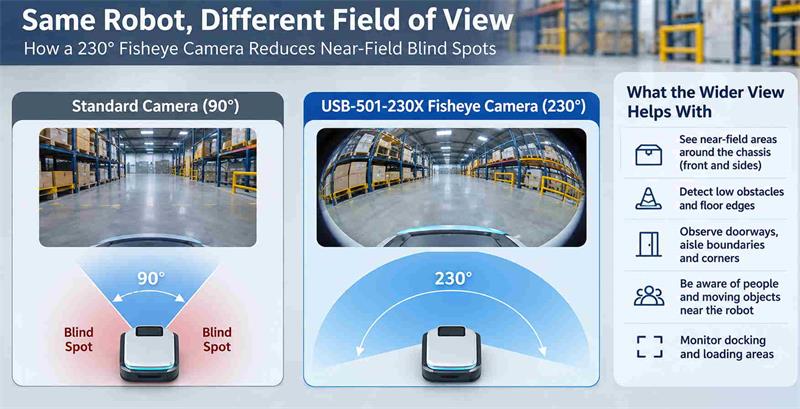
Goobuy 230° fisheye USB camera USB-501-230X provides ultra-wide visual coverage from a compact mounting point, helping mobile, service and inspection robots observe near-field blind spots and surrounding areas that a standard forward-facing camera may not see.
A 230° fisheye USB camera is most useful when a robot needs to see more of its nearby environment from a very small mounting position. Instead of providing precision recognition by itself, an ultra-wide camera can help reduce near-field visual blind spots, expand operator viewing context and provide wide-area video input for compact mobile, service and inspection robots.
For robotics engineers, the important question is therefore not simply:
“Does my robot need a fisheye camera?”
A better question is:
“What part of the environment can my robot not see with its current camera position?”
That distinction matters. A standard forward-facing camera may produce a more natural image with less distortion, while a 230° fisheye camera sacrifices geometric appearance to capture much more of the surrounding scene.
For some robots, that trade-off solves a very practical problem.
Robot cameras are frequently evaluated by resolution, frame rate, sensor type and interface.
Those specifications matter, but they do not answer another basic engineering question:
Does the camera actually see the area the robot needs to observe?
Imagine a mobile robot with a conventional forward-facing camera.
The image may clearly show objects several meters ahead, but areas immediately beside the chassis, close to the bumper, near aisle boundaries or approaching from the side may fall outside the camera's field of view.
Adding another camera can solve part of the problem, but that introduces another mounting position, cable, USB connection and video stream.
An ultra-wide fisheye camera takes a different approach:
capture more scene context from one compact camera position.
That is the main reason a 230° camera can be useful in robotics.
AMRs and AGVs often operate around shelves, pallets, loading areas, workstations, doors, walls and people.
A narrow forward view can leave areas around the edges of the robot difficult to observe visually.
Typical areas of concern include:
front corners of the chassis;
floor areas close to the bumper;
aisle boundaries;
nearby table or rack legs;
objects approaching from the side;
docking areas;
door edges and narrow passages.
A 230° fisheye camera mounted in an appropriate position can provide a much wider view of these near-field areas than a conventional narrow-angle camera.
This does not mean the camera itself performs obstacle avoidance.
The camera provides visual input. Object detection, distance estimation, SLAM, sensor fusion, navigation and motion control remain functions of the customer's robot system.
For an AMR engineer, therefore, the practical value of a fisheye camera is often:
better visual coverage around the platform from a limited mounting position.
Sometimes the problem is mechanical rather than algorithmic.
A compact robot may already contain LiDAR, ultrasonic sensors, depth cameras, antennas, displays and other electronics. The design team wants to add another visual viewpoint, but there is little room for a conventional industrial camera housing.
This is where camera-head size becomes important.
The Goobuy USB-501-230X uses a compact 15 × 15 × 10 mm class camera head while providing a 230° fisheye view and USB UVC video output.
That combination can be useful when engineers need to test a camera position around:
a robot front panel;
bumper area;
side panel;
sensor mast;
compact mobile platform;
inspection head;
robotic wrist;
or another space-constrained location.
The advantage is not simply that the camera is small.
It is that a small mounting point can provide a very large viewing area.
For compact robot design, that can be more valuable than adding another large camera assembly.
Commercial cleaning robots operate in environments that are visually complicated at floor level.
They may move around:
chair and table legs;
walls and corners;
cleaning equipment;
carts;
people;
low objects;
doorways;
narrow passages;
and changing furniture positions.
A camera with a narrow field of view may provide good forward detail but limited surrounding context.
A fisheye camera can be considered when the robot needs a broader visual input around its movement direction or when an operator needs to see more of the immediate environment during remote supervision.
Again, the important distinction is:
wide visual awareness is not the same as autonomous navigation.
USB-501-230X can provide an ultra-wide video stream to the host system, but the cleaning robot developer remains responsible for interpreting that image and deciding how it affects navigation or control.
Hotel, office, hospital, restaurant and indoor delivery robots frequently operate in shared spaces.
The visual challenge is not always identifying a distant object.
Often the difficult areas are much closer:
a person approaching from the side;
the edge of an elevator entrance;
a partially open door;
furniture beside the route;
a docking point;
a corridor intersection;
or activity immediately around the robot.
For these tasks, a wide-context camera can complement other navigation sensors by giving the robot system—or a remote operator—a broader visual scene.
A compact 230° fisheye camera may therefore be useful as an auxiliary context camera, particularly when the existing primary camera sees mainly forward.
This is different from saying that the fisheye camera should replace every other sensor.
In many practical robot architectures, different cameras have different jobs.
A standard or autofocus camera may handle detailed viewing.
A depth sensor may handle distance.
LiDAR may support navigation.
A fisheye camera can provide wide scene context.
A robot does not always need a camera primarily for AI.
Sometimes a human needs to see through the robot.
This is common in:
telepresence robots;
remote inspection platforms;
facility patrol robots;
laboratory robots;
remotely operated service platforms;
and maintenance observation systems.
A narrow camera can create a “tunnel view.”
The operator sees what is directly ahead but has little understanding of what is happening beside the robot.
This becomes inconvenient when:
passing through a doorway;
turning in a confined room;
approaching equipment;
moving beside shelving;
checking a machine room;
or observing people approaching from the side.
A 230° fisheye image gives the operator more surrounding context in one stream.
The image will be strongly distorted near the edges—that is an inherent characteristic of such a wide fisheye lens—but for situational awareness, seeing more of the scene can be more important than producing natural-looking geometry.
Industrial inspection robots may operate in machine rooms, utility corridors, factories, equipment areas, warehouses or other constrained spaces.
The camera problem is often simple:
the robot can see forward, but the useful information is also beside it.
An ultra-wide camera can help an operator or customer-side software observe more of:
surrounding equipment;
passage boundaries;
adjacent pipes;
nearby machinery;
walls and openings;
and the general environment around the robot.
For patrol or inspection robots, USB-501-230X can therefore be considered as an auxiliary wide-view camera rather than a precision inspection camera.
If the task is reading a small gauge, identifying a tiny defect or inspecting a component from a long distance, a different lens and camera configuration will usually be more appropriate.
A particularly interesting use of fisheye optics appears in confined spaces.
A conventional camera mounted at the front of a pipe or duct inspection device mainly sees what is ahead.
But sometimes the engineer also wants more visual information from the surrounding internal structure.
An ultra-wide lens can expose more of the nearby:
pipe wall;
duct wall;
cavity;
junction;
surrounding internal surface;
or structural context.
This does not automatically make USB-501-230X a finished pipe-inspection camera.
The standard camera is a compact board-level USB camera. Wet, dusty, abrasive or mechanically demanding inspection environments may require customer-side lighting, lens protection, enclosure design, cable protection and environmental sealing.
That distinction is important:
the fisheye camera provides the viewing geometry; the robot designer provides the environmental integration.
Robot arms provide another useful example of why different camera types should have different jobs.
A camera used for:
dimensional measurement;
defect inspection;
barcode reading;
fine feature recognition;
or precise positioning
usually benefits from controlled optics and lower distortion.
A 230° fisheye camera is generally not the first choice for those tasks.
But an engineer may have a different problem:
“I can see the object, but I cannot see enough of what is happening around the gripper.”
A small fisheye camera near the wrist or end-effector can provide:
gripper scene context;
surrounding workspace visibility;
setup and debugging view;
operator assistance;
or a broad view of nearby tools and components.
In this role, the fisheye camera is not the precision vision camera.
It is the context camera.
That is an important distinction when selecting optics for robotic arms.
The following table summarizes where a compact 230° fisheye USB camera can provide practical value—and where its limitations need to be considered.
| Robot Type | Real Camera Pain Point | How a 230° Fisheye Camera Can Help | Important Limitation |
|---|---|---|---|
| AMR / AGV | Blind areas near chassis, aisles and docking zones | Wider near-field scene coverage | Navigation and obstacle logic remain customer-side |
| Cleaning Robot | Walls, furniture legs, people and floor-level clutter | Broad front/side visual context | Does not replace navigation sensors |
| Delivery / Service Robot | Doorways, corridors and people approaching from side | Wider situational awareness | Strong fisheye distortion |
| Telepresence Robot | Operator sees only a narrow forward view | Wider remote viewing context | Edge geometry is distorted |
| Patrol / Inspection Robot | Narrow passages and changing viewing directions | More scene coverage from one camera | Outdoor use may require protection |
| Pipe / Duct Robot | Forward view misses surrounding internal surfaces | Wider cavity or wall context | Lighting and enclosure may be required |
| Robotic Arm | Precision camera lacks workspace context | Wide view around gripper/end-effector | Not intended for precision measurement |
The common pattern is clear:
USB-501-230X is most useful when wide visual context is the problem.

The Goobuy USB-501-230X is a compact fisheye USB camera designed for projects that already have a robot, host computer or software platform and need an additional ultra-wide camera input.
Key specifications include:
230° super fisheye lens
2MP / 1920 × 1080 video
1080P at up to 30fps
15 × 15 × 10 mm class camera head
USB Type-C / USB interface
UVC video output
MJPG / YUY2 formats
5V operation
approximately 150mA power consumption
The combination of compact size + 230° viewing angle + standard USB video output is more important than any one specification by itself.
The current Goobuy USB-501-230X product page provides the complete product specifications and integration information for engineers evaluating the camera for an existing robot or host platform.
visiti our Product page: Goobuy USB-501-230X 230° Fisheye USB Camera
A fisheye camera should not be selected from an FOV number alone.
A specification such as “230°” does not tell an engineer:
how strong the edge distortion looks;
how much detail remains near the image edge;
whether the center area provides enough useful detail;
whether the mounting position captures the intended robot blind zone;
or whether the customer's software can use the fisheye image effectively.
For this reason, Goobuy has published an actual USB-501-230X fisheye camera test video.
Watch the test video: Goobuy USB-501-230X 230° Fisheye Camera Test on YouTube
When reviewing the footage, do not simply ask whether the image “looks good.”
Instead, imagine the camera mounted on the intended robot and ask:
Does this viewing geometry show the area our current camera cannot see?
That is the more useful engineering question.
A fisheye camera is not an upgrade over a standard camera in every respect.
It is a different optical tool.
| Requirement | Standard USB Camera | 230° Fisheye USB Camera |
|---|---|---|
| Natural-looking image | Better | Strong distortion |
| Detailed object viewing | Usually better | Less suitable near image edges |
| Long-distance recognition | Better with suitable lens | Not the primary purpose |
| Near-field scene coverage | Limited by lens | Very wide |
| Compact panoramic context | Requires wider lens or more cameras | Strong advantage |
| Precision measurement | Better with low-distortion optics | Generally unsuitable |
| Robot operator view | Moderate | Wider surrounding context |
| Small-space integration | Depends on camera | 15×15mm class head |
The correct camera depends on the task.
USB-501-230X should not be selected simply because 230° sounds better than 90° or 120°.
It is probably not the best choice when the main requirement is:
barcode or QR-code reading;
small defect inspection;
precision measurement;
low-distortion machine vision;
long-distance object recognition;
telephoto observation;
highly detailed inspection at the edge of the image;
depth sensing;
synchronized multi-camera capture;
or a complete SLAM/navigation solution.
These tasks may require another camera, lens, sensor architecture or complete perception system.
For some robot systems, the best architecture is therefore not:
fisheye camera instead of standard camera
but:
fisheye context camera + task-specific camera or sensor.
Before choosing USB-501-230X—or any ultra-wide robot camera—evaluate it in the intended mounting position.
Do not start with the camera.
Mark the physical area the existing robot cannot see.
Then determine whether the proposed camera position and FOV actually cover that area.
A fisheye camera tested flat on a desk tells very little about how it will perform on a robot.
Mount it at approximately the intended:
height;
tilt;
orientation;
and distance from the robot body.
A 230° image contains strong distortion.
Determine which part of the image actually contains useful visual information for the task.
Confirm that the robot computer or host device supports the required UVC USB input and video format.
If the project requires dewarping, calibration, SLAM, VIO or AI analysis, confirm that the customer's software stack can process the camera output.
A 15mm camera head may fit mechanically while the cable does not.
Check bend radius, routing space, connector position and movement near joints or rotating components.
For dust, water, outdoor operation, pipes, industrial contamination or impact exposure, determine whether the camera requires an additional protective structure.
These checks are usually more useful than comparing megapixel numbers alone.
A 230° fisheye USB camera does not make a robot intelligent by itself.
It does not replace LiDAR, depth sensing, navigation software, SLAM, VIO, object detection or the robot controller.
Its value is much more specific:
it can provide a very wide visual input from a very small camera position.
That can be useful for an AMR with chassis blind spots, a cleaning robot moving around furniture, a service robot passing through doorways, a telepresence robot with a narrow operator view, an inspection robot in a confined passage, or a robotic arm that needs context around its gripper.
For engineers evaluating Goobuy USB-501-230X, the best starting point is therefore not:
“Can this camera be used for robotics?”
The better questions are:
Where will the camera be mounted?
What area does the robot currently fail to see?
Is wide contextual vision more important than low distortion or fine detail?
If those questions point toward a compact ultra-wide camera, USB-501-230X is a practical platform to evaluate with the actual robot, host system and software stack.
this article is updated by shenzhen novel electronics limited in Nov 9th, 2026
Follow Me
Address:A615, 6F, Huachuangda Building, No107 Xinghua 1st Road, 43 District, Xinan street, Baoan, shenzhen, China 518101