

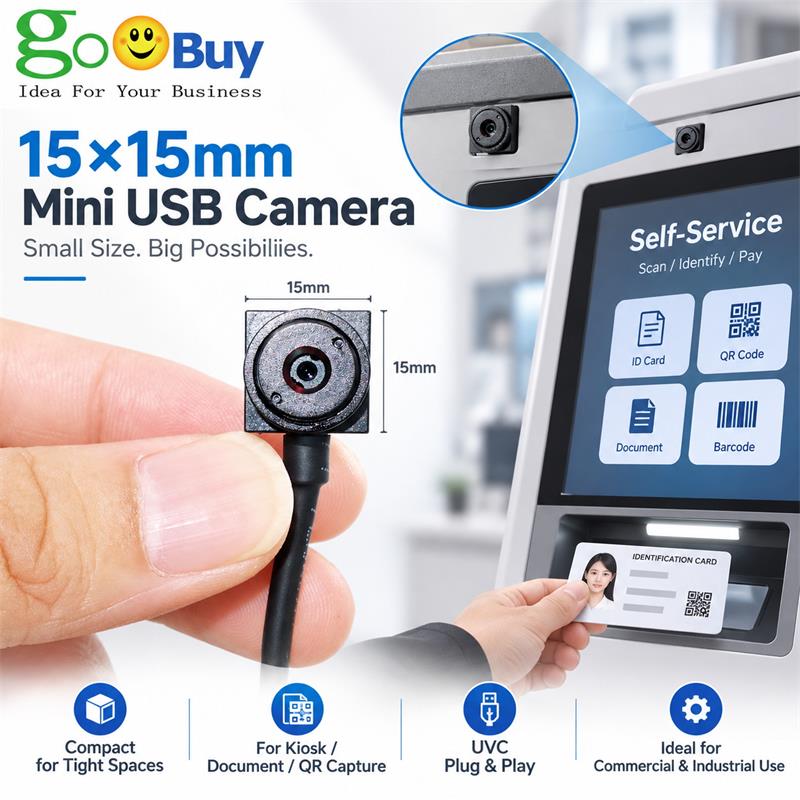
Goobuy UC-501-5MP-AF 15×15mm USB UVC camera is a compact embedded camera platform for commercial equipment such as smart lockers, vending machines and self-service terminals where the camera must be positioned separately from the host computer. Depending on the task, the same miniature camera platform can use fixed-focus, low-distortion, wide-angle or autofocus optics to solve different problems including compartment coverage, machine-internal observation, QR and barcode capture, ID-card imaging and document acquisition. The correct configuration should be selected by actual mounting position, working distance, target size and required field of view rather than resolution alone
Goobuy UC-501 is built around this task-based approach. Instead of treating every commercial application as a new camera-development project, the 15×15mm UVC platform can be configured from existing lens, focus, cable and connector options and then validated on the customer’s real Android, Linux or Windows host.
Commercial equipment is becoming smaller, more connected and increasingly dependent on visual input. Smart lockers need to see compartment or pickup areas. Vending machines may need an internal view of dispensing mechanisms or product zones. Self-service terminals increasingly capture QR codes, tickets, labels, ID cards or transaction evidence.
In many of these systems, the camera requirement is surprisingly simple:
The camera must fit into a very small space, connect easily to the existing host, and provide the right field of view for the actual task.
This is creating a practical role for miniature 15×15mm USB UVC cameras.
A tablet, industrial PC or Android terminal may already have a built-in camera, but that camera is fixed to the host.
Commercial equipment often needs a different viewpoint.
For example, a smart locker may need the camera close to the compartment opening rather than beside the display. A vending machine may need a camera inside the cabinet near the pickup bin. A kiosk may need a camera behind a narrow bezel where a conventional webcam cannot fit.
A miniature USB camera allows the equipment designer to separate:
Host Position
from
Camera Position
The basic architecture remains simple:
Camera → USB UVC → Android / Linux / Windows Host
This is one reason USB remains useful for compact commercial equipment. When the camera is relatively close to the host, there may be no need to add an IP camera, network encoder or separate DVR.
Smart lockers and parcel cabinets often have very limited camera-to-target distance.
A camera may need to observe:
In this situation, field of view becomes more important than simply increasing resolution.
A 150° wide-angle camera can capture more of the compartment from a short mounting distance, while a 90–105° low-distortion lens may be better when natural object geometry matters more.
The correct question is therefore not:“What is the widest lens available?”
It is: “How much of the locker area must one camera cover from the actual mounting position?”
Automatic vending machines are another good example.
A compact camera may be installed near:
These positions often have very different optical requirements.
A standard or low-distortion lens may be appropriate for a defined mechanism. A wide-angle lens may be better when the camera is close to a larger internal area.
The value of a 15×15mm camera is therefore not just its small size. It gives the equipment designer more freedom to place the camera near the actual task instead of designing the machine around a conventional webcam.
Kiosks and commercial terminals create a different camera problem.
The target may change during use:
These targets may be presented at different distances from the camera.
A fixed-focus camera works well when the working distance is controlled. But when users hold cards, labels or documents at inconsistent distances, autofocus can provide a more flexible capture range.
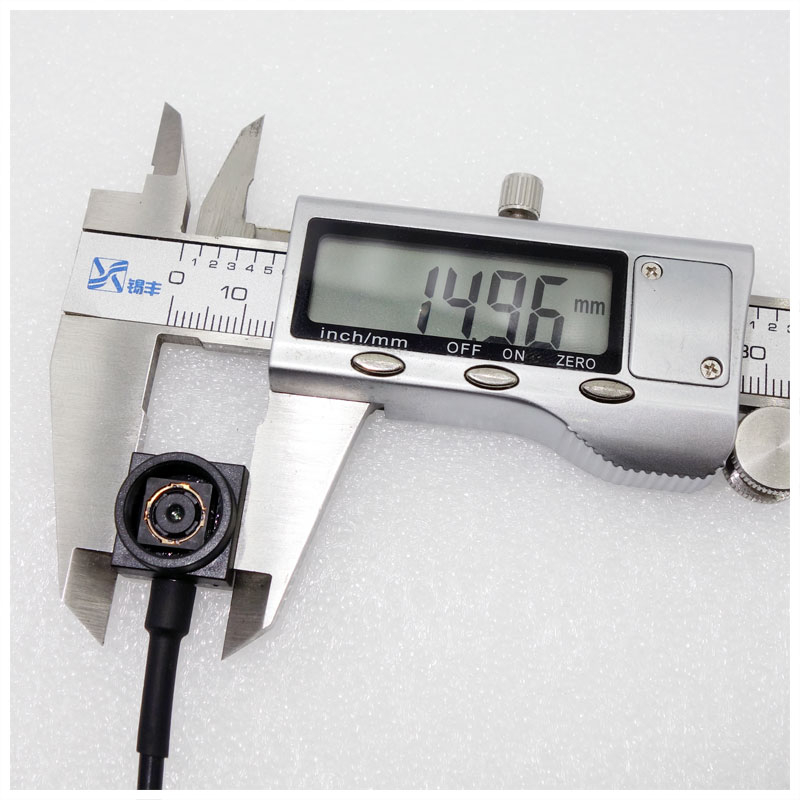
For these applications, a compact solution such as the Goobuy UC-501-5MP-AF autofocus USB camera combines a 15×15mm-class embedded form with 5MP image output, autofocus and standard USB UVC integration. The current configuration supports up to 2592×1944 MJPEG output and is designed for kiosk, ID-card, QR-code and document-capture tasks.
One of the most common mistakes in compact-camera selection is assuming that a wider lens is automatically better.
It is not.
A wide-angle lens captures more scene, but the target occupies fewer pixels.
For example:
Wide Angle
Controlled FOV
This distinction is especially important in QR, barcode and document applications.
A 5MP camera with an excessively wide lens may provide less useful target detail than a correctly selected 2MP or 5MP camera with a narrower field of view.
For commercial equipment, camera selection becomes easier when the optical task is defined first.
Choose fixed focus when:
Choose wide angle when:
Choose autofocus when:
For document, ID and label applications, the UC-501-5MP-AF embedded UVC camera also uses a controlled approximately 66.2° horizontal field of view in its standard configuration, helping concentrate more useful image detail on the target instead of simply maximizing scene coverage.
Another important design principle is separating the camera from the software task.
The USB camera should provide:
The host system can provide:
This keeps the camera platform simple and reusable across different commercial equipment.
A vending machine manufacturer and a kiosk manufacturer may use similar camera hardware while running completely different software.
The fastest way to select a miniature camera is not to compare specification tables indefinitely.
Start with four questions:
From there, the choice between standard view, low distortion, wide angle and autofocus becomes much clearer.
The growth of smart lockers, vending machines and self-service terminals does not necessarily require increasingly complex cameras.
In many cases, the better approach is a mature miniature UVC platform with the correct:
A 15×15mm camera may appear simple, but when it is matched correctly to the equipment geometry and host architecture, it can solve a surprisingly wide range of commercial imaging tasks.
For equipment manufacturers, the key is no longer simply choosing “a USB camera.”
It is choosing: the right camera viewpoint, the right field of view and the right focus behavior for the actual commercial task.
Choose a 150° wide-angle camera when the camera is mounted very close to the target and one camera must cover a larger compartment, shelf or pickup area. Choose a 90–105° standard or low-distortion lens when the target area is more defined and natural geometry or higher pixel density on the object is more important.
The correct choice should be based on the real mounting distance and required coverage, not simply the widest available lens.
Autofocus is most useful when the target distance changes during normal use—for example, when users present ID cards, QR codes, receipts, tickets or shipping labels at different distances from the camera.
If the terminal mechanically fixes every target at one known distance, a fixed-focus camera may be simpler and more repeatable. If the working distance varies, a model such as the UC-501-5MP-AF provides more tolerance while maintaining detailed source images for host-side OCR, barcode or document-processing software.
The most useful information is:
With these details, the camera can usually be selected from an existing mature configuration instead of starting a new custom-camera development project.
Follow Me
Address:A615, 6F, Huachuangda Building, No107 Xinghua 1st Road, 43 District, Xinan street, Baoan, shenzhen, China 518101