15*15mm Micro USB Camera:
Technical Comparison & Selection Guide for USA Integrators
Introduction
From Detroit’s automotive powerhouses to Chicago’s industrial hubs, and from San Jose’s robotics labs to New York City’s security networks, USA integrators like Magna Electronics, Allied Universal, and Fanuc demand compact, high-resolution micro USB vision camera module solutions for industrial automation, medical imaging, security, consumer electronics, agriculture, drones, and robotics. Shenzhen Novel Electronics Limited’s 15*15mm autofocus USB camera UC-501 (2/5/8/12MP) delivers a tiny footprint, fast autofocus, and UVC compatibility. This blog compares it against competitors like Omnivision 5MP, Sony IMX179, 14*14mm board-level modules, and the smallest Sony 4K USB camera module, while contrasting our **1515mm IMX323 AHD camera AC-501** to guide US integrators in selecting the right compact USB vision system.
Technical Comparison: Resolution and Sensor Options
1. 2MP 15*15mm USB Camera (UC-501, Interchangeable Lenses)
- Specs: 1080P@30fps, 1515mm, 1212mm PCB, 0.1Lux, 5°-230° lenses, 85mA, UVC-compliant.
- Applications: Smart doorbells (San Jose), basic retail security (Chicago).
- Pros: Low cost, low power for low-power USB camera module, MJPEG/YUY2 for smooth video.
- Cons: Limited resolution for precision tasks.
- Best For: Cost-sensitive IoT or basic surveillance, e.g., Logitech’s smart home devices.
2. Omnivision 5MP Autofocus 15*15mm (Competitor)
- Specs: 2592x1944@30fps, 15*15mm, 0.05Lux, 90°-120° lenses, 120mA, UVC-compliant.
- Applications: Parking lot surveillance (New York City), agricultural drones (Des Moines).
- Pros: Balances cost and clarity for high-res USB monitoring module.
- Cons: Weaker low-light (0.05Lux vs. 0.01Lux), limited lens options, higher power draw.
- Best For: Mid-tier security or agriculture, e.g., Allied Universal’s retail monitoring.
3. Sony IMX179 8MP Autofocus 15*15mm (UC-501)
- Specs: 3264x2448@30fps, 15*15mm, 0.01Lux, 5°-230° lenses, 150mA, UVC-compliant.
- Applications: Assembly line inspection (Detroit), endoscopy (San Francisco).
- Pros: High clarity, excellent low-light, versatile lenses for autofocus USB diagnostic camera.
- Cons: Higher cost, increased power consumption.
- Best For: Precision industrial or medical imaging, e.g., Magna Electronics’ quality control.
4. 14*14mm Autofocus Board-Level Camera Module (Competitor)
- Specs: 5MP@30fps, 14*14mm, 0.1Lux, 90° lens, 100mA, non-UVC (custom driver).
- Applications: Custom robotics (Chicago), niche IoT (San Jose).
- Pros: Smaller footprint, higher cost for compact board-level USB camera.
- Cons: Non-standard size, fixed lens, custom drivers add 1-2 weeks to integration.
- Best For: Custom projects with driver development, e.g., Fanuc’s niche robots.
5. Smallest Sony 4K@30fps USB Camera Module 12MP (UC-501)
- Specs: 4000x3000@30fps, 15*15mm, 0.01Lux, 5°-230° lenses, 220mA, UVC-compliant.
- Applications: High-end drones (San Jose), automation (Detroit), medical imaging (Boston).
- Pros: Top-tier resolution for 4K USB automation camera, wide lens range.
- Cons: Higher cost, power draw limits battery-powered use.
- Best For: Premium applications needing ultra-high clarity, e.g., DroneTech’s UAVs.
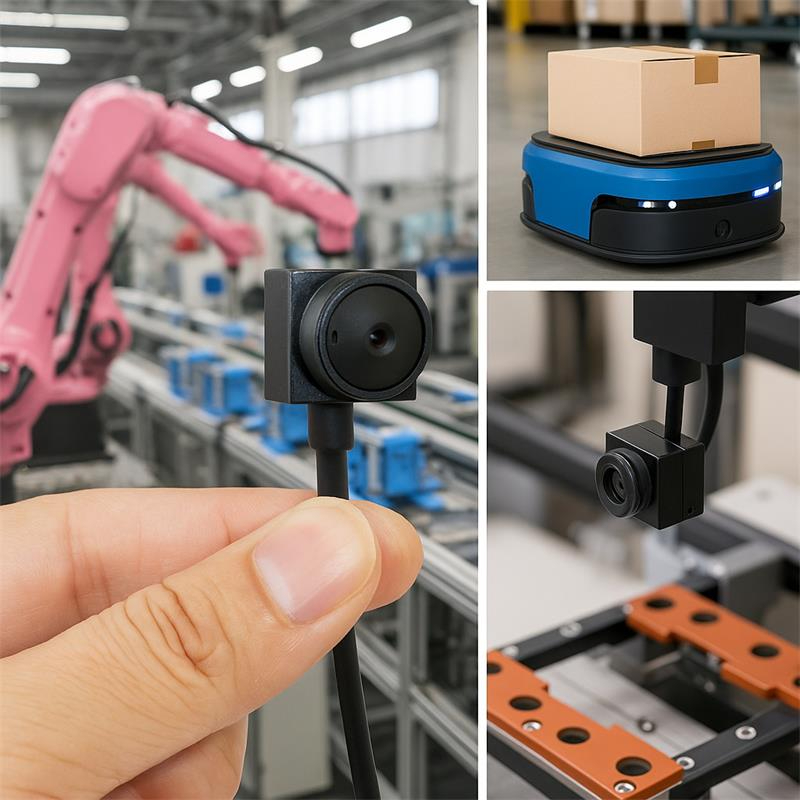
Comparison: 15*15mm USB Camera UC-501 vs. IMX323 AHD Camera AC-501
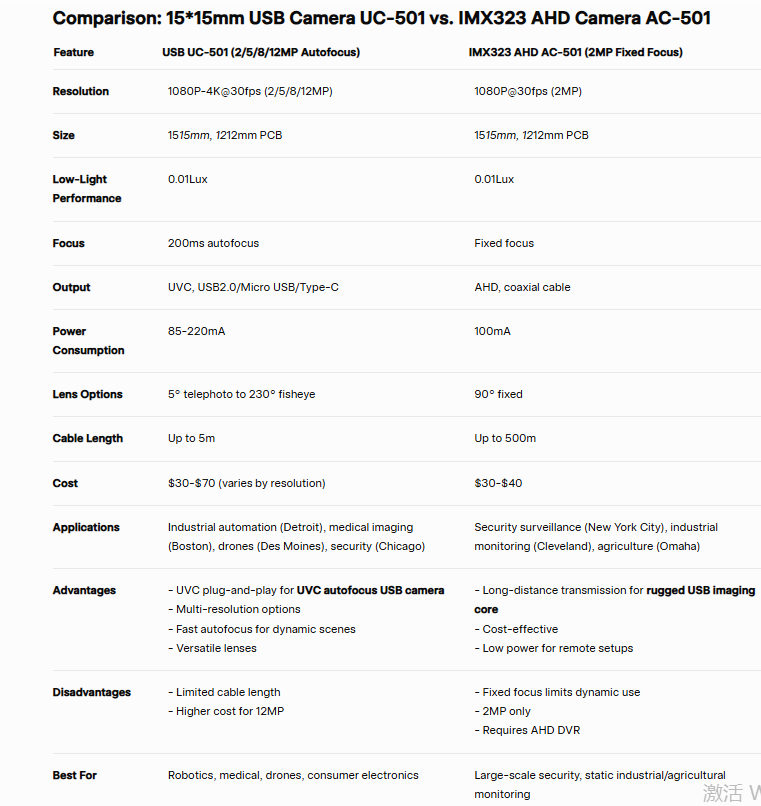
Selection Guide: UC-501 vs. AC-501
- Choose UC-501 (USB) for:
- Multi-Platform Needs: UVC simplifies integration for UVC autofocus USB camera in Windows/Linux systems (e.g., Fanuc robots in Chicago).
- High-Resolution Tasks: 5/8/12MP for 4K USB automation camera in industrial (Detroit) or medical (Boston) applications.
- Dynamic Scenes: 200ms autofocus suits drones (Des Moines) or endoscopy (San Francisco).
- Choose AC-501 (AHD) for:
- Long-Distance Setups: Coaxial cable supports rugged USB imaging core in security (New York City) or agriculture (Omaha).
- Budget Projects: 2MP at $20-$30 fits basic surveillance (Cleveland).
- Static Monitoring: Fixed focus for stable environments (e.g., parking lots).
- Integration Tips:
- UC-501: Use USB2.0 for 2/5MP, Type-C for 8/12MP. Test MJPEG for high-res USB monitoring module. Ensure 5V power for 12MP.
- AC-501: Pair with AHD DVR for 1080P. Use RG59 cable for >100m. Verify grounding to avoid noise.
Selection Tips for US Integrators
Detailed Selection Scenarios
- Detroit: Automotive Manufacturing (Magna Electronics)
- Need: High-resolution camera for assembly line defect detection.
- Requirements: 8-12MP, 0.01Lux low-light, 5° telephoto lens, UVC compatibility.
- Recommendation: Sony IMX179 8MP or 12MP UC-501 for 4K USB automation camera. Avoid 2MP (insufficient clarity) or 14*14mm (non-standard integration).
- Why: 8MP/12MP ensures micro-defect detection; UVC speeds integration.
- Chicago: Industrial Robotics (Fanuc Integrator)
- Need: Compact camera for robot navigation and inspection.
- Requirements: 5-8MP, 200ms autofocus, 85°-120° lens, UVC, low latency.
- Recommendation: Sony IMX179 8MP UC-501 for autofocus USB diagnostic camera. Avoid Omnivision 5MP (weaker low-light) or AC-501 (no autofocus).
- Why: 8MP and fast autofocus enhance navigation precision.
- San Jose: Drones & Collaborative Robots (DroneTech/Cobot Systems)
- Need: Lightweight, high-res camera for UAVs and Cobots.
- Requirements: 8-12MP, 230° fisheye lens, 85-150mA, UVC.
- Recommendation: Sony 12MP UC-501 for smallest Sony 4K USB camera module. Avoid 14*14mm (non-UVC) or 2MP (low resolution).
- Why: 12MP and lightweight design maximize UAV flight time and Cobot clarity.
- New York City: Urban Security (A+ Technology)
- Need: Discreet camera for financial district surveillance.
- Requirements: 5MP, 0.01Lux, 120° lens, long-distance option.
- Recommendation: Omnivision 5MP UC-501 or AC-501 for high-res USB monitoring module (short range) or rugged USB imaging core (long range).
- Why: 5MP balances cost/clarity; AC-501 suits >100m setups.
- Des Moines: Agricultural Drones (AgriDrone Solutions)
- Need: Durable, low-power camera for crop monitoring.
- Requirements: 5-8MP, 230° fisheye, 85-120mA, UVC.
- Recommendation: Sony IMX179 8MP UC-501 for low-power USB camera module. Avoid AC-501 (no autofocus) or 14*14mm (non-standard).
- Why: 8MP and low power optimize drone performance.
- Boston: Medical Imaging (A2 Systems)
- Need: High-res, autofocus camera for endoscopy.
- Requirements: 8-12MP, 5° telephoto, 0.01Lux, UVC.
- Recommendation: Sony 12MP UC-501 for autofocus USB diagnostic camera. Avoid Omnivision 5MP (lower clarity) or AC-501 (fixed focus).
- Why: 12MP and fast autofocus ensure diagnostic precision.
- Los Angeles: Commercial Security (Allied Universal)
- Need: Cost-effective camera for parking lot monitoring.
- Requirements: 2-5MP, 120° lens, 0.01Lux, low cost.
- Recommendation: 2MP UC-501 or AC-501 for low-power USB camera module (short range) or rugged USB imaging core (long range).
- Why: 2MP minimizes cost; AC-501 supports extended cabling.
General Tips
- Resolution: Match resolution to task: 2MP for basic IoT, 5MP for mid-tier security, 8/12MP for precision industrial/medical.
- Lens: Use 230° fisheye for drones, 5° telephoto for medical, 85°-120° for security/robotics.
- Power: Select 2/5MP UC-501 for battery-powered low-power USB camera module; avoid 12MP for ultra-low-power needs.
- Integration: Prioritize UVC for UVC autofocus USB camera to reduce setup time vs. 14*14mm’s custom drivers.
- Budget: 2MP UC-501 or AC-501 for low-cost; 12MP UC-501 for premium applications.
Shenzhen Novel Electronics: Your OEM Partner
Shenzhen Novel Electronics Limited is a trusted OEM USB camera supplier:
- Expertise: 15 years delivering compact board-level USB camera solutions, FCC/RoHS-compliant.
- Customization: R&D team delivers tailored lenses/interfaces in 7-10 days.
- Support: 24/7 English-speaking team, samples shipped in 3-5 days to Chicago.
- Affordability: Factory-direct pricing for medium-sized integrators.
- Logistics: Global supply chain ensures delivery to Detroit, San Jose, and beyond.
Conclusion
Selecting the right micro USB vision camera module hinges on resolution, lens flexibility, power, and integration needs. The 15*15mm autofocus USB camera UC-501 offers unmatched versatility with 2-12MP options, fast autofocus, and UVC compatibility for 4K USB automation camera applications in Detroit’s factories or Boston’s labs. For long-distance, budget-conscious setups, the 15*15mm IMX323 AHD camera AC-501 excels as a rugged USB imaging core for New York City’s security systems. US integrators can trust our expertise to optimize their projects.
Get Started Today
Explore our compact USB vision system! Download our spec sheet or request a sample at novel-electronics.com or sales@novel-electronics.com. Transform your project in Detroit, Chicago, and across the US!
Keywords: micro USB vision camera module, 1515mm autofocus USB camera UC-501, compact USB vision system, 4K USB automation camera, autofocus USB diagnostic camera, high-res USB monitoring module, low-power USB camera module, UVC autofocus USB camera, compact board-level USB camera, rugged USB imaging core*