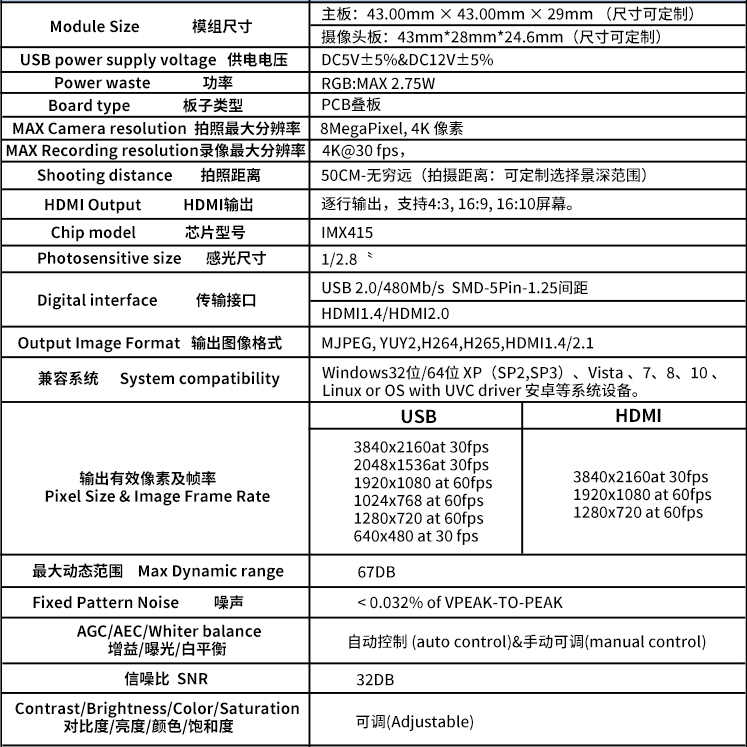
This article explains how a distortion-free IMX415 USB + HDMI camera can be used in industrial and embedded vision systems requiring accurate geometry, stable color imaging, and real-time monitoring. Unlike standard cameras, deployment success depends on distortion control, low-light performance, timing stability, and integration reliability rather than resolution alone.
For dynamic environments, motion stability and latency consistency are often more important than raw sensitivity. For fixed installations, image accuracy and system stability typically determine performance.
2026 IMX415 Status Check
The Positioning: While IMX678 (STARVIS 2) rules the high-end, IMX415 remains the global standard for affordable 4K integration.
The Lens Advantage: Its 1/2.8" optical format is compatible with thousands of low-cost M12 lenses, drastically reducing the total BOM (Bill of Materials) cost compared to larger 1/1.8" sensors.
Best Use Cases: Document Scanning (OCR), Kiosks, 3D Printers, and controlled-lighting Industrial Inspection.
Platform Ready: Native driver support in Linux 6.x kernels for Raspberry Pi 5 and NVIDIA Jetson Orin Nano
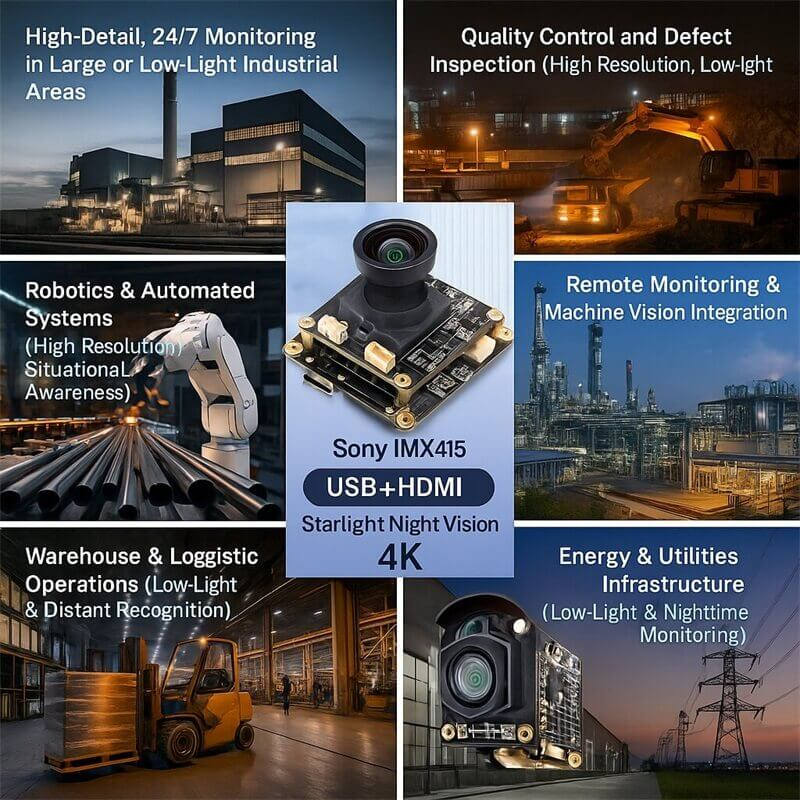
Engineers and product managers across the U.S. and Western Europe are under pressure to deliver higher-resolution, lower-latency imaging that works in real factories, retail floors, and outdoor sites—often in low-light and tight mechanical envelopes. This is exactly where a distortion-free Sony STARVIS IMX415 module with USB + HDMI dual interface shines. It combines the deployment speed of UVC (plug-and-play) with instant HDMI preview, making proof-of-concepts faster and production rollouts more predictable. Demand remains strong in the U.S. (Texas, California, Great Lakes) and the EU for embedded vision camera options that cut calibration effort, keep color fidelity at night, and integrate cleanly into kiosks, robots, and inspection stations.
Below, you’ll find the challenges teams face at project kickoff, IMX415/STARVIS technical advantages, five field-proven success stories, an integration blueprint, quantified outcomes, and a clear competitive comparison.
Technical Reference
Distortion-Free Imaging
An optical and calibration characteristic where straight lines remain geometrically accurate, improving measurement reliability.
Low-Light Color Performance
The ability of a camera to retain usable color information under minimal illumination without excessive noise.
Real-Time Monitoring
Image capture and processing with minimal delay between acquisition and display or analysis.
Search Terms Engineers Commonly Use
Engineers evaluating imaging systems for industrial deployment often search for terms such as:
distortion-free industrial camera
USB HDMI dual-output camera
low-light color industrial camera
embedded vision camera module
These keywords reflect common real-world integration requirements rather than marketing terminology.

System Validation Checklist
Engineers typically verify the following before deployment:
continuous streaming stability
frame timing consistency
low-light color accuracy
glare and reflection handling
exposure transition behavior
thermal stability during long operation
cable stability and strain tolerance
Structured validation ensures reliable real-world performance.
Pain: Night-shift safety checks; legacy cameras produced noisy monochrome and missed badge/face details.
Solution: IMX415 distortion-free module integrated into NVR; HDMI preview used for quick on-site focusing.
Results: Clear color faces captured at ~0.01–0.05 lux; false alarms down 28% (fewer escalations). Investigations reported review time cut by ~22% thanks to cleaner footage.
Pain: Robot pick-and-place suffered from de-warp drift using wide fisheye; calibration fragile after maintenance.
Solution: Swapped to distortion-free IMX415, USB to the robot controller, HDMI to technician’s portable screen for weekly checks.
Results: Removed de-warp stage; cycle time improved; alignment errors reduced by 35%, and station downtime fell ~18% over two months.
Pain: Variable factory lighting caused edge loss; fisheye skewed gauge readings; software compensation added latency.
Solution: IMX415 (low-distortion lens) + controlled exposure/WDR profile; USB to the AOI PC, HDMI for operator overview.
Results: Inspection time shortened by ~30% per unit (less re-processing), and false rejects decreased 19%.
Pain: Kiosk needed day/night color capture without adding big IR arrays; field service wanted instant preview for swap-outs.
Solution: Compact IMX415 inside kiosk bezel; dual interface STARVIS camera module for kiosks used USB for analytics, HDMI for field service preview.
Results: Technician visit time down 27% (faster focus/QA), while customer-presence detection accuracy +17% in low-light corridors.
Pain: Tight enclosures, occasional salt fog, dim lighting. Needed high detail for nameplates/tools without lens distortion.
Solution: Ruggedized IMX415 with sealed cabling; USB to edge computer (analytics), HDMI to local panel for quick checks.
Results: Unplanned service calls down 14%; operators reported faster tool verification (~25% quicker) at night due to clearer color edges.
Measurement Context
Performance improvements described in real-world deployments depend on environmental lighting, lens configuration, exposure settings, motion conditions, processing pipeline, and baseline system performance. Results may vary depending on system architecture and validation methods.

Application Decision Matrix
| Use Case | Primary Challenge | Recommended Interface Role | Validation KPI |
|---|---|---|---|
| Industrial Inspection | Geometric accuracy | HDMI preview + USB analysis | Measurement precision |
| Robotics Alignment | Motion stability | USB processing | Frame timing consistency |
| Self-Service Kiosk | Lighting variation | USB streaming | Color consistency |
| Outdoor Monitoring | Low illumination | USB capture | Detail retention |
|
Feature / Metric |
IMX291/327 USB Module (2MP, low-light) |
||
|
Resolution / Detail |
4K class (8MP) – fine edges for OCR/measurement |
4K class (8MP) |
2MP (good detail for FHD) |
|
Low-light color (starlight) |
Excellent (STARVIS; tuned ISP) |
Good in general office light; color may desaturate in very low lux |
Very strong sensitivity, but lower total pixels |
|
Lens distortion impact |
Low-distortion lens path reduces or removes de-warp |
Often needs de-warp; adds CPU and error |
Varies by lens; many builds still need correction |
|
Interfaces |
USB (UVC) + HDMI preview for field alignment |
USB (typ.), HDMI rare |
USB (typ.) |
|
Pipeline latency |
Low (no de-warp + HDMI live) |
Medium (USB + de-warp) |
Low-to-medium |
|
Power / Thermals |
Optimized for continuous duty |
Similar class |
Lower power (2MP) |
|
Form factor |
Compact board + brackets |
Compact |
Compact |
|
Best fit |
AOI/OCR, robotics alignment, kiosks, night color |
General 4K capture when lighting is decent |
Extreme low-light with FHD output needs |
Takeaway: IMX415 pairs 4K detail with STARVIS low-light color and a distortion-free optical path. That means fewer image corrections, more deterministic timing, and easier field operations with HDMI preview. IMX335 is capable, but often needs more software help in low-light + distortion compensation. IMX291/327 excel in sensitivity at 2MP, but trade away the 4K granularity many industrial teams now expect for measurement and analytics.
Deployment Considerations
System architects often evaluate long-term supply stability, firmware support, integration complexity, and validation effort in addition to imaging performance. These factors can significantly influence overall project cost and reliability.
Q1: "Is the IMX415 'End of Life' (EOL) in 2026?"
A: No. The IMX415 is a key part of Sony's long-term industrial roadmap. Due to its massive adoption base, supply is guaranteed well into the late 2020s. Goobuy ensures stable stock for long-lifecycle industrial projects.
Q2: "Does IMX415 work with the Raspberry Pi 5 ISP?"
A: Yes. The IMX415 is fully supported by the libcamera stack on Raspberry Pi 5. Goobuy provides tuned ISP configuration files to ensure accurate color reproduction without manual calibration.
Q3: "Why choose IMX415 over IMX412 or cheaper sensors?"
A: The IMX415 offers true STARVIS technology. Even though it's the "entry-level" 4K STARVIS, it is vastly superior to generic 8MP sensors in dealing with shadows and noise, ensuring higher accuracy for AI object detection.
Need help determining whether this camera architecture fits your application?
Providing a few parameters enables accurate engineering guidance:
lighting conditions
working distance
motion speed
platform type
latency requirement
With this information, an imaging configuration can be evaluated for your specific deployment scenario.
Answer (Definition-First):
A distortion-free camera is required when geometric accuracy affects measurement, alignment, or object positioning. If an application depends on dimensional consistency or coordinate precision, optical distortion can introduce measurable errors that affect system output.
Engineers typically verify this by comparing captured images against calibrated reference patterns rather than relying on specification claims alone.
Answer:
Dual-interface cameras separate deployment tasks into two workflows. HDMI enables real-time monitoring and alignment during installation, while USB provides digital data streams for processing and analysis.
This architecture reduces setup time, simplifies troubleshooting, and allows simultaneous visualization and computation without reconfiguring hardware.
Answer:
Eliminating software distortion correction can reduce processing load because geometric correction algorithms require computational resources. The actual improvement depends on resolution, frame rate, and pipeline architecture.
In many embedded systems, reducing unnecessary image processing improves overall timing stability and frees compute capacity for analysis tasks.
Answer:
Camera validation typically includes structured testing under real operating conditions such as continuous streaming, motion scenarios, lighting variation, and long-duration runtime stability.
Engineering-focused suppliers such as goobuy often support integrators by providing evaluation hardware and validation guidance so performance can be confirmed before system deployment.
Answer:
Low-light color performance is more critical when applications depend on object recognition, identification, or monitoring in variable lighting environments. In such scenarios, usable image information is more valuable than pixel count.
Systems designed for real-world environments prioritize signal quality and stability rather than peak resolution values.
Answer:
System reliability depends on integration quality, thermal stability, cable robustness, firmware consistency, and exposure control rather than sensor performance alone.
Manufacturers such as goobuy often focus on system-level validation and integration support because real deployment success is determined by stability, not just component specifications.
Answer:
Objective comparison requires measurable criteria such as frame timing consistency, latency tolerance, low-light usability, geometric accuracy, and long-duration stability.
Structured testing under real operating conditions provides more reliable data than specification sheets or promotional descriptions.
Answer:
The most common mistake is selecting a camera based on specifications alone without validating performance in the actual deployment environment. Differences in lighting, motion, optics, and processing architecture can significantly affect results.
Successful projects prioritize testing and system-level evaluation rather than feature comparison.
Author: Imaging Engineering Team
Reviewed by: Embedded Vision Systems Specialist
Last Updated: March 7th, 2026 (Added validation framework, decision matrix, and deployment guidance)