
An RK3588 STARVIS camera module is a 4K low-light camera front end used by edge AI hosts to capture stable video in harsh-site equipment, robotics, vehicles and industrial monitoring systems. Engineers should first choose the interface, then compare IMX415, IMX678 and IMX585 by bandwidth, lens/FOV, autofocus, housing, cable routing and sample-to-pilot validation.
An RK3588 starlight camera module is a camera-side hardware input used with Rockchip RK3588 edge-AI hosts for low-light video, 4K visual capture, AI inspection, remote monitoring or equipment-side video recording. For real projects, engineers should choose the camera interface first, then compare sensors such as IMX415, IMX678 and IMX585 based on low-light performance, bandwidth, lens/FOV, autofocus, zoom, housing, cable routing and harsh-site validation.
Goobuy helps OEMs and system integrators select and configure camera-side hardware for existing RK3588, Linux, Android or embedded host systems. We usually start from existing USB, HDMI, STARVIS and rugged camera platforms, then adjust lens, cable, connector, housing and interface details for sample-to-pilot validation.
For RK3588 camera module projects, the best sensor is not simply the newest or most expensive one. The correct starting point depends on the host interface, harsh-site environment, lighting condition, lens requirement, bandwidth and cost target.
| Project Need | Better Starting Point | Why |
|---|---|---|
| Mature 4K starlight camera with cost control | IMX415 | Good for price-sensitive 4K visible imaging where the project does not require the latest STARVIS 2 direction |
| Current 4K STARVIS 2 camera evaluation | IMX678 | Strong balance of low-light image quality, 4K detail, platform flexibility and sample availability |
| Premium low-light image quality | IMX585 | Larger sensor direction, better for higher-end low-light and fixed-view applications where optics and cost can be accepted |
| RK3588 edge-AI terminal prototype | IMX678 USB / HDMI / CS lens platform | Practical for fast camera-side validation before deeper system integration |
| Autofocus requirement | IMX678 AF platform first | Better when working distance changes and compact 4K AF validation is needed |
| Long-distance or specific FOV testing | CS-lens camera platform | Lens choice may matter more than sensor name |
| Harsh-site deployment | Sensor + lens + housing + cable review | Dust, vibration, condensation, washdown and cable routing often decide success before AI software |
A customer searching for “IMX415 vs IMX585 vs IMX678 RK3588 camera module comparison autofocus zoom starlight 4K price” is usually not looking for a normal webcam. They are probably designing an RK3588-based industrial AI terminal, robot vision device, vehicle camera system, edge recording box or harsh-site visual monitoring unit.
Many RK3588 projects start by asking which sensor is better: IMX415, IMX585 or IMX678. In real engineering, the first decision should be the camera interface.
The interface decides how video enters the RK3588 host, how much bandwidth is available, how much driver work is required, how long the cable can be, and whether the camera can be validated quickly.
USB is often the fastest path for early RK3588 camera validation. A USB/UVC camera can be tested more quickly on Linux or Android systems that support standard UVC video input.
USB is a good starting point when:
For harsh-site equipment, USB can work well when the camera is close to the host or control box. However, long USB cable routing, vibration, EMI, moisture and power stability must be tested in the real installation.
USB2.0 is useful for many compressed 4K or lower-frame-rate evaluation projects, especially when MJPEG is acceptable. It is common in compact USB camera modules and easier to integrate for many host devices.
USB3.0 provides more bandwidth and is better when the project needs higher frame rate, less compression or stronger host-side processing. But USB3.0 cable quality, connector stability and EMI control become more important in industrial environments.
For RK3588 edge-AI projects, the question is not only “Can the camera output 4K?” The better question is:
Can the RK3588 host receive, decode, process, record and run AI inference on this video stream reliably in the final field environment?
HDMI is useful when the project needs direct display, external recording, or an independent video output path. It is not always the best route for AI capture unless the RK3588 system has a suitable HDMI input/capture architecture.
HDMI is practical for:
Goobuy’s IMX415 4K USB+HDMI Camera is a practical example of a camera-side platform that can support both host-side USB use and monitor-side HDMI viewing in certain projects.
MIPI can be powerful for tightly integrated embedded products, but it is also the highest-support-risk direction. MIPI projects usually require sensor driver work, RK3588 BSP alignment, ISP pipeline tuning, image parameter work, board-level integration and long debugging cycles.
MIPI may be suitable when:
For new customers, Goobuy does not recommend starting from MIPI unless the project background, host platform, budget and integration responsibility are clearly defined.
In harsh-site edge-AI vision, the sensor is important, but it is not the whole camera solution.
A camera module that works on a desk may fail after it is installed on mining equipment, construction machinery, conveyor monitoring stations, outdoor inspection robots, ports, rail equipment, BESS sites, substations or wet industrial machines.
For harsh-site RK3588 camera projects, engineers should review:
This is why Goobuy positions IMX415, IMX678 and IMX585 as camera-side hardware platforms, not as finished AI systems.
IMX415 is a mature 4K STARVIS sensor direction. It is a good starting point when the project needs 4K visible imaging, starlight performance, stable cost and practical integration rather than the newest sensor generation.
For RK3588 projects, IMX415 is suitable when:
The Goobuy IMX415 4K USB+HDMI Camera can be considered for projects that need a mature 4K STARVIS camera module with flexible output for embedded vision, industrial viewing or edge-device validation.
IMX415 can be considered for:
IMX415 may not be the first choice when:
IMX678 is often the most practical starting point for current RK3588 4K starlight camera projects. It gives a strong balance between 4K detail, STARVIS 2 low-light direction, platform availability and camera-side configuration options.
For customers building RK3588 edge-AI equipment, IMX678 is attractive because it can support different camera-side paths:
The Goobuy IMX678 Camera Platform is designed for OEMs and system integrators that need to start from existing IMX678 USB, USB3.0, HDMI, autofocus, CS lens or compact camera platforms, then adjust camera-side details for the customer’s host system and sample-to-pilot testing.
IMX678 is a strong candidate for:
Many RK3588 projects are not ready for a from-zero camera design. They need a camera that can be tested quickly with the host, then adjusted if the sample test proves the direction.
IMX678 is useful because the customer can start from an existing camera-side platform and compare:
IMX585 is better suited for projects where low-light image quality is more important than compact size or lowest cost. It is a premium 4K STARVIS 2 direction and often requires more attention to optics, lens size, mechanical structure and final camera housing.
For RK3588 projects, IMX585 is suitable when:
The Goobuy IMX585 Low-Light USB Camera can be evaluated when the project needs a stronger 4K low-light camera head for industrial video input, remote observation, ruggedized housing review or higher-end image capture.
IMX585 can be considered for:
IMX585 may be too expensive or too large for some compact RK3588 devices. If the customer is still deciding the host interface, lens/FOV, cable routing and software capture path, IMX678 or IMX415 may be a more practical first evaluation step.
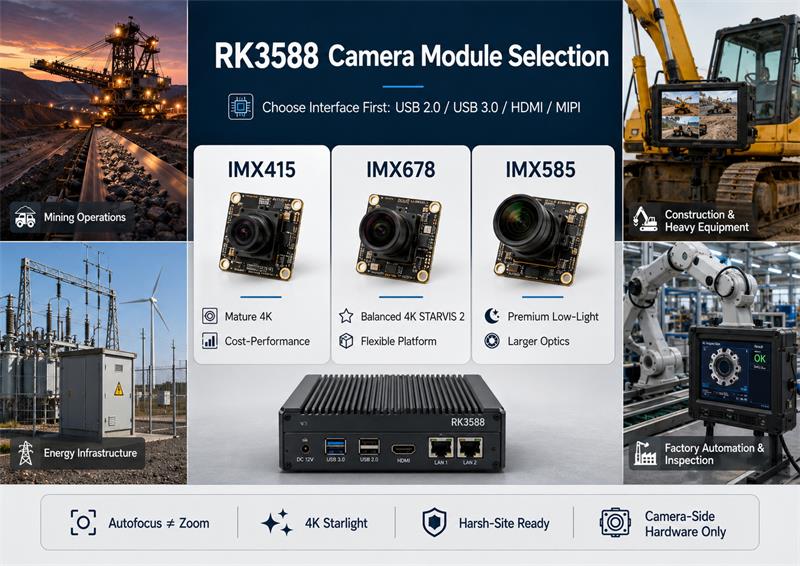
Many customers search for “RK3588 autofocus zoom camera module” as one combined phrase. In camera engineering, autofocus and zoom are different decisions.
Autofocus is useful when the working distance changes. For example:
Autofocus does not mean the camera has optical zoom. It only means the lens focus can adjust to different object distances.
A CS-lens camera is often better for engineering validation. It allows the customer to test different focal lengths, apertures, FOVs and working distances before freezing the final camera.
CS lens is useful when:
Optical zoom is a more complex project requirement. It usually affects:
For harsh-site RK3588 systems, optical zoom should not be requested casually. A zoom camera needs a clear working-distance range, FOV range, target size, mounting position and control method.
Goobuy can review camera-side options, but the customer must define the actual use case first.
A 4K starlight camera module does not work alone. The RK3588 host must receive, decode, process, record and analyze the video stream.
For harsh-site edge-AI projects, bandwidth is often as important as sensor selection.
| Camera Path | Typical Strength | Main Risk |
|---|---|---|
| USB2.0 MJPEG | Fast validation, easier UVC testing | Compression, bandwidth and multi-camera limits |
| USB3.0 | Higher bandwidth, better for 4K or higher frame rate | Cable quality, EMI and connector stability |
| HDMI | Direct viewing or recording | AI capture depends on host input architecture |
| MIPI | Deep embedded integration | Driver, BSP, ISP and long engineering cycle |
| H.264 camera-side output | Lower host bandwidth/storage pressure | Encoder controls, latency, GOP/IDR behavior must be checked |
| CS-lens camera | Flexible optical validation | Requires lens selection and mechanical planning |
For RK3588 projects, the correct question is not only:
Which sensor is better?
The better question is:
Which camera-side platform can send stable video to our RK3588 host under our real lighting, cable, enclosure and field conditions?
Customers often search for “IMX415 vs IMX585 vs IMX678 price.” Price matters, but the sensor is only one part of the real camera module cost.
| Camera Direction | Cost Level | Practical Meaning |
|---|---|---|
| IMX415 4K STARVIS | Lower / mature | Better when mature 4K cost-performance is the main target |
| IMX678 4K STARVIS 2 | Middle to higher | Better balance of current performance and platform flexibility |
| IMX585 4K STARVIS 2 | Higher | Better for premium low-light and larger optics |
| Autofocus camera | Higher than fixed-focus | Adds lens motor, control and structure complexity |
| CS-lens camera | Depends on lens | Lens may affect cost more than the camera board |
| Optical zoom camera | Project-specific | Requires separate lens, control and structure review |
| Rugged housing / long cable / custom connector | Project-specific | Depends on harsh-site installation and sample validation |
Goobuy does not recommend choosing an RK3588 camera module only by sensor price. A low-cost sensor choice can fail if the lens, cable, enclosure, USB bandwidth or host capture workflow is wrong.
Goobuy focuses on camera-side hardware, including sensor, lens/FOV, interface, cable, connector, housing and sample-to-pilot configuration. The RK3588 host system, BSP, ISP pipeline, AI software, cloud platform, safety logic and final equipment integration should be handled by the customer or embedded platform partner.
For a mature 4K STARVIS direction with USB+HDMI output, start with the Goobuy IMX415 4K USB+HDMI Camera.
For a balanced current 4K STARVIS 2 direction with multiple camera-side paths, start with the Goobuy IMX678 Camera Platform.
For premium low-light image quality and higher-end 4K industrial video input, review the Goobuy IMX585 Low-Light USB Camera.
In most RK3588 edge-AI projects, we recommend starting with an existing standard or near-standard camera platform first. After the customer validates host capture, FOV, lighting, cable routing and real environment performance, Goobuy can review lens, housing, connector or small-batch configuration.
To recommend the correct IMX415, IMX678 or IMX585 camera path, please send the following project details:
The more clearly the customer defines the host and application, the faster Goobuy can recommend a practical camera-side platform.
IMX415 is better for mature 4K cost-performance projects. IMX678 is often the best balanced starting point for current 4K STARVIS 2 RK3588 validation. IMX585 is better when premium low-light image quality is more important than compact size or cost.
USB is better for fast validation and lower integration risk. MIPI is better for deeply embedded products only when the customer has driver, BSP and ISP integration capability. For new projects, Goobuy usually recommends USB, USB3.0 or HDMI evaluation before MIPI development.
Yes, many RK3588 systems can evaluate 4K USB cameras, but the final result depends on USB bandwidth, video format, frame rate, host decoding, AI workload, recording workflow and system software. The customer must validate the full pipeline on the real RK3588 host.
IMX678 is a newer STARVIS 2 direction and is often preferred when the project needs stronger current low-light camera evaluation. IMX415 remains useful when the project needs mature 4K cost-performance and the latest STARVIS 2 direction is not mandatory.
Not always. IMX585 can provide a higher-end low-light direction, but it may require larger optics, higher cost and more mechanical planning. IMX678 is often more practical for compact RK3588 camera module evaluation, especially when USB, autofocus or CS-lens platform options are needed.
No. Autofocus adjusts focus for different object distances. Optical zoom changes focal length and field of view. Optical zoom requires separate lens, control, housing and project review.
There is no single best sensor for every harsh site. For mining, conveyor, heavy equipment, outdoor energy sites or robots, the final choice depends on lighting, vibration, dust, water exposure, mounting position, lens/FOV, cable routing and enclosure design. Sensor selection should be combined with camera-side mechanical review.
No. Goobuy focuses on camera-side hardware. We provide sensor, lens, interface, cable, connector, housing and camera-head configuration. The customer handles RK3588 host design, BSP, ISP, AI model, software, cloud platform, safety logic and final system integration.
Yes, after the customer confirms the project background, host system, camera position, cable length, connector direction, environmental risk and sample validation path. Goobuy usually starts from existing camera platforms before reviewing custom housing or cable changes.
Send your RK3588 host model, application, interface requirement, lens/FOV, lighting condition, environment, cable length, mechanical limits and sample schedule. Goobuy can then suggest whether IMX415, IMX678, IMX585 or another camera-side platform is the most practical first sample.
For most RK3588 camera module projects, choose the interface first, then compare IMX415, IMX678 and IMX585.
Start with IMX415 when the project needs mature 4K STARVIS cost-performance.
Start with IMX678 when the project needs a balanced 4K STARVIS 2 camera platform with USB, USB3.0, HDMI, autofocus or CS-lens evaluation options.
Start with IMX585 when the project needs premium low-light image quality and can accept larger optics and higher camera-side cost.
For harsh-site edge-AI projects, the winning camera is not only the best sensor. It is the camera-side configuration that survives the real environment and delivers stable video to the RK3588 host.
Follow Me
Address:A615, 6F, Huachuangda Building, No107 Xinghua 1st Road, 43 District, Xinan street, Baoan, shenzhen, China 518101