
Sony STARVIS camera roadmap 2026–2027 is moving from mature STARVIS and STARVIS 2 USB camera platforms toward STARVIS 3 IMX908, a new 4K HDR security image sensor with 1.45 μm LOFIC pixels, up to 96 dB HDR, improved low-light performance, and future potential for custom OEM camera-module development.
Sony STARVIS Camera Roadmap 2026–2027: From STARVIS 2 to STARVIS 3 IMX908
Sony STARVIS camera technology is entering a new stage in 2026. For many OEM engineers, product managers, system integrators, and device manufacturers, the real question is no longer only “What is the newest Sony sensor?” The more practical question is:
Which STARVIS camera platform can we actually test, customize, and integrate into our product with acceptable cost, risk, and schedule?
In March 2026, Sony Semiconductor Solutions announced IMX908, a new 4K CMOS image sensor for security cameras using STARVIS 3 technology and the industry’s smallest 1.45 μm LOFIC pixels. Sony states that IMX908 can achieve up to 96 dB HDR at 4K resolution with single-exposure imaging, while improving low-light performance and reducing highlight blowout, shadow detail loss, and noise in high-contrast or dark scenes.
This is an important signal for the future of security cameras, edge AI vision, low-light monitoring, dashcams, smart infrastructure, and industrial embedded imaging. However, IMX908 should not be misunderstood as an immediately mature off-the-shelf USB camera module for every OEM project. Sony’s announcement listed IMX908 sample shipment as planned for the end of March 2026, but broad commercial camera-module availability, mature bridge-chip support, ISP tuning, UVC output, and production-ready module ecosystems still need time to develop.
For customers who need immediate testing, Goobuy usually recommends starting with existing STARVIS and STARVIS 2 camera platforms such as IMX678, IMX585, IMX415, IMX335, IMX662, or IMX462. For customers planning a next-generation product in 2026–2027 and able to support NRE development, IMX908 can become a future evaluation direction.
Quick Answer: What Should OEM Buyers Do in 2026?
| Project Situation | Recommended Starting Point | Why |
|---|---|---|
| Need 4K low-light camera samples now | IMX678 STARVIS 2 USB / HDMI camera | Practical 4K STARVIS 2 platform available for near-term testing |
| Need larger sensor and stronger low-light foundation | IMX585 STARVIS 2 camera module | Strong choice for premium low-light monitoring and high-end imaging |
| Need mature 4K STARVIS cost-performance | IMX415 USB+HDMI camera | Proven 4K STARVIS option for industrial/security applications |
| Need 5MP camera for terminals, kiosks, parking, access control | IMX335 USB3.0 camera | Practical 5MP STARVIS camera with USB3.0 integration path |
| Need ultra-low-light NIR sensitivity | IMX462 / IMX662 camera module | Useful for night monitoring, IR-assisted imaging, and low-light recognition |
| Planning 2026–2027 next-generation HDR camera | IMX908 STARVIS 3 evaluation path | Future-facing sensor with LOFIC HDR and low-light potential |
| Need lens/FOV/cable/housing/interface customization | Custom STARVIS USB Camera Project | Best path when standard modules do not fit the final device |
From 2020 to 2025, many buyers treated STARVIS mainly as a low-light sensor label. In 2026, that is no longer enough.
A real OEM camera project is not decided by the sensor name alone. It is decided by a complete camera system:
This is why the STARVIS roadmap must be read from a camera-project perspective, not only from a Sony datasheet perspective.
Google’s own generative AI search guidance also confirms that AI Overviews and AI Mode still rely on core Search ranking and quality systems, and that there are no separate “special optimizations” for AI features beyond useful, technically accessible, high-quality content. For a technical B2B page, this means the content should answer the buyer’s real decision path: Which sensor? Which camera module? Which interface? Which application? Which customization route?
STARVIS 1 sensors such as IMX415, IMX335, and IMX462 are not obsolete. They remain valuable because many OEM projects prioritize availability, cost-performance, stable image output, and mature integration over having the newest sensor generation.
Typical STARVIS 1 use cases include:
A customer may not need the newest STARVIS 3 sensor if the real requirement is:
For these situations, IMX415, IMX335, and IMX462 can still be commercially better than waiting for a new sensor ecosystem.
STARVIS 2 is currently the most practical premium generation for many OEM camera projects. It gives buyers a stronger low-light and HDR foundation than older STARVIS sensors, while still being closer to real module availability and customization feasibility than newly announced STARVIS 3 platforms.
Goobuy’s existing STARVIS 2 direction should be clearly linked from this blog:
IMX678 is one of the most important 4K STARVIS 2 choices for 2026. It is suitable for customers who need stronger low-light performance, 4K detail, edge AI image capture, robotics vision, industrial inspection, or embedded monitoring.
Recommended internal anchor:
IMX678 4K STARVIS 2 USB Camera Module for Edge AI Vision
IMX585 is suitable for higher-end low-light projects where a larger sensor foundation and stronger image quality may justify a more premium camera design.
Recommended internal anchor:
IMX585 STARVIS 2 Low-Light USB Camera Module
IMX662 and IMX462 are valuable for night monitoring, NIR-assisted imaging, and low-light embedded devices where the buyer does not necessarily need 4K resolution but needs practical low-light image usability.
Recommended internal anchor:
Sony STARVIS Low-Light USB Camera Modules for Night Vision Projects
IMX908 is the first major STARVIS 3 signal that OEM camera buyers should pay attention to.
Sony’s official IMX908 product page describes it as a 1/2.8-type, approximately 8.4-megapixel, 4K-compatible CMOS image sensor for security camera applications using STARVIS 3 technology. It uses 1.45 μm LOFIC pixels and can deliver up to 96 dB HDR in single-shot exposure. Sony also lists 10-bit 90 fps, 12-bit 60 fps, MIPI D-PHY 2/4 lane output, rolling shutter, and Bayer color filter in the published specifications.
Sony’s March 17, 2026 announcement also states that IMX908 uses newly developed LOFIC pixels to achieve high dynamic range at 4K resolution with single exposure, while improving low-light performance and reducing highlight blowout, shadow detail loss, and noise.
LOFIC stands for Lateral Overflow Integration Capacitor. In practical terms, the sensor can handle more charge in bright areas, which helps reduce overexposure in high-contrast scenes. Sony states that IMX908 enables nearly 20 times the saturated charge amount compared with the conventional IMX778 security sensor, while also improving low-light performance by approximately 27% based on Sony’s SNR1s index.
For camera buyers, this means IMX908 is not just “another 4K sensor.” Its real value is the possibility of cleaner image recognition in difficult scenes such as:
Sony lists IMX908 applications including facility surveillance, street monitoring, dashcams, and real-time audience monitoring.
This part is very important for professional customers.
IMX908 is exciting, but a sensor announcement does not automatically mean a mature USB camera module is ready for immediate mass production.
A future IMX908 USB camera module would need engineering work around:
Goobuy’s own IMX908 development guide already explains that IMX908 should currently be treated as a future-facing sensor platform rather than a mature off-the-shelf USB camera module, and that existing STARVIS 2 camera modules such as IMX678 or IMX585 may be more practical for immediate validation.
Therefore, the correct message to customers should be:
If your project needs camera samples now, start with IMX678, IMX585, IMX415, IMX335, IMX662, or IMX462. If your roadmap targets next-generation HDR performance in 2026–2027 and you can support custom development, discuss IMX908 as a future NRE project.
IMX678 is the strongest near-term recommendation for many 4K low-light and edge AI projects.
Best-fit applications:
Recommended internal link:
Sony IMX678 4K STARVIS 2 USB Camera Module
IMX585 is suitable when a customer needs stronger imaging performance and is willing to accept a higher-value platform.
Best-fit applications:
Recommended internal link:
IMX585 STARVIS 2 USB Camera Module for Premium Low-Light Vision
IMX415 remains useful when the customer wants 4K, mature STARVIS performance, and practical USB+HDMI integration without waiting for newer platforms.
Best-fit applications:
Recommended internal link:
IMX415 4K STARVIS USB+HDMI Camera Module
IMX335 is a good choice when 5MP detail, USB3.0 workflow, commercial terminal integration, and mixed-light performance matter more than using the newest sensor generation.
Best-fit applications:
Recommended internal link:
IMX335 USB3.0 HDR Camera for Retail and Access Terminals
Not every project needs 4K. Some projects need usable low-light and near-infrared image quality in compact form.
Best-fit applications:
Recommended internal link:
Sony STARVIS Low-Light USB Camera Modules for Night Vision Projects
IMX908 should be positioned as a future-facing platform for customers who have:
Recommended internal link:
Sony IMX908 STARVIS 3 USB Camera Development Guide 2026–2027
This is a key commercial point.
In many industrial and embedded camera markets, new sensors do not immediately replace older platforms. A new sensor may be technically stronger, but the older platform may still win because it is:
Therefore, STARVIS 3 should be described as the future direction, while STARVIS 2 remains the practical main platform for most 2026 OEM camera projects.
A strong page should not say:
“STARVIS 3 is here, so STARVIS 2 is outdated.”
A better statement is:
STARVIS 3 IMX908 shows where high-dynamic-range low-light imaging is going, while IMX678, IMX585, IMX415, and IMX335 remain the practical camera platforms for near-term testing, customization, and production.
For robotics and AI vision customers, IMX908 is interesting because single-exposure HDR can reduce some motion-related HDR artifacts in high-contrast scenes. Sony specifically highlights that IMX908 can provide high dynamic range with single exposure and fewer artifacts in moving-subject scenes.
But for most robotics and edge AI buyers, the first question should still be:
For immediate projects, IMX678 or IMX585 may be the more realistic starting point. IMX908 is better positioned as a future option for product teams planning a next-generation low-light HDR camera platform.、
IMX908’s official applications include facility surveillance, street monitoring, dashcams, and real-time audience monitoring. These are all environments where lighting changes quickly or contains both very bright and very dark regions.
However, many commercial devices do not need a future sensor. They need a reliable module now.
For example:
This is how the blog should guide customers: do not oversell the newest sensor; help buyers choose the right camera-development stage.
Goobuy should position its STARVIS product line in three levels:
For buyers who need samples now:
For buyers who need adjustment but not full new development:
For qualified customers with roadmap projects:
To recommend the correct STARVIS camera platform, customers should send:
| Information | Why It Matters |
|---|---|
| Target application | Defines whether the camera is for robotics, kiosk, monitoring, inspection, parking, or AI vision |
| Host device | Determines USB, HDMI, MIPI, UVC, Linux, Windows, Jetson, or IPC requirements |
| Working distance | Helps select lens focal length and focus range |
| Required FOV | Prevents wrong lens selection |
| Lighting condition | Determines whether STARVIS 1, STARVIS 2, or future STARVIS 3 is needed |
| Indoor/outdoor use | Affects housing, sealing, cable, and lens choices |
| Mechanical space | Determines board size, lens height, cable direction, and enclosure feasibility |
| Interface preference | Helps choose USB2.0, USB3.0, HDMI, or custom architecture |
| Sample timeline | Separates immediate sample projects from future roadmap projects |
| Batch forecast | Determines whether customization or NRE is commercially realistic |
Sony’s March 2026 IMX908 announcement confirms that STARVIS 3 is no longer just a forecast. It is now a real new direction for compact 4K HDR security sensors. IMX908’s 1/2.8-type format, 8.4MP resolution, 1.45 μm LOFIC pixels, up to 96 dB HDR, and improved low-light performance make it an important future platform for high-contrast, low-light, and recognition-oriented camera applications.
But for OEM buyers, the most practical conclusion is:
Use IMX908 as a future roadmap signal. Use IMX678, IMX585, IMX415, IMX335, IMX662, or IMX462 for real sample validation today.
If your project needs immediate testing, choose an existing STARVIS or STARVIS 2 USB/HDMI camera module. If your project targets a 2026–2027 next-generation HDR camera and can support NRE development, discuss IMX908 as a future custom camera-module path.
Sony’s STARVIS technology was originally designed to enable ultra low-light performance in CMOS sensors. Unlike older CCDs, STARVIS achieves sensitivity in near-infrared ranges, making it ideal for applications like surveillance, robotics navigation, and covert military use.
This period also marked a shift from USB-only modules to hybrid solutions such as Starvis 2 IMX678 USB camera modules with HDMI and AI-ready processing, ideal for OEM Starvis camera solutions.
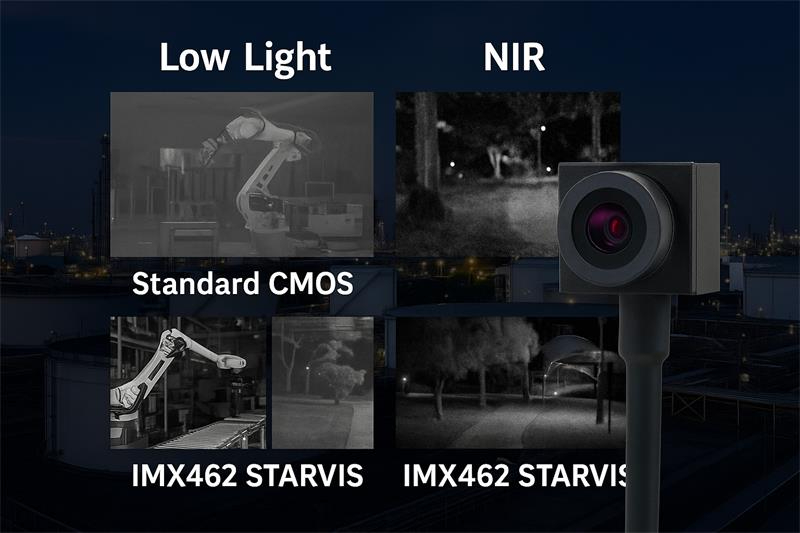

The leap from STARVIS to STARVIS2 is not just about incremental resolution upgrades:
For engineers evaluating Starvis vs Starvis 2, the choice often depends on whether the project prioritizes cost and compactness (IMX415, IMX335) or dynamic range and AI-readiness (IMX678, IMX585).
Sony announced IMX908 in March 2026 as a new STARVIS 3 CMOS image sensor for security cameras. It is a 1/2.8-type, approximately 8.4MP, 4K-compatible sensor using 1.45 μm LOFIC pixels and supporting up to 96 dB HDR.
Not yet for most standard OEM buyers. Sony planned IMX908 sample shipment for the end of March 2026, but a mature USB camera module still requires MIPI-to-USB architecture, ISP tuning, firmware, lens matching, thermal validation, and production testing. For immediate projects, IMX678 or IMX585 is usually more practical.
IMX908 is important because it combines 4K resolution, compact 1/2.8-type size, STARVIS 3 technology, LOFIC pixels, and up to 96 dB HDR. This makes it promising for high-contrast, low-light, and recognition-oriented camera applications.
If your project needs samples, image testing, or customer validation now, test IMX678 first. If your product roadmap targets 2026–2027 and can support custom development cost and schedule, IMX908 can be discussed as a future NRE direction.
STARVIS 3 introduces a stronger HDR and low-light direction through IMX908’s LOFIC pixel architecture. However, STARVIS 2 platforms such as IMX678 and IMX585 remain more practical for many current USB camera projects because they are closer to existing module availability and integration readiness.
IMX678 STARVIS 2 is the best starting point for many 4K low-light USB or HDMI camera projects today. It is more realistic for immediate testing than IMX908 and more advanced than older STARVIS 1 platforms for premium low-light imaging.
IMX335 USB3.0 is often practical for commercial terminals, parking kiosks, access-control devices, and retail equipment because it provides 5MP detail, USB3.0 workflow, and mixed-light usability without requiring a more expensive future sensor platform.
No. Sony’s published IMX908 specifications list rolling shutter. It is designed for high dynamic range and low-light performance in security-camera applications, not as a global shutter machine-vision sensor.
LOFIC means Lateral Overflow Integration Capacitor. In IMX908, this structure helps increase charge saturation capacity, reduce overexposure, improve low-light performance, and support high dynamic range imaging in difficult lighting conditions.
Goobuy can evaluate future IMX908 camera development for qualified OEM projects when sensor access, bridge-chip compatibility, ISP tuning, firmware, and production feasibility become realistic. Customers should provide host device, interface, lens, FOV, lighting, housing, timeline, and batch forecast for evaluation.
Follow Me
Address:A615, 6F, Huachuangda Building, No107 Xinghua 1st Road, 43 District, Xinan street, Baoan, shenzhen, China 518101