
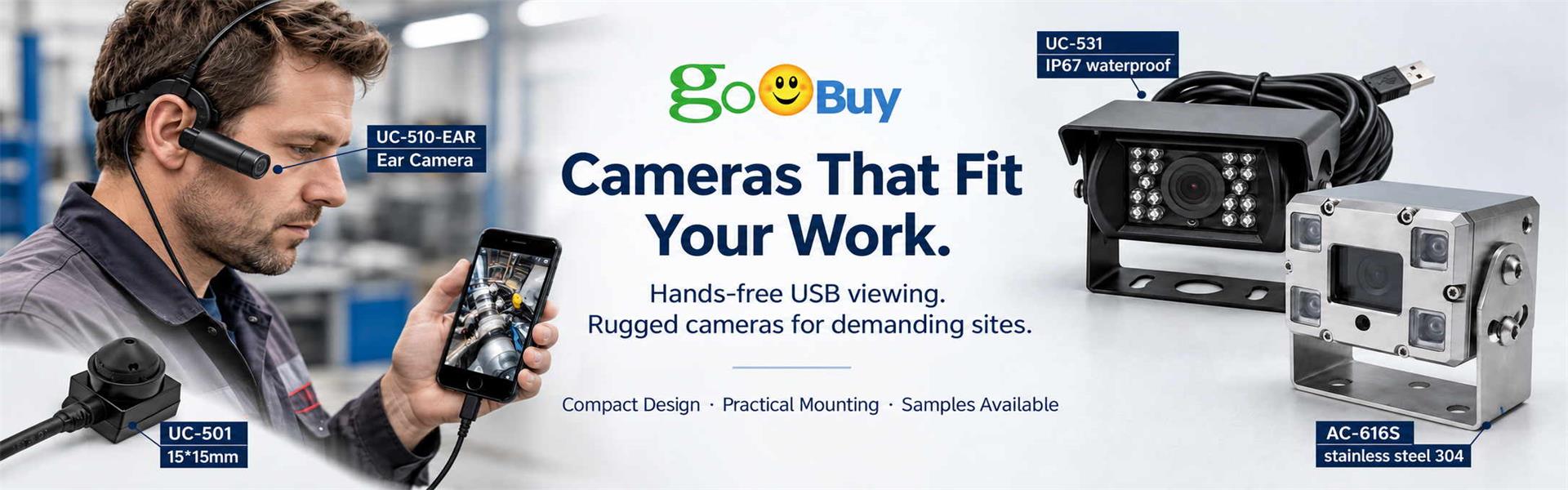
Goobuy Harsh-Site Cameras are rugged USB, AHD and PoE camera platforms developed for marine, workboat, harbor, heavy-equipment and other demanding environments. Our 2026–2027 roadmap prioritizes marine equipment, with stainless-steel, IP69K, low-light and future SUS316 PoE solutions designed around real exposure, system architecture and camera-location requirements
A harsh-site camera is not defined by resolution or an IP rating alone. The right camera must match the actual environmental exposure, viewing task, host architecture, cable route and failure risks of the equipment.
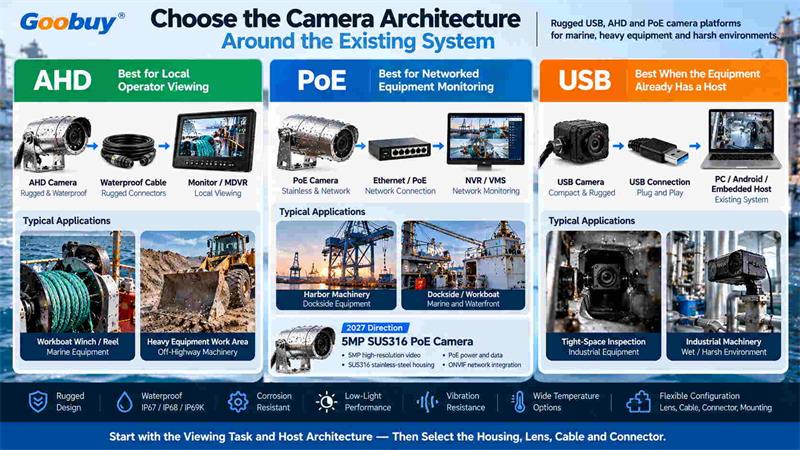
From 2026 through 2027, Goobuy is focusing its rugged camera development on three practical architectures: AHD cameras for direct local operator viewing, PoE cameras for networked equipment monitoring, and USB cameras for equipment that already has a compatible computer or embedded host.
Our priority is also becoming more focused.
Marine, workboat and harbor equipment will be the first development direction, followed by selected heavy-equipment and other harsh-site applications where our existing camera platforms provide a practical fit.
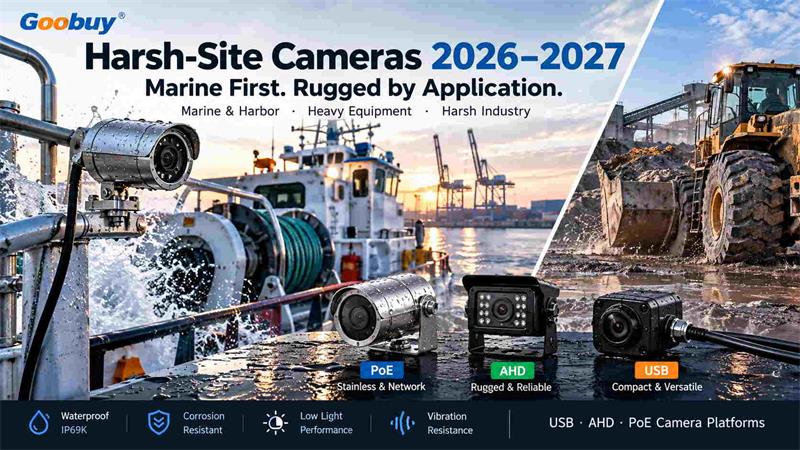
Marine equipment creates a combination of problems that a standard industrial camera does not always address well.
A camera may face:
rain and water spray
salt-containing air and chloride exposure
direct or occasional seawater contact
corrosion around the housing and mounting points
poor lighting around machinery
wet connectors and long cable routes
vibration from working equipment
limited installation space
At the same time, different marine customers need very different video architectures.
A workboat operator may only need to see a winch directly from the wheelhouse. A harbor operator may need several network cameras connected to an NVR. A maintenance technician may already have an industrial PC and need a rugged USB camera.
That is why Goobuy is developing marine cameras around the system architecture first, rather than trying to make one universal “marine camera.”
For applications such as:
Workboat winch and reel observation
Working deck machinery
Loading and unloading areas
Harbor service equipment
Wet machinery and local work areas
our rugged AHD platforms provide a simple path:
Camera → Waterproof Cable → Local Monitor → Operator
The Goobuy AC-606 direction combines rugged local video, low-light capability and IP69K protection for selected wet, dirty and washdown-prone operating areas.
AHD remains useful when the operator needs immediate local video but does not need an Ethernet network, NVR or cloud platform.
Where corrosion resistance becomes more important, Goobuy is also developing stainless-steel AHD camera configurations.
These are intended for customers who already use compatible AHD monitors or MDVRs but need a more suitable camera head for exposed machinery locations.
The goal is not to replace the complete existing system.
Keep the AHD architecture. Upgrade the camera location.
PoE becomes more appropriate when video needs to travel through an Ethernet network to an NVR, VMS or monitoring computer.
Our current stainless PoE direction already combines stainless housing, standard PoE and ONVIF/RTSP network integration for suitable marine, harbor and wet-industrial equipment.
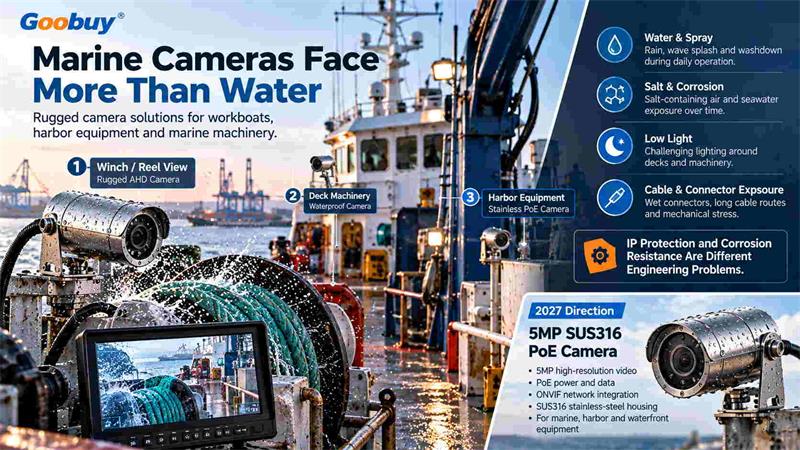
For 2027, we plan to take this direction further.
One of our key upcoming rugged platforms is a 5MP PoE camera in a SUS316 stainless-steel housing, developed specifically around more demanding marine and waterfront environments.
The planned platform combines:
5MP high-resolution network video
H.265 compression
PoE power and data
ONVIF network integration direction
SUS316 stainless-steel housing
Target applications include:
Port and harbor machinery
Dockside equipment
Workboat machinery
Loading and material-handling equipment
Waterfront industrial equipment
Locations with more severe chloride or seawater exposure
Selected underwater observation applications after complete-camera validation
The reason for moving toward SUS316 is practical: water resistance and corrosion resistance are different engineering problems.
An IP rating addresses ingress protection under specified test conditions. It does not by itself tell us how a housing will perform under long-term chloride or seawater exposure.
Before the new 5MP SUS316 camera is released for underwater or severe marine applications, the finished assembly—including housing, front window, seals, cable exit and connector—will require appropriate validation for the intended installation conditions.
Heavy equipment remains an important Goobuy market, but our strategy is not to build another broad catalog of generic vehicle cameras.
We will focus on applications where the environmental problem creates a clear reason to use a rugged camera.
Typical examples include:
mobile crusher hopper observation
loader and material-handler work areas
muddy or washdown-prone machinery
low-light equipment areas
cold-weather off-highway equipment
For wet and dirty equipment, AC-606 provides an IP69K AHD camera-and-monitor direction for local operator viewing.
For colder regions, another development direction is automatic heated AHD cameras for equipment operating in freezing conditions where frost, snow or ice around the camera window can become a visibility problem.
Rather than competing across every backup-camera application, Goobuy will concentrate on specific environments where water, mud, low light, cold or unusual camera placement makes the camera-side hardware more important.
Not every harsh-site application needs AHD or PoE.
If the machine already has a Windows/Linux computer, Android device or compatible embedded host, USB can provide a simpler video path.
Goobuy will continue developing selected rugged USB platforms for:
Waterproof external camera locations
Tight or unusual camera positions
Low-light equipment viewing
Wet industrial machinery
Marine and harbor equipment with a nearby USB host
Maintenance and inspection applications
Existing directions include waterproof USB cameras, IP69K H.264 USB cameras and stainless-steel high-resolution USB configurations.
Our USB strategy is simple:
If the customer already owns the host, we focus on providing the right external camera viewpoint.
This keeps the camera-side architecture practical and avoids adding an unnecessary IP video system.
Across marine, heavy-equipment and other harsh-site projects, our 2026–2027 roadmap increasingly focuses on three recurring problems.
Rain, spray, mud and cleaning water affect more than the housing.
Cable exits, connectors, lens windows and mounting arrangements must also be considered.
Marine environments introduce a different problem from simple waterproofing.
Salt-containing air, chlorides and seawater exposure make material selection increasingly important, which is why stainless-steel camera platforms—especially our planned SUS316 direction—will become a larger part of the Goobuy rugged-camera range.
Many equipment problems exist because the operator, technician or monitoring system simply cannot place a conventional camera where the useful view actually exists.
The camera may need to be closer to a winch, behind machinery, beside a hopper, inside a restricted equipment area or at a wet exposed location.
The useful camera position should define the camera—not the other way around.
| Architecture | Best Starting Point |
|---|---|
| AHD | Operator needs direct local viewing through a monitor or MDVR |
| PoE | Site uses Ethernet, NVR, VMS or remote network monitoring |
| USB | Equipment already has a PC, Android device or compatible host |
Environmental protection comes next.
A PoE camera is not automatically better than AHD because it is digital. A 5MP camera is not automatically better than a 2MP camera because it has more pixels.
The right architecture depends on where the video needs to go and what the user needs to do with it.
Before recommending a rugged camera, we normally want to understand six things:
1. What exactly must the operator or system see?
2. Where will the camera be installed—protected or directly exposed?
3. What is the main environmental risk: water, washdown, salt exposure, mud, cold, vibration or low light?
4. Does the existing system require USB, AHD or Ethernet/PoE?
5. What working distance, field of view and lighting conditions are involved?
6. How will the cable, connector and camera actually be mounted?
Only after these questions are clear does it make sense to discuss resolution, lens, housing material or customization.
Goobuy will continue supporting selected applications in:
bulk material and conveyor equipment
wet industrial machinery
cold outdoor equipment
low-light equipment areas
water and utility equipment
These are supporting applications rather than separate product families.
Our objective is not to create a different camera page for every industry.
It is to build a smaller number of rugged camera platforms that can solve repeatable environmental and viewing problems across different equipment.
Goobuy is the industrial camera brand of Shenzhen Novel Electronics Limited, supplying compact and rugged camera hardware since 2007.
Our role in harsh-site projects is deliberately focused on the camera-side solution.
We work with USB, AHD and PoE camera platforms and help equipment builders, distributors and system integrators select a practical starting point based on the real viewing task and operating environment.
Instead of beginning every inquiry with a new camera development project, we prefer to start from an existing platform and configure practical elements such as the lens, cable, connector, housing, interface and mounting arrangement, followed by sample and field validation.
Our roadmap is not about building the largest possible industrial camera catalog.
It is about developing a smaller, stronger family of rugged USB, AHD and PoE camera platforms—led increasingly by marine, workboat and harbor applications—then adapting those proven platforms to real equipment and real harsh-site viewing problems.
Follow Me
Address:A615, 6F, Huachuangda Building, No107 Xinghua 1st Road, 43 District, Xinan street, Baoan, shenzhen, China 518101