
A third-party AHD camera is an application-specific camera option for heavy equipment that already has a working monitor or MDVR but needs a better fit in FOV, cable, connector, housing or harsh-site performance.
Many U.S. heavy equipment distributors already have a working monitor, MDVR or camera-control platform installed on excavators, loaders, skid steers, agricultural machinery or other off-road equipment.
The real sourcing problem is often not the host system.
It is finding a heavy equipment AHD camera that fits the machine better — the right field of view, housing size, cable length, connector, mounting position and environmental protection.
That is where a third-party, application-specific camera can make more sense than replacing the entire camera system.
This situation is more common than many suppliers realize.
A dealer or equipment distributor may already be using:
Brigade openly serves mobile plant, quarry, mining and other demanding off-road environments with camera-monitor systems. Stoneridge-Orlaco builds dedicated monitor and camera systems for earthmoving machines and other heavy equipment. Dakota Micro even offers AHD/CVBS monitors and adapter cables for third-party displays, which confirms that camera-to-monitor interoperability is already part of the U.S. off-road market.
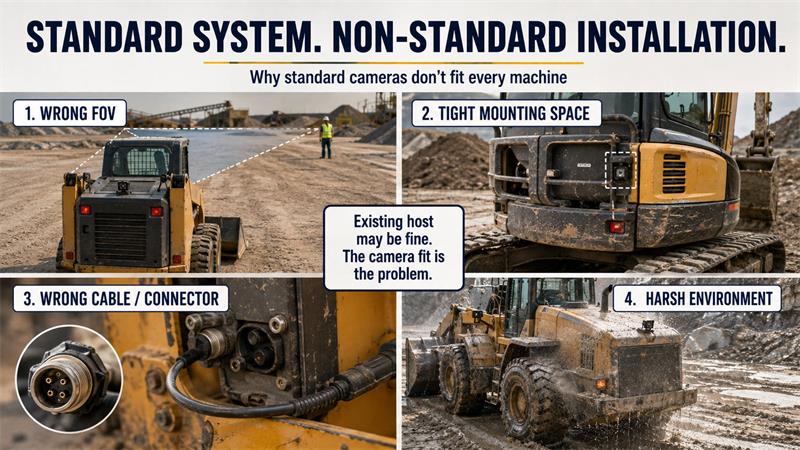
The problem starts when the standard catalog camera does not fit the actual machine.
Maybe the customer needs:
At that point, replacing the monitor or MDVR makes little sense.
The customer needs a better camera match.
That is the key distinction.
A heavy equipment video system may be standardized.
The machine is not.
A skid steer has different rear visibility problems than a wheel loader.
A mini excavator may have extremely limited mounting space.
A fertilizer tender may need corrosion resistance.
A snow-removal machine may need cold-weather startup.
A quarry loader may need a camera that survives mud, pressure washing and continuous vibration.
Dakota Micro’s current RazerCam line is a good example of how specialized the U.S. market has already become: it offers compact AHD cameras for tight-space equipment, 120° or 170° FOV options, multiple cable lengths, waterproof construction and adapter support for third-party monitors.
That tells distributors something important:
The value is no longer just “a camera.” It is the right camera for the exact machine and installation.
Price can be one reason, but it is usually not the most interesting reason.
The stronger commercial reasons are flexibility and fit.
The widest camera is not always the best camera.
A 170° camera may work well for very close blind-spot coverage, but a loader operator who needs to judge distance farther behind the machine may prefer a narrower view.
Typical requirements can include:
90°
for longer working-distance visibility
110–120°
for general rear-view and blind-spot monitoring
140–160°
for close-range coverage around compact equipment
This is why a custom FOV AHD camera for heavy equipment can be more valuable than simply buying another standard camera from the original system catalog.
Heavy equipment often has:
A standard commercial vehicle camera may physically fit the specification but not the machine.
This creates demand for:
compact AHD cameras
low-profile heavy equipment cameras
tight-space rear-view cameras
Dakota Micro explicitly markets compact low-profile cameras for skid steers and other tight-space equipment, which confirms this is a real U.S. use case rather than a theoretical one
On heavy equipment, the camera itself is only half the job.
Cable routing matters.
So does:
Dakota Micro currently offers multiple cable lengths and twist-lock, water-sealed connectors for demanding installations, illustrating how important cable configuration is in this market.
For a distributor installing cameras across 30, 50 or 100 machines, changing the entire host system just because the standard camera cable is wrong is unnecessary.
A better approach is often:
keep the existing monitor or MDVR, and configure the camera side correctly.
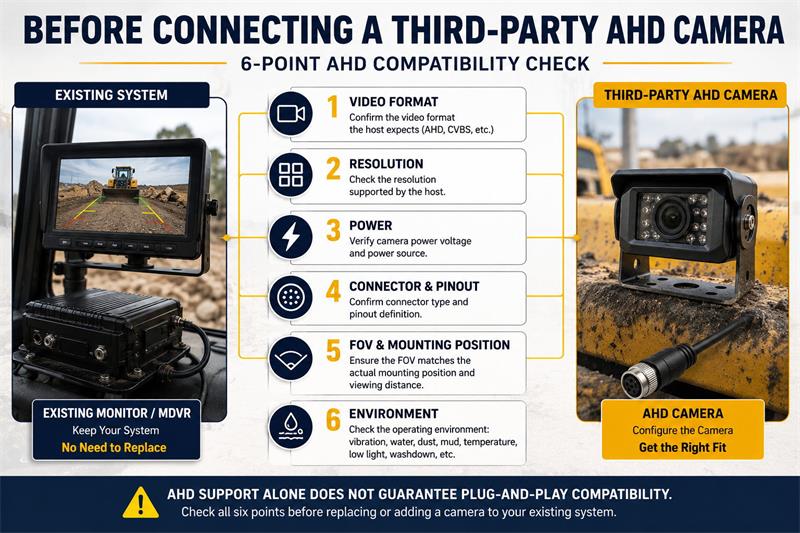
AHD support does not mean universal plug-and-play compatibility.
Before connecting a new camera to an existing Brigade, Dakota Micro, Orlaco, STONKAM, Streamax or other system, the distributor should verify:
AHD, CVBS or another analog-HD standard?
720P, 1080P or both?
What voltage does the host or harness provide?
A similar-looking connector does not guarantee identical wiring.
Rear view, side view, hitch view and work-area monitoring may require different optics.
Mud, high-pressure washdown, vibration, freezing temperatures, fertilizer residue or coastal exposure?
This compatibility step is what separates a professional heavy equipment replacement camera from a generic aftermarket camera.
The best opportunities are usually not large OEM vehicle programs.
They are existing fleets and installed equipment.
For example:
The dealer already has monitors installed but needs a more compact rear-view camera.
The standard camera is too wide or too large for the available mounting area.
The customer needs one rear camera and one implement-monitoring camera per machine.
The host architecture is already approved, but the camera needs stronger sealing, stainless housing or a different cable.
A project involving only 30 machines can easily create demand for 30–120 camera units, depending on how many views are required per machine.
For a small or mid-sized equipment distributor, that is often the right scale for platform-based camera configuration.
Traditional camera sourcing often starts with resolution.
Heavy equipment sourcing should usually start with the environment.
Off-road machinery may expose the camera to:
That is why terms such as:
IP69K heavy equipment camera
rugged AHD camera
cold-weather camera
stainless steel AHD camera
low-light heavy equipment camera
can matter more than simply moving from 1080P to a higher resolution.
The camera has to stay usable after installation
These brands illustrate how mature the heavy equipment video ecosystem has become.
Brigade offers camera-monitor solutions for mobile plant and demanding off-road environments. Orlaco offers dedicated rugged monitors and camera systems for earthmoving machinery. Dakota Micro openly supports AHD/CVBS systems and third-party monitor adapters. Streamax and STONKAM operate broader MDVR/mobile-video ecosystems.
But a mature host ecosystem does not mean every camera installation is standardized.
A distributor may still need:
That is the gap an independent camera supplier can fill.
A third-party camera makes the most sense when:
This is especially common in the 30–200 unit range.
That volume can be too small for a major system supplier to redesign a catalog camera around one customer's exact need, but large enough to justify controlled camera-level configuration.
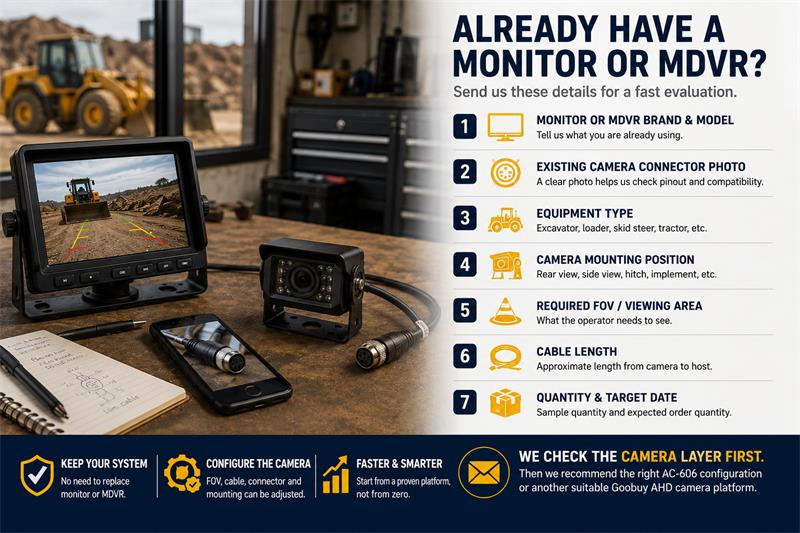
Goobuy does not build the MDVR, AI controller or fleet platform.
Our role is narrower.
The AC-606 AHD camera platform can be evaluated for off-road heavy equipment projects where the customer already has the host system and needs the camera side configured around the actual installation.
Typical platform-level changes may include:
For projects requiring cold-weather, corrosion-resistant or other harsh-site features, related rugged AHD camera platforms can also be evaluated.
The first step is not a long engineering meeting.
It is a compatibility check.
The best-fit buyers include:
U.S. heavy equipment distributors
off-road equipment dealers
retrofit installers
equipment accessory suppliers
small and mid-sized system integrators
specialty equipment OEMs with an existing display architecture
particularly when the requirement is approximately: sample → pilot → 30–200 cameras
rather than a major automotive OEM development program.
AC-606 is probably not the right starting point if you need:
In these cases, a complete system supplier may be more appropriate.
This boundary is intentional.
Goobuy's role is to provide a compact and configurable camera layer, not to replace the customer's existing host architecture.
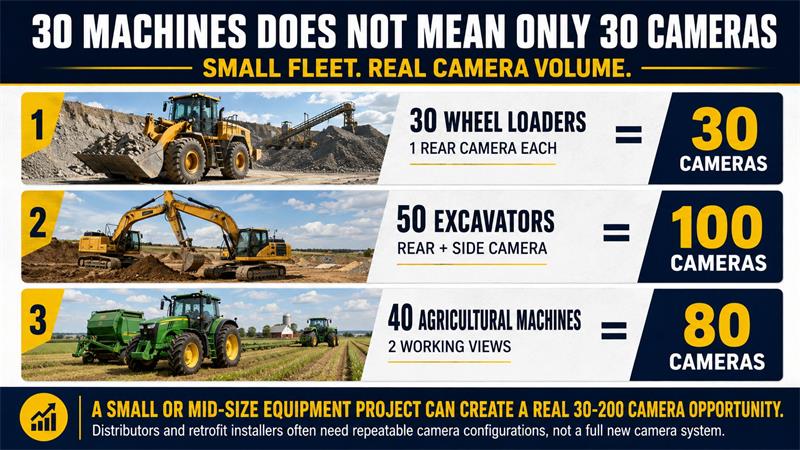
Send us:
We first determine whether an existing Goobuy AHD camera platform can fit the application.
For a 30–200 camera project, that can be much simpler than replacing an entire heavy equipment video system.
Goobuy is an independent camera supplier and is not affiliated with, sponsored by, authorized by or endorsed by Brigade Electronics, Dakota Micro/AgCam, Stoneridge-Orlaco, STONKAM, Streamax or other third-party brands mentioned in this article. Brand names are referenced only to identify existing equipment ecosystems and explain camera compatibility considerations. Compatibility must be verified for each specific monitor, recorder or host model before deployment.
Potentially yes, but AHD support alone does not guarantee plug-and-play compatibility.
The camera and existing monitor or MDVR should be checked for video format, supported resolution, camera power, connector pinout and image requirements.
Goobuy can evaluate these items before an AC-606 sample is prepared.
This is particularly useful when the existing host works well but the original camera does not provide the required FOV, housing size, cable or mounting configuration.
AC-606 can be evaluated as a third-party camera option, but Goobuy does not claim universal compatibility with these brands or all of their models.
We first need the exact monitor or MDVR model and, preferably, the existing camera connector and specification.
The evaluation focuses on:
If these requirements can be matched with the existing AC-606 platform, sample validation is the next step.
Goobuy is an independent camera supplier and is not affiliated with or endorsed by the third-party brands mentioned above.
The fastest starting point is:
host brand and model + connector photo + equipment type + required camera position.
If available, also send:
You normally do not need to prepare a complex RFQ before we can determine whether an existing camera platform is worth testing.
If the required viewing angle can be achieved using a suitable lens on the existing AC-606 optical platform, it can normally be treated as a platform configuration rather than a completely new camera development.
The correct FOV should be selected from the actual machine:
A wider lens is not automatically better for every heavy equipment application.
That is the type of small-to-medium B2B requirement the AC-606 platform is intended to evaluate.
Where technically practical, cable length, connector and pinout can be reviewed around the existing camera platform.
We normally recommend validating a small number of samples on the customer's actual equipment before repeating the same configuration for a 30–200 unit batch.
No. The correct FOV depends on what the operator needs to see and at what distance.
Very wide cameras can provide excellent close-range coverage but may make distant objects appear smaller and introduce stronger perspective distortion.
For general rear visibility, a more moderate FOV may sometimes provide better distance judgment.
Goobuy recommends selecting the lens from the actual mounting position rather than simply choosing the widest available option.
For a one-time installation, a generic camera may be enough.
For repeat B2B deployment, buyers often need more control over:
AC-606 is positioned as a configurable camera platform for repeat equipment deployment, not simply as a generic retail backup camera.
The goal is to validate one configuration and reproduce it for the pilot or production batch.
8. When should I choose another Goobuy harsh-site camera instead of AC-606?
AC-606 is not intended to solve every harsh-site camera problem.
Another platform may be more appropriate when the equipment requires:
Send the operating environment and existing host information first. We would rather recommend a better-fitting existing platform than force AC-606 into an unsuitable application.
Follow Me
Address:A615, 6F, Huachuangda Building, No107 Xinghua 1st Road, 43 District, Xinan street, Baoan, shenzhen, China 518101