
UKCA-Compliant Micro USB Vision is the industrial standard for British robotics integration, characterized by 15x15mm ultra-compact form factors, UKCA certification, and native ROS 2 support. Designed for the Oxford-Cambridge tech clusters, these modules enable Eye-in-Hand perception in Physical AI applications, ensuring long-term hardware availability and high-flex durability for UK manufacturing and research hubs
2026 UK Robotics Snapshot: Engineering Reliability
The Compliance: Full UKCA certification support for seamless entry into the British industrial market.
The Ecosystem: Native compatibility with NVIDIA Jetson and Ubuntu 24.04 (Jazzy Jalisco) for high-speed AI deployment.
The Integration: Ultra-slim 15x15mm form factor designed for the next generation of UK-made Cobots and Dexterous Hands.
The Durability: Upgraded with High-Flex Drag Chain Cables to withstand 24/7 operation in UK logistics and manufacturing hubs.
Micro USB Vision Modules for UK Integrators: The 2026 Standards for Physical AI & UKCA Compliance
The Integrator's Playbook: How Micro USB Vision Unlocks High-Margin Automation Projects
For a UK system integrator, the landscape is clear: the high-value projects are no longer in simple pick-and-place. They are in complex, high-precision tasks within the UK’s resurgent automotive, aerospace, and medical device sectors. But these projects often come with a hidden challenge that can derail timelines and erode profits: the physical limitations of traditional machine vision systems.
Imagine being tasked to automate a quality control process on a busy production line in the West Midlands. The robot needs to be fast and agile, but the bulky vision system you’ve quoted for the end-of-arm tooling is compromising the entire cell's performance.
This article is a playbook for the forward-thinking integrator. We'll explore how a component-level, micro-vision strategy is not just a technical choice, but a powerful commercial advantage, enabling you to win more complex and profitable projects.
In modern robotics, especially in applications like electronics or medical device assembly, the real estate on the end-of-arm tooling (EOAT) is the most valuable and contested space. A large, heavy camera system directly limits the robot's:
Speed & Agility: It creates inertia, slowing down cycle times.
Accessibility: It prevents the robot from reaching into confined spaces.
Payload Capacity: It consumes valuable payload that could be used for other tools.
This is where the paradigm must shift from bulky smart cameras to discreet, powerful, component-level vision.
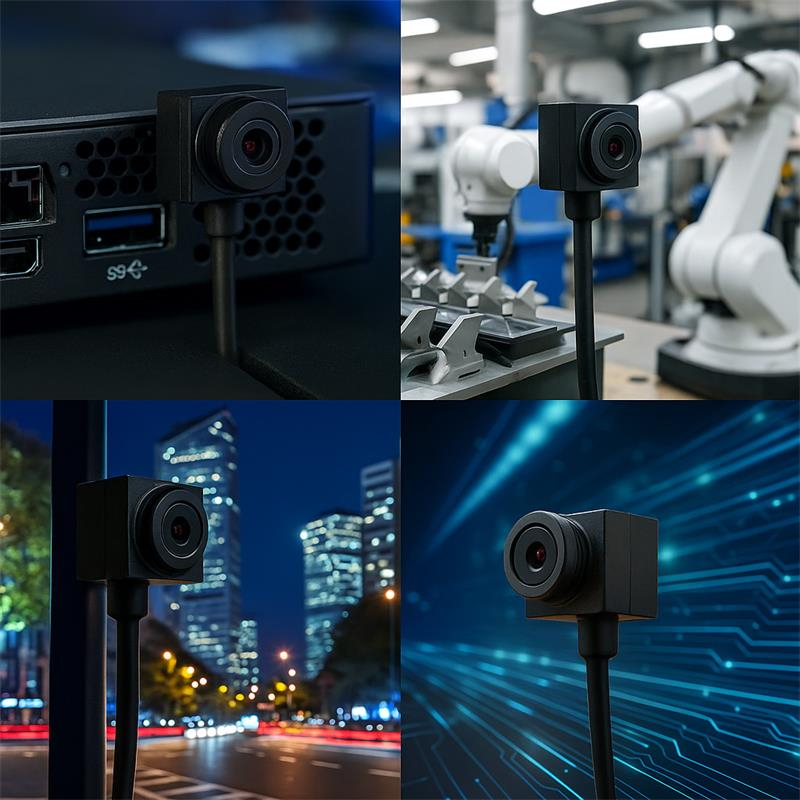
A leading Coventry-based system integrator, serving the UK's burgeoning Electric Vehicle (EV) supply chain, was contracted to develop a robotic cell for the 100% quality inspection of a miniature, multi-pin battery management system (BMS) connector.
The primary challenges were:
Extreme Space Constraints: The inspection points were located deep within the connector's housing, requiring the vision system to be positioned almost inside the part itself.
Multiple Focal Planes: The robot needed to inspect both the pins at the bottom of the connector and the housing's surface features, requiring different focal distances.
Rapid Integration: The project timeline was tight, and the control system was a standard industrial PC.
Their initial plan to use a traditional smart camera failed because the camera body was too large for the EOAT.
Their winning solution was to build a custom inspection tool around our 15*15mm micro USB camera with 8MP autofocus.
The Size Solution: Its miniature footprint allowed their engineers to embed the camera directly alongside a pneumatic gripper on the same EOAT, creating an ultra-compact, multi-functional tool.
The Autofocus Advantage: The integrated autofocus was the game-changer. It allowed the robot to inspect the deep pins and the shallow surface features in a single sequence, without any mechanical refocussing or moving the robot arm back and forth, saving critical cycle time.
The USB Simplicity: As a UVC-compliant device, goobuy micro USB camera was instantly recognised by their PC controller. There was no need for complex GigE cards or custom drivers. Their software team could immediately access the video stream and focus on their core task: writing the inspection algorithms.
For UK integrators, a supplier must be more than just a component vendor; they must be a reliable partner who understands the demands of the local market. This means providing:
Responsive Technical Support: Access to engineers who can help solve integration challenges across different time zones.
Robust Documentation: Clear, comprehensive datasheets and development resources that your engineering team can rely on.
A Stable Supply Chain: The confidence that the components you design into a project today will have a long and stable production life.
Why UK Integrators Choose Goobuy in 2026
1. Navigating the Post-Brexit Standards (UKCA) Compliance is no longer an afterthought. We ensure our micro camera modules meet UKCA (UK Conformity Assessed) standards, reducing the certification friction for UK integrators exporting to global markets.
2. Oxford-Cambridge Tech Cluster Support For R&D teams in the Golden Triangle, we offer Agile Prototyping. Whether you are developing Humanoids in London or AMRs in Oxfordshire, our 15mm Micro Modules provide the high-fidelity data needed for the latest Vision-Language-Action (VLA) models.
3. Reliable "Eye-in-Hand" Connectivity UK manufacturing demands uptime. Our cameras feature customized High-Flex TPE Cabling, tested for 5 million+ cycles, preventing the common "cable-snap" failures in robotic wrist joints.
The ability to take on complex, high-precision automation projects is what separates a leading integrator from the competition. By moving beyond bulky, off-the-shelf systems and embracing a flexible, component-level strategy with tools like a 15*15mm autofocus USB camera, you can design more compact, faster, and more capable robotic cells.
This approach doesn't just solve technical problems; it unlocks a new category of high-margin projects that your competitors, with their traditional vision systems, simply cannot bid for.
Is the physical size of your vision system limiting the scope of projects you can win? It might be time to think smaller to win bigger.
Powering the UK’s Physical AI Revolution.
From Bristol to Edinburgh, we are the trusted vision partner for British robotics innovation.
Developing a Robot? [Request a UKCA Compliance Data Sheet]
Need Custom Cables? [Configure Your High-Flex Connectivity Kit]
Talk to an Expert: [Schedule a Technical Consultation for UK Projects]
Professional FAQ
Q1: "How do you ensure long-term availability for UK industrial projects?"
A: We provide a 5-year longevity guarantee for our core 15mm modules. This allows UK integrators to design with confidence, knowing their Bill of Materials (BOM) won't change mid-project
Q2: "Can the 15mm module handle the vibration in UK heavy-industry environments?"
A: Yes. We offer Thread-Locked Lenses and industrial-grade Potting/Coating as customization options, making them resilient to the high-G vibrations common in automotive and aerospace assembly lines.
Q3: "Do you support the latest ROS 2 distributions used in UK universities?"
A: Absolutely. Our cameras are fully tested on Ubuntu 24.04 with ROS 2 Jazzy. We provide standard V4L2 interfaces that work out-of-the-box with any standard Linux perception stack.
Q1: "How to eliminate motion artifacts in VLA-based robotic grasping at high speeds?"
A: To eliminate motion artifacts, you must transition from Rolling Shutter to Global Shutter sensors. Unlike software-based de-blurring, a Global Shutter captures the entire frame at a single point in time, providing the Vision-Language-Action (VLA) model with geometrically accurate snapshots. This is critical for real-time spatial reasoning and preventing grasp failures caused by "jello effect" distortions during rapid end-effector movement.
Q2: "What are the critical requirements for USB camera cables in 6-axis collaborative robot arms?"
A: Standard USB cables lack the torsional resilience required for continuous robotic motion. The industry standard for 2026 requires High-Flex (Drag Chain Rated) TPE cables tested for a minimum of 5 to 10 million bending and twisting cycles. These cables must also feature high-density shielding to prevent EMI (Electromagnetic Interference) from the robot’s high-torque motors, which can otherwise trigger intermittent video stream drops.
Q3: "How do you integrate a high-resolution camera into a humanoid dexterous hand with zero spare volume?"
A: Integration requires a Micro-PCB architecture, typically in a 15x15mm or 10x10mm form factor. For extreme space constraints in humanoid fingers, specialized ODMs like goobuy offer customized PCB shapes (circular or strip-type) and ultra-miniature M7/M6 lenses. This approach allows the camera to be embedded directly into the phalanx of the finger, enabling Tactile-Visual Fusion without increasing the hand’s bulk or mass.
Q4: "What is the most effective way to handle dynamic lighting shifts in AMR warehouse-to-outdoor transitions?"
A: The most effective solution is Hardware-based True WDR (Wide Dynamic Range) with at least 100-120dB capability. Standard auto-exposure is too slow for mobile robots moving at 2m/s. Hardware WDR processes highlights and shadows simultaneously in every frame, ensuring the perception stack maintains feature tracking (VSLAM) when a robot moves from a dimly lit indoor rack to a sunlit loading dock.
Q5: "How can robotics OEMs de-risk their supply chain against sudden sensor end-of-life (EOL) events?"
A: De-risking requires a Longevity Guarantee (5-7 years) and firmware locking. Integrators should partner with manufacturers like goobuy that provide persistent hardware serial numbers and "frozen" firmware versions. This ensures that when you scale from 10 to 1,000 robots, every visual unit behaves identically, eliminating the need for costly software re-calibration or driver rewrites due to silent hardware revisions.