

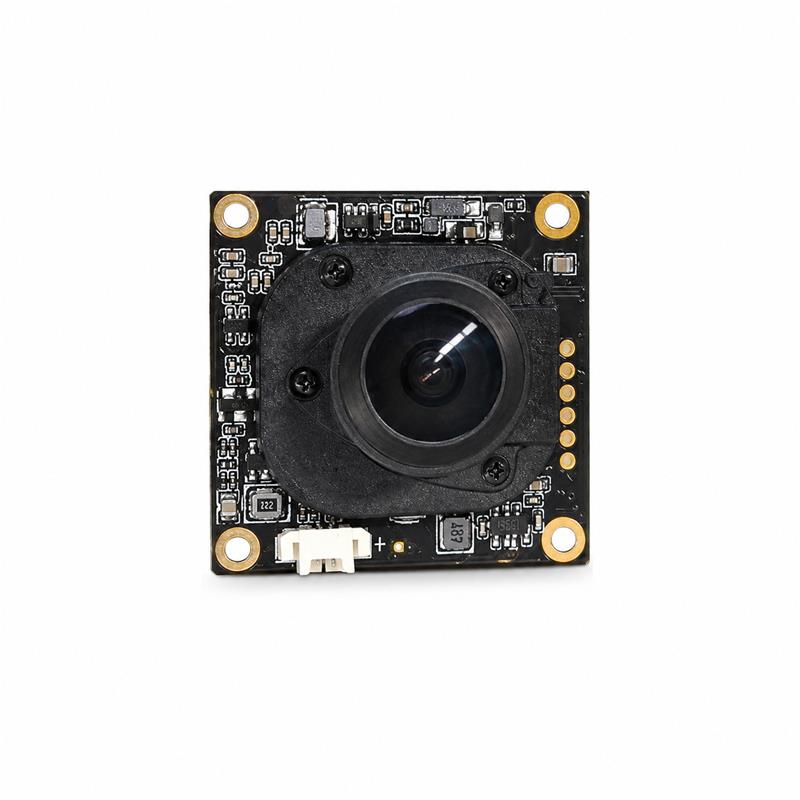
Add compact H.265 robot video to a defined platform—configured for lens, cable, power, LED and stream settings for patrol robots, inspection units, AMR monitoring and docking vision.
Goobuy POE-H2C is a board-level 3MP ONVIF IP camera module for existing robot platforms that need a fast-configured remote video node for patrol monitoring, inspection viewing, AMR/AGV auxiliary video, and VMS/NVR connection without a long camera development cycle.
Goobuy POE-H2C 3MP ONVIF IP Camera Board is a compact board-level IP video module for robot OEMs and system integrators who already have a robot platform and need to quickly add a remote video node. It is designed for patrol robots, indoor inspection robots, AMR/AGV auxiliary viewing and robot docking systems that need H.265/H.264 video streaming, ONVIF/VMS/NVR connection, low-light monitoring or operator auxiliary view without starting a long custom camera development cycle.
POE-H2C is not a robot perception camera. It is a fast-configured ONVIF IP video board for adding remote video to existing robot platforms.
Core Decision Snapshot
| Buyer Question | POE-H2C Answer |
|---|---|
| Who is POE-H2C for? | Robot OEMs and system integrators with an existing robot, AMR, inspection device or docking platform. |
| What problem does it solve? | It helps add a compact ONVIF IP video node for remote viewing, patrol monitoring, event recording, VMS/NVR connection or operator assistance. |
| Is this for early robot R&D? | No. H2C is best for defined robot platforms with a clear camera position, power input, video requirement and sample timeline. |
| Is it a machine vision camera? | No. It outputs compressed H.265/H.264 IP video, not RAW machine vision data. |
| What can be configured quickly? | Lens/FOV, cable length, connector, LED option, power wiring, stream settings, device name and sample kit. |
| Best-fit projects | Security patrol robots, indoor inspection robots, AMR/AGV remote viewing and robot docking/access-control vision. |
| Not a fit for | SLAM, safety-rated obstacle avoidance, robot arm vision, humanoid main perception or open-ended algorithm development. |
| Current form | Board-level camera module for internal robot integration. |
| External housing | A metal-housed PoE/IP robot camera can be evaluated later as a separate SKU or custom assembly. |
| Important power note | Current board specification lists DC12V input. Standard PoE or PoE-based cable integration should be confirmed by project configuration. |
Product Facts for Robot Integration
| Fact | POE-H2C Detail |
|---|---|
| Product name | POE-H2C 3MP ONVIF IP Camera Board/POE camera module |
| Product type | Board-level IP camera module |
| Primary role | Remote video node for existing robot platforms |
| Best-fit customers | Robot OEMs and system integrators with defined host platforms |
| Main applications | Patrol robots, indoor inspection robots, AMR/AGV auxiliary view, robot docking systems |
| Video output | H.265/H.264 compressed IP video |
| Protocol | ONVIF |
| Sensor class | 1/3" 3MP CMOS |
| Main stream | 2304×1296, 1–15fps |
| 1080P output | 1920×1080, up to 20fps |
| Power input | DC12V according to current board specification |
| Board size | Approx. 32×32×10mm |
| Not designed for | SLAM, robot arm guidance, safety perception, RAW machine vision or open-ended camera R&D |
When a robot project is close to pilot build or delivery, the camera problem is often not about inventing a new vision system. It is about fitting a reliable video node into limited space, connecting it to the existing platform and shipping on time.
H2C is built for that situation.
H2C 3MP ONVIF IP Camera Board is a compact board-level video module for robot teams that already have a host controller, mechanical enclosure, network architecture and project schedule. Instead of starting a long camera development cycle, Goobuy helps configure the H2C board around your existing robot platform.
H2C is suitable when your project is blocked by practical video requirements such as:
H2C is not positioned as a new robot perception development platform. It is a mature board-level IP camera base that can be quickly configured for remote video, inspection viewing and embedded robot monitoring.
H2C is designed for customers who already know what they need the camera to do.
Best-fit customers usually have:
Goobuy’s role is to help you configure the camera around those requirements.
Typical fast-configuration items include:
H2C is not intended for open-ended robot architecture exploration, long-cycle sensor selection, SLAM development, safety perception, robot arm vision guidance or algorithm development.
If your project already has a robot host and your current problem is “we need a practical video node to finish this project,” H2C is the right type of product to evaluate.
Robot Use-Case Fit Matrix
| Robot Use Case | Fit Level | Why |
|---|---|---|
| Security patrol robot remote video | Strong fit | ONVIF, H.265/H.264, low-light support, compact board integration |
| Indoor facility inspection robot | Strong fit | Suitable for remote viewing, event recording and low-light monitoring |
| AMR/AGV auxiliary viewing | Conditional fit | Good for front/rear monitoring, incident recording and operator view; not for navigation |
| Robot docking / charging station view | Strong fit | Compact IP video node for visual confirmation and remote maintenance |
| Crawler / narrow-space inspection system | Conditional fit | Only suitable when customer already has sealed housing and lighting design |
| SLAM / VIO robot navigation | Not fit | Compressed IP video, not RAW low-latency perception input |
| Safety-rated obstacle avoidance | Not fit | Human-shape detection is auxiliary only, not safety-certified |
| Robot arm guidance | Not fit | Not designed for deterministic machine vision or hardware trigger |
| Humanoid robot main perception | Not fit | Not intended for main perception, synchronization or embodied AI vision training |
Many robot projects already have a working base platform, but the video layer becomes a late-stage problem. The camera may be too large, the interface may not fit, the stream may not connect to the customer’s monitoring platform, or the team may still need a compact board to fit behind the robot cover.
H2C helps solve this by providing a mature ONVIF IP camera board that can be configured around your existing structure instead of forcing a new camera development cycle.
Not every robot camera needs RAW data, trigger sync or machine vision SDK control. For many patrol robots, facility inspection robots and AMR monitoring systems, the requirement is simpler but still critical:
Send stable video to an operator, command center, VMS/NVR platform or service team.
H2C supports H.265/H.264 video streaming and ONVIF protocol, making it better suited for remote video workflows than a basic USB camera.
Finished CCTV cameras are often too bulky or visually unsuitable for robot integration. H2C is a board-level camera module that can be placed inside a robot head, front cover, AMR body panel, dock housing or embedded monitoring device.
This gives the robot OEM more control over external design, mounting, cable routing and final system integration.
Patrol robots and inspection robots often work in dim environments: warehouses, parking facilities, data centers, utility rooms, basements and factory corridors.
H2C supports low-light imaging and IR/white LED control, helping robot builders create a practical monitoring view in poor lighting conditions.
A-class robot customers usually do not want months of abstract discussion. They want a workable sample configuration to test inside their own platform.
H2C is suitable for that workflow. Once you provide the camera position, FOV, power input, cable requirement, video platform and testing schedule, Goobuy can help confirm a practical sample configuration for evaluation.
This H2C page focuses on the board-level version.
It is intended to be integrated inside the customer’s own robot housing or device enclosure.
Typical installation locations include:
This is best for robot OEMs and system integrators who already have their own mechanical design and want a compact camera board that can be fitted into their platform.
If your project needs a ready-to-mount external camera, Goobuy can evaluate a separate metal-housed PoE/IP robot camera assembly as another SKU or custom project.
This page is intentionally focused on the board-level H2C module first, because it is the fastest option for OEMs who already have a robot host and enclosure.
Your patrol robot platform already exists. The robot can move, communicate and operate, but the video module still needs to fit inside the robot head or front cover. Your customer may also require live viewing, event recording, low-light patrol video or VMS/NVR connection.
H2C provides a compact ONVIF IP camera board with H.265/H.264 streaming, low-light imaging and LED control. It can be configured with project-specific lens, cable, power wiring and stream settings for your existing patrol robot platform.
H2C is suitable for:
H2C is not intended for:
Your inspection robot already has a platform and application environment. It may be used in a data center, warehouse, factory corridor, utility room or smart building. The missing part is a compact video board that can provide remote visual confirmation for operators.
H2C can be embedded inside the robot housing as a small IP video node. It supports compressed video streaming, low-light monitoring and ONVIF-based platform evaluation.
This allows your robot team to add a practical remote viewing camera without changing the main robot architecture.
H2C is suitable for:
H2C is not the best choice for:
H2C can be configured as a compact IP video node for existing patrol robots, indoor inspection robots, AMR/AGV auxiliary viewing and robot docking systems. Crawler inspection is conditional when the customer already has a sealed housing design

Goobuy POE-H2C is best suited for defined robot platforms where the camera role is clear: remote video, patrol monitoring, inspection viewing, AMR/AGV auxiliary view or docking confirmation. It is not positioned as a robot perception camera or machine vision sensor.
Your AMR or AGV already has navigation and safety sensors. The robot does not need another perception camera. What you need is a compact video node for front view, rear view, remote operator assistance, docking status, loading confirmation or incident recording.
H2C can be configured as an auxiliary IP camera board for your existing AMR/AGV platform. It provides compressed video streaming, which is useful when network bandwidth and battery power matter.
H2C is suitable for:
H2C is not intended for:
Your robot docking station, charging point, access-control area or service station needs visual confirmation. You may need to see whether the robot docked correctly, whether a connector aligned, whether a package is present or whether a person is near the service area.
H2C can be embedded inside a docking station or access-control device as a compact ONVIF IP camera board. It provides remote video for operators, service teams or monitoring platforms without requiring a full machine vision system.
H2C is suitable for:
H2C is not intended for:
Crawler inspection projects can be a fit only when the customer already has a sealed camera head or enclosure design.
H2C may be evaluated as the internal video board for a crawler camera head, but it is not a complete waterproof crawler camera by itself. If your project requires a fully sealed IP68/IP69K camera head, waterproof cable, LED ring, anti-fog window and mechanical housing development, that should be treated as a separate assembly project.
H2C is suitable for crawler projects when:
This keeps the project practical and prevents both teams from entering a long mechanical development cycle without clear scope.
H2C is designed for fast configuration around existing robot platforms. It is not intended for open-ended robot vision development.
H2C is not recommended for customers who need:
If your project needs those functions, Goobuy can discuss other camera modules, but H2C itself should be selected for remote video, monitoring, recording and auxiliary operator view.
H2C is based on a mature IP camera board. The goal is not to redesign the camera from zero, but to configure it quickly for your robot platform.
Available configuration items include:
For A-class projects, the best workflow is simple:
You send the robot-side problem. Goobuy confirms whether H2C can be configured quickly. Then we prepare the sample configuration for your internal test.
Technical Specifications
| Item | Specification |
|---|---|
| Model | H2C |
| Product Type | Board-level ONVIF IP camera module |
| Sensor | 1/3" 3MP CMOS |
| Main Stream | 2304×1296, 1–15fps |
| Other Video Output | 1920×1080 / 1280×720, 1–20fps |
| Sub Stream | D1 and lower resolutions supported |
| Compression | H.265 + H.264 |
| Main Encoding | Smart H.264 |
| Protocol | ONVIF |
| Low-Light Sensitivity | Color 0.05Lux @ F1.2; B/W 0.005Lux @ F1.2 |
| WDR | Digital WDR >80dB |
| Audio Input | MIC input |
| Audio Output | Not supported |
| LED Control | IR light, white light, dual-light support |
| IO | IRCUT, reset |
| Storage | Video and image support |
| Recording | Loop recording, alarm recording |
| Client Access | Browser/client/mobile platform support |
| Mobile Platform | iOS, Android |
| Working Temperature | -30°C to +60°C |
| Working Humidity | 0%–90% |
| Power | DC12V / 100mA |
| Power Consumption | About 1.2W |
| Board Size | Approx. 32×32×10mm |
| Weight | Approx. 10g |
The current H2C board specification lists DC12V input. For robot projects, the final PoE or Ethernet power architecture should be confirmed before sample preparation.
This matters because buyers may use the term “PoE camera module” in different ways.
Possible configurations include:
| Configuration | Description | Best For |
|---|---|---|
| DC12V Ethernet Board | Board receives 12V power and transmits video over Ethernet | Internal robot systems with 12V power rail |
| PoE Splitter Cable Assembly | Standard PoE input is converted to the required board voltage through a splitter or cable assembly | Robots using PoE switch architecture |
| Custom PoE/IP Camera Assembly | Project-specific PoE power conversion, cable and housing design | Future housed SKU or OEM assembly project |
Before ordering samples, please confirm:
This helps avoid confusion between a DC12V IP camera board and a standard PoE camera assembly.
H2C supports ONVIF and H.265/H.264 IP video streaming. For professional robot projects, Goobuy recommends validating the camera with your actual video platform before final mechanical integration.
Recommended validation items include:
For AMR/AGV remote viewing or operator assistance, video latency should be tested under the real robot network environment.
For patrol robot and inspection robot projects, VMS/NVR compatibility should be tested early if the final customer requires security platform integration.
For faster project validation, customers may request a configured H2C sample kit.
Suggested evaluation kit:
This helps your engineering team test video quality, stream stability, ONVIF behavior, power architecture and physical fit before committing to pilot builds.
If your robot platform is already defined and you need a compact ONVIF IP camera board to complete a current project, send us the problem you need to solve.
Please include:
The more specific your project background is, the faster we can confirm whether H2C can be configured for your robot.
Goobuy helps robot OEMs and system integrators quickly add a practical remote video node to existing robot platforms—without entering a long camera development cycle.
Yes. Goobuy POE-H2C camera board is best suited for robot OEMs and system integrators who already have a defined robot platform and need to quickly add a compact ONVIF IP video node.
It can be configured for patrol robots, indoor inspection robots, AMR/AGV auxiliary viewing, robot docking systems and embedded monitoring devices. Goobuy can help configure the lens, FOV, cable, power wiring, LED option and stream settings around your existing robot structure.
H2C is not intended for open-ended robot architecture development. It is designed to help existing robot projects add remote video, patrol monitoring, event recording, VMS/NVR connection or operator auxiliary view.
H2C is a robot IP camera board, not a machine vision camera.
It outputs compressed H.265/H.264 IP video and supports ONVIF-based video integration. It is suitable for remote viewing, patrol video, inspection monitoring, AMR auxiliary video and embedded robot surveillance.
It is not designed for RAW image capture, hardware trigger, global-shutter motion analysis, SLAM, safety-rated obstacle avoidance, robot arm guidance or precision machine vision inspection.
A robot builder may choose Goobuy POE-H2C when the camera is mainly used for network video, not local RAW image processing.
H2C is useful when the robot needs:
USB cameras are usually better for local AI processing or low-latency RAW image capture. H2C is better when the robot needs a compact IP video node for monitoring and remote visibility.
H2C supports ONVIF and IP video streaming, so it can be evaluated with compatible VMS, NVR or robot monitoring software.
Final compatibility should be tested with your actual platform because different systems may handle ONVIF discovery, RTSP streams, authentication, recording, time synchronization and user permissions differently.
If VMS/NVR integration is required by your end customer, please tell us the target platform before sample preparation so we can support a more practical evaluation process.
The current H2C board specification lists DC12V input. Therefore, the final PoE architecture must be confirmed based on your robot project.
Possible configurations may include:
If your robot must connect directly to a standard IEEE 802.3af PoE switch, please state this clearly before sample preparation. Goobuy will confirm whether the required PoE configuration can be supported.
This avoids confusion between a DC12V IP camera board and a standard PoE camera assembly.
Yes. H2C is designed as a board-level camera module and is best suited for internal integration.
It can be installed inside a patrol robot head, robot front cover, AMR body panel, indoor inspection robot housing, robot docking station or custom embedded camera cavity.
Please share the available internal space, camera position, cable exit direction, lens window location and required FOV. This helps us confirm whether H2C can be configured quickly for your robot platform.
Yes, if the role is auxiliary video.
H2C can be used for AMR/AGV front-view monitoring, rear-view monitoring, remote operator assistance, docking-area viewing, loading confirmation or incident recording.
It should not be used for AMR primary navigation, SLAM, VIO, safety-rated obstacle avoidance, certified human detection or high-speed perception. For AMR/AGV projects, video latency and stream stability should be tested under the real robot network environment
Yes. H2C is suitable for low-light robot monitoring when configured with the right lens, lighting and enclosure design.
It can support patrol robots, indoor inspection robots, facility monitoring robots and docking systems used in warehouses, parking areas, data centers, utility rooms, factory corridors and other dim environments.
Final image quality depends on lens selection, LED design, exposure settings, housing window, internal reflection control and system-level testing.
Please send the project details that affect camera configuration:
The more specific your project background is, the faster Goobuy can confirm whether H2C is a good fit and prepare a realistic sample configuration.
 office@okgoobuy.com
Follow Me
Address:A615, 6F, Huachuangda Building, No107 Xinghua 1st Road, 43 District, Xinan street, Baoan, shenzhen, China 518101