Shenzhen Novel Electronics Limited

Starvis Cameras: 24/7 High-Precision Industrial Inspection

Date:2025-08-28    View:585    


STARVIS cameras are ultra-low-light CMOS imaging modules designed for high-precision industrial inspection, robotics, and 24/7 monitoring environments. They enable reliable detection in conditions where traditional cameras fail due to noise, motion blur, or insufficient illumination.

This guide helps you choose the right sensor for:

  • low-light inspection lines

  • high-speed production systems

  • remote monitoring environments

Covered Sensors
IMX385 · IMX335 · IMX415 (plus 2026 update: STARVIS 2 IMX678 / IMX585)

Selection Rule (Fast Decision)

  • Low light priority → choose larger pixel sensor

  • Motion priority → optimize exposure + sync capability

  • Measurement accuracy → prioritize distortion + calibration


Key Takeaways for Robotics Engineers (2026 Update)

  • The Upgrade: Shift from legacy STARVIS to STARVIS 2 (e.g., IMX585, IMX678) for 2.5x wider dynamic range.

  • Core Application: Perfect for VSLAM Navigation in changing light conditions (warehouse shadows vs. outdoor sun).

  • Dark Factory Ready: Exceptional NIR (Near-Infrared) sensitivity allows robots to "see" in total darkness without visible floodlights.

  • Edge AI Friendly: High Signal-to-Noise Ratio (SNR) data significantly reduces AI Model Hallucinations and false positives.

Overview: The Industrial Imperative for 24/7 Precision

In today’s highly competitive industrial landscape, automation and robotics have become the backbone of productivity in Europe and the United States. From precision electronics assembly in Germany to automated logistics warehouses in the U.S. Midwest, the demand for reliable, high-resolution machine vision is skyrocketing. Yet, industrial companies face a persistent obstacle: low-light conditions, variable illumination, and 24/7 operational requirements that exceed the limits of traditional camera sensors.

Sony’s Starvis technology, with its back-illuminated CMOS design optimized for low-light imaging, is reshaping how industries handle defect detection, barcode reading, and object recognition across production lines. Coupled with the IMX385, IMX335, and IMX415 modules, Starvis cameras offer not just incremental improvement, but a fundamental leap in industrial vision performance.

This guide explores how Starvis technology enables 24/7 high-precision inspection and how companies can integrate these solutions to address critical operational challenges.


Industrial Pain Points in Europe & the U.S.

1. Lighting Variability and Low-Illumination

Factories, warehouses, and outdoor inspection sites often suffer from inconsistent lighting. Traditional cameras struggle with image noise, motion blur, and missed defects in suboptimal conditions. This creates bottlenecks in automated quality inspection and compromises accuracy in robot navigation.

2. High-Speed Production Lines

Modern production systems, such as automotive electronics assembly in Detroit or pharmaceutical packaging in Basel, run at very high speeds. Standard cameras often introduce motion artifacts or fail to deliver precise images in real time, leading to costly false positives or undetected defects.

3. Continuous Operations & Remote Sites

Refineries, steel plants, and offshore energy stations must operate 24/7, often in environments where lighting cannot be controlled. Vision systems here must deliver consistent quality, withstand dust, moisture, and vibration, and support remote monitoring.

Requirement Recommended Direction
Low light <1 lux Large pixel STARVIS sensor
Moving objects Short exposure + high sensitivity
Precision measurement Low distortion optics
Outdoor monitoring Wide dynamic range sensor
Edge AI integration USB3 interface recommended


How Starvis Technology Solves These Challenges

Sony’s Starvis back-illuminated sensors are engineered to address exactly these pain points. Their unique architecture enhances photon capture efficiency and minimizes signal-to-noise ratio, even at 0.001 Lux—equivalent to near-total darkness.

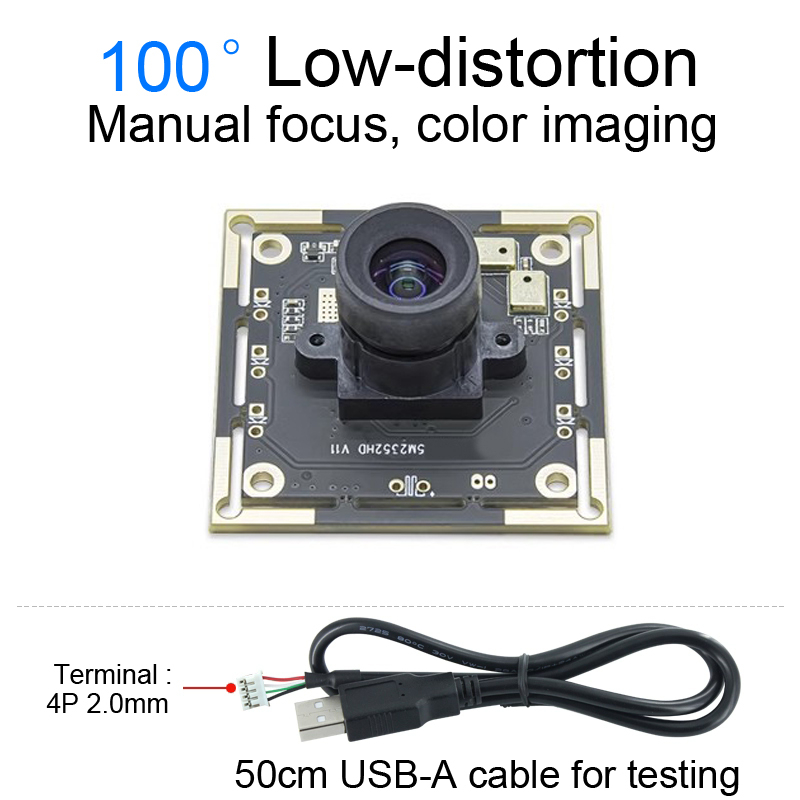
1. IMX385 Starvis Night Vision USB Camera Module

  • Sensor Size: 1/2"
  • Key Feature: Exceptional low-light performance, designed for night vision inspection.
  • Industrial Use: Ideal for logistics warehouses in the Great Lakes region, where robots operate without lighting during night shifts. The IMX385 ensures clear imaging for navigation, barcode scanning, and obstacle detection.

2. IMX335 Starvis No-Distortion USB3.0 Camera Module

  • Resolution: 5MP (2592 × 1944)
  • Key Feature: No-distortion lens options for high-precision defect detection.
  • Industrial Use: Used in European semiconductor fabs, where micron-level defects on wafers must be identified under low-light inspection environments. The no-distortion design eliminates image warping, enabling reliable machine vision for automated quality inspection.

3. IMX335 Starlight Autofocus USB Camera Module

  • Added Functionality: Autofocus for dynamic environments.
  • Industrial Use: Deployed in robotic arms for flexible manufacturing lines in France and the U.K. The autofocus ensures clarity whether the robot inspects components from 5 cm or 50 cm away, without manual lens adjustment.
 

2026 Update: STARVIS vs STARVIS 2

Recent industrial deployments increasingly request higher dynamic range and HDR stability. Sony’s newer generation STARVIS 2 sensors (such as IMX678 and IMX585) provide:

  • improved signal-to-noise ratio

  • better highlight control

  • stronger backlight handling

  • improved AI-vision compatibility

When to choose STARVIS 2

  • outdoor inspection

  • reflective surfaces

  • welding / metal inspection

  • warehouse robotics navigation

Applications in Action: Case Studies

Case Study 1: Automotive Assembly Plant – Detroit, USA

  • Problem: High-speed robotic arms assembling components at night missed fine cracks and scratches under low light.
  • Solution: Integration of the IMX385 Starvis USB module.
  • Result: Defect detection rates improved by 37%, reducing warranty claims and boosting production reliability.
 

Case Study 2: Semiconductor Inspection – Dresden, Germany

  • Problem: Conventional cameras produced distorted images during precision defect inspection of wafers.
  • Solution: IMX335 no-distortion USB3.0 module was integrated into inline machine vision systems.
  • Result: Distortion-free images improved defect classification accuracy by 22%, supporting better yield control.
 

Case Study 3: Robotics in Flexible Manufacturing – Lyon, France

  • Problem: Robots assembling multi-size components needed frequent lens adjustments, reducing throughput.
  • Solution: IMX335 starlight autofocus USB module automated the refocusing process.
  • Result: Increased production efficiency by 18%, reducing manual intervention.
 

Case Study 4: Energy Sector Pipeline Monitoring – Texas, USA

  • Problem: Pipeline inspections conducted at night often missed defects due to poor visibility.
  • Solution: IMX385 Starvis modules integrated with AI-driven anomaly detection.
  • Result: Enabled 24/7 continuous monitoring, detecting leaks early and reducing downtime costs by millions annually.
 

Why Starvis Is a Game-Changer for 24/7 Inspection

  1. Industrial Night Vision: Captures fine defects in environments where traditional cameras fail.
  2. Clear HDR Imaging: Reduces motion blur and ensures accurate inspection on high-speed production lines.
  3.  
  4. USB3.0 & Autofocus: Enables high-bandwidth data transfer and dynamic adaptation for real-world industrial needs.
  5. Future-Ready with AI Integration: Pairing with embedded AI accelerators like NVIDIA Jetson or Intel Movidius transforms cameras into smart sensors capable of predictive analytics and anomaly detection.


Why "Good Enough" Sensors Fail in Edge AI?

  • Problem: "Garbage In, Garbage Out". Noisy low-light images confuse Neural Networks (CNNs/Transformers), leading to detection failures.

  • Solution: STARVIS 2 provides clean, high-SNR raw data. This improves your AI model's Mean Average Precision (mAP) without retraining the model. It's a hardware upgrade that boosts software performance.


Visual Illustration (Conceptual A/B Sample Scene)

Imagine a PCB inspection line:

  • Conventional CMOS Camera: Image shows blurred edges, missing tiny cracks under low light.
  • IMX385 Starvis Module: Same scene captured with clear edges, no motion artifacts, and defects highlighted, even at 0.001 Lux.
 

FAQ – 10 Key RFQ Questions Answered

Q1: Can these Starvis modules integrate with our existing automation systems?
A: Yes. With USB2.0/3.0 and UVC compliance, integration is plug-and-play for most industrial PCs and embedded vision systems.


Q2: How durable are these cameras in harsh industrial environments?
A: Modules are available with IP67 waterproofing, anti-vibration housings, and wide temperature tolerance (-30°C to +70°C).


Q3: Do you offer lens customization for different inspection tasks?
A: Yes. Options include wide-angle, telephoto, no-distortion lenses, and autofocus.


Q4: Can Starvis modules be combined with AI platforms?
A: Absolutely. Our modules are tested with Jetson Nano/Xavier, Raspberry Pi CM4, and x86 industrial PCs, supporting real-time AI inference.

Q5: What industries benefit most from these solutions?
A: Automotive, semiconductor, food processing, energy, logistics, and any sector requiring 24/7 automated quality inspection.


Q6 — How do I choose between rolling shutter and global shutter cameras for industrial inspection or robotics?

Answer (Definition-first):
Rolling shutter sensors capture images line-by-line and are best suited for static or slow-moving objects, while global shutter sensors capture the entire frame simultaneously and are required for high-speed motion or precision measurement tasks.

Decision rule engineers use

  • static inspection → rolling shutter is sufficient

  • fast conveyor / robotics → global shutter required

  • dimensional measurement → global shutter strongly recommended

Integration Notes for Engineers

For optimal deployment performance, system designers should consider:

  • bandwidth requirements for resolution and frame rate

  • trigger or synchronization needs for multi-camera setups

  • ISP tuning for noise reduction in low light

Image quality differences between systems using the same sensor often come from processing pipeline optimization rather than sensor hardware alone.


Q7 — What actually determines low-light camera performance — sensor, lens, or software processing?

Answer:
Low-light performance is determined by the combined system sensitivity, not just the sensor. The three dominant factors are:

  1. pixel size and sensor read noise

  2. lens aperture and transmission

  3. ISP noise reduction and gain tuning

In real deployments, two cameras using the same sensor can perform differently depending on optics and tuning. Industrial suppliers such as goobuy often optimize the imaging pipeline specifically for inspection or embedded AI scenarios rather than relying on sensor specs alone.


Q8— Is USB2 bandwidth enough for industrial vision, or should I always choose USB3 cameras?

Answer:
USB2 is sufficient for low-resolution or low-frame-rate applications, but USB3 is recommended whenever image data volume becomes critical.

Practical guideline

  • ≤1080p @ ≤30fps → USB2 may work

  • ≥2MP or ≥60fps → USB3 preferred

  • AI inference pipelines → USB3 strongly recommended

Bandwidth limits do not only affect frame rate — they also affect latency stability, which is critical in automation systems.


Q9 — Do low-light industrial cameras always need infrared illumination to work reliably?

Answer:
No. Modern high-sensitivity sensors can operate in very low visible light, but illumination strategy determines consistency.

Engineering principle

  • ambient low light → high-sensitivity sensor may suffice

  • variable lighting → controlled illumination recommended

  • mission-critical inspection → always add controlled lighting

Many integrators deploy tuned camera modules from vendors such as goobuy together with matched lighting to ensure repeatable detection accuracy rather than relying on ambient conditions.


Q10 — What specifications actually matter most when selecting a camera for machine vision or AI systems?

Answer:
Experienced system designers prioritize system-level performance metrics rather than headline specifications.

Top selection criteria used in real projects

  1. signal-to-noise ratio under real lighting

  2. motion stability (exposure + sync capability)

  3. optical distortion and calibration stability

  4. interface bandwidth reliability

  5. long-term thermal stability

Resolution alone is rarely the deciding factor in industrial deployments.


Conclusion & Call to Action

Sony Starvis sensors—IMX385, IMX335, and IMX415—represent the future of 24/7 industrial inspection. By overcoming low-light limitations, minimizing distortion, and enabling autofocus in dynamic environments, they are becoming essential to industrial automation and robotic vision worldwide.

If your company seeks to achieve high-precision inspection around the clock, it’s time to explore Starvis-powered solutions. contact our engineering team for a custom evaluation kit.
Need help choosing the right industrial camera for your system?

Share your application details:

  • lighting condition

  • object speed

  • required accuracy

  • working distance

Our engineering team can suggest a configuration optimized for your exact scenario.


Author: Industrial Vision Engineering Team  
Reviewed by: Embedded Systems Specialist  
Last Updated: March 9th, 2026 (Added STARVIS 2 section and integration notes)

Testing Method:
Performance data based on internal lab testing and real deployment validation under controlled lighting conditions.