
A compact thermal imaging module is an embedded infrared camera core used by OEMs and system integrators to add heat-aware vision into existing host devices, edge AI boxes, inspection terminals, industrial robots, rugged monitoring systems, energy equipment, rail infrastructure and harsh-site platforms.
For U.S. and European industrial customers, the key value of a compact thermal module is not only small size. The real value is the ability to detect heat patterns where visible cameras cannot work well: darkness, fog, smoke, dust, cabinet interiors, remote outdoor sites, heavy machinery, high-value infrastructure and harsh operating environments.
Goobuy provides compact thermal camera module platforms for customers who already have a host device, enclosure concept, software workflow, pilot project or industrial system that needs embedded thermal vision.
This page is written for serious engineering projects, not consumer gadgets or hobby experiments.
| Harsh Environment Requirement | Recommended Thermal Direction |
|---|---|
| Compact embedded device with limited space | 21×21mm USB-C radiometric thermal module |
| Electrical cabinet or battery hot-spot detection | USB-C radiometric thermal module |
| Industrial PC / Linux / Windows evaluation | USB thermal module |
| Edge AI box or inspection terminal integration | USB/UVC thermal module with SDK requirement discussion |
| Wide near-field thermal awareness | 640×512 wide-FOV CVBS thermal core |
| Analog monitor, DVR or low-latency live view | CVBS thermal module |
| High-detail industrial thermal monitoring | 1280×1024 HD thermal module |
| Heavy equipment or outdoor harsh-site platform | Thermal core + project-specific enclosure design |
| Low-light + thermal scene understanding | STARVIS visible camera + thermal module direction |
| Pilot before batch deployment | Standard sample first, then lens/FOV/cable/interface customization |
A finished thermal camera is a complete end-user product.
A compact thermal imaging module is an integration component.
It normally needs to be connected to a customer’s host platform, such as:
This difference matters.
A European rail integrator, a U.S. factory automation company, an energy monitoring equipment builder, or a heavy equipment OEM usually does not want a consumer-style handheld thermal camera. They need a thermal core that can become part of their own product.
Visible cameras depend on light. Thermal cameras depend on heat.
In harsh industrial environments, this difference is critical.
A normal visible camera may fail to show useful information in:
Thermal imaging can help detect:
For harsh-site projects, thermal imaging should be treated as one sensing layer inside a larger industrial system. It does not replace good engineering, enclosure design, safety procedures or certified monitoring equipment. But it can provide valuable heat-aware visibility that visible cameras cannot provide.
In the United States, compact thermal imaging modules are especially suitable for industrial and commercial OEM projects where customers already have a product platform or integration plan.
U.S. factories, manufacturing cells and automated inspection systems often need to monitor motors, bearings, pumps, power electronics, welding stations, conveyor rollers, robotic cells and high-duty equipment.
A compact thermal module can be integrated into:
For these projects, USB thermal modules are usually a practical evaluation path because the customer can test the image stream, software compatibility, working distance and thermal visibility before moving into pilot deployment.
Recommended product direction:
21×21mm USB-C Radiometric Thermal Camera Module with SDK
This type of compact module is suitable when the system needs thermal images, temperature data, hot-spot detection logic or software-side monitoring.
Many U.S. industrial sites contain electrical cabinets, control panels, power distribution boxes, battery systems and power electronics that may generate abnormal heat before visible failure appears.
Thermal modules can support monitoring around:
For this application, the system builder should define:
A compact radiometric thermal module is often more useful than video-only thermal output if the final system needs data, logs or software alarms.
Many U.S. system integrators now use edge AI boxes or industrial computers to combine camera data, sensor data, local analytics and remote reporting.
A compact thermal imaging module can be added as a heat-aware sensor layer.
Typical use cases include:
The key question is not only whether the thermal module can output an image. The customer also needs to confirm whether they require:
For projects requiring visible + thermal fusion or dual-sensor layout, Goobuy can also discuss platform-level configuration around STARVIS visible cameras and thermal modules.
Some U.S. customers need thermal vision on outdoor equipment, service vehicles, logistics equipment, inspection vehicles, agricultural equipment, mobile industrial platforms or remote monitoring devices.
These applications often face:
For these projects, the thermal module itself is only the starting point. The final product must also consider enclosure, sealing, lens window, mounting, cable exit, connector protection and serviceability.
If the system only needs live thermal video for operator awareness, a CVBS thermal core can be easier to integrate than USB.
Recommended product direction:
640×512 Ultra-Wide Micro CVBS Thermal Core with 90.3° HFOV
This module is more suitable for wide near-field thermal awareness and analog video integration than for radiometric data analytics.
In Europe, harsh industrial thermal vision is often connected to energy infrastructure, rail systems, heavy industry, ports, outdoor equipment and cold-weather industrial environments.
European customers usually care about long-term reliability, host integration, serviceability, compliance path, documentation and realistic application boundaries.
European energy infrastructure projects may need thermal monitoring for substations, transformers, inverter cabinets, wind turbine auxiliary systems, solar farm electrical equipment, battery storage systems and remote utility assets.
Thermal camera modules can be integrated into monitoring systems for:
If the target is close and the system needs compact integration, a 21×21mm USB-C radiometric thermal module may be suitable.
If the target is smaller, farther away or requires more thermal detail, a higher-resolution module should be considered.
Recommended high-resolution direction:
1280×1024 HD Micro USB Thermal Module for Industrial OEMs
This type of HD thermal module is better suited for high-value industrial monitoring where image detail, target distance and analytics value justify the higher configuration.
European rail and tunnel projects often involve remote cabinets, power equipment, tunnel systems, platform infrastructure, rolling-stock auxiliary equipment and service inspection devices.
Thermal imaging can help system integrators add temperature awareness to:
These projects usually require more than just the module. The complete design may need vibration protection, cable sealing, enclosure protection, remote diagnostics and long-term supply planning.
For digital monitoring systems, USB thermal modules are usually a good evaluation starting point. For analog operator-viewing systems, CVBS thermal modules may still be appropriate.
European heavy industry, quarrying, mining support equipment, recycling plants, steel-related processes, port equipment and industrial mobile platforms can create harsh operating conditions for cameras.
Common challenges include:
Thermal modules can support:
For broader harsh-site vision options, customers can review:
Rugged Cameras for Harsh Environments | STARVIS & Thermal Modules
This category includes STARVIS low-light cameras, thermal modules, rugged USB cameras and project-specific harsh-site camera platforms.
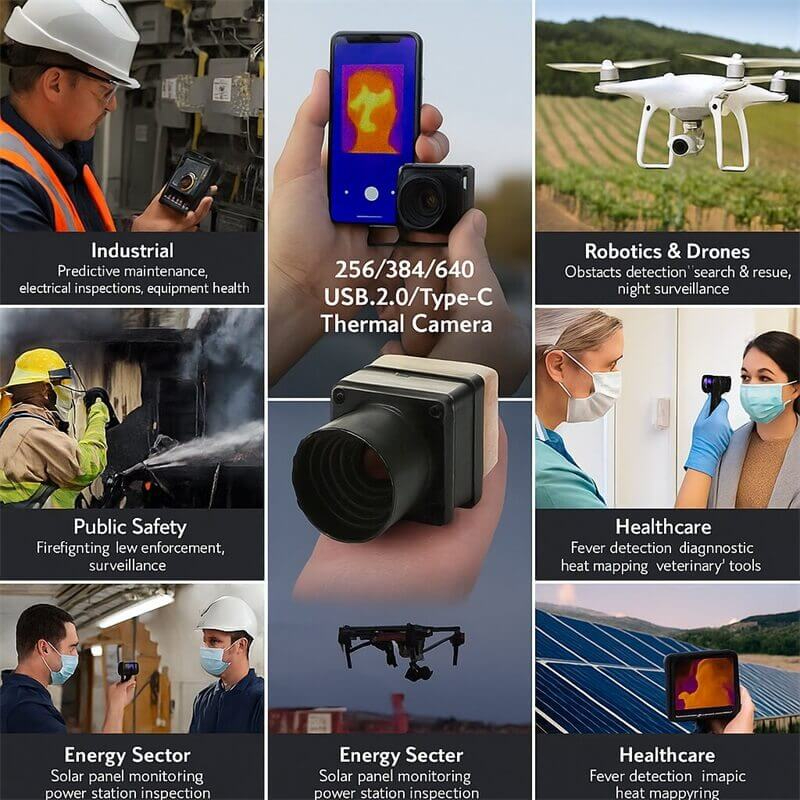
European ports, logistics centers and outdoor industrial facilities often operate equipment in rain, fog, salt air, low light and long-duty cycles.
Thermal modules can be considered for:
For near-field operator awareness, a wide-FOV thermal module may be useful. For high-detail monitoring, a higher-resolution thermal module may be better.
The selection should be based on target distance, field of view, installation position, host system and whether temperature data is required.
Recommended product direction:
21×21mm USB-C Radiometric Thermal Camera Module with SDK
Recommended product direction:
640×512 Ultra-Wide Micro CVBS Thermal Core with 90.3° HFOV
Recommended product direction:
1280×1024 HD Micro USB Thermal Module for Industrial OEMs
Higher resolution is not always the best answer.
The right thermal resolution depends on:
Lower resolution modules can be useful for compact hot-spot indication, short-distance monitoring, simple temperature awareness and cost-sensitive embedded equipment.
They are suitable when the target is large, close and easy to distinguish thermally.
Mid-range thermal modules can be suitable for many industrial monitoring applications where size, cost and useful detail need to be balanced.
They are often practical for electrical cabinets, compact monitoring nodes, battery equipment and fixed inspection devices.
640×512 is useful when the target is smaller, the scene is wider, the installation distance is longer, or the customer needs better image detail for professional use.
This level is often relevant for heavy equipment, energy infrastructure, mobile platforms and higher-value monitoring systems.
1280×1024 thermal imaging should be considered for high-detail industrial monitoring, long-distance observation, advanced analytics or premium inspection systems.
This is not necessary for every project, but it can be valuable when image detail directly affects system performance.
In many harsh industrial projects, thermal imaging alone is not enough.
A thermal module can show heat patterns, but it cannot provide the same visual detail as a visible camera. A STARVIS low-light camera can show object shape, color, labels, equipment condition and scene details, but it cannot detect heat.
For some U.S. and European projects, the best direction is a dual-sensor approach:
This can be useful for:
Goobuy can discuss platform-level configuration when the customer already has a host device, project requirement and pilot plan.
Goobuy does not position compact thermal modules as one-size-fits-all consumer products.
For OEM and system integration projects, possible discussion items include:
For some projects, a standard sample can be used first to confirm the core imaging performance. After validation, the customer can discuss lens, cable, connector, mounting, firmware or mechanical customization.
If hardware or firmware changes are required, paid NRE may be needed.
This keeps the development path realistic and avoids wasting time on projects without a clear host device, budget or deployment plan.
This page is not suitable for customers looking for:
Goobuy is a better fit for OEMs, product companies and system integrators with real host devices, test schedules and commercial deployment needs.
This page is especially suitable for:
The best-fit customer usually has:
To help Goobuy recommend the right direction, please send the following information:
Based on this information, Goobuy can help decide whether your project should start with a compact USB-C radiometric thermal module, a CVBS thermal core, a 1280×1024 HD thermal module, or a STARVIS + thermal dual-sensor configuration.
A compact thermal imaging module is an embedded infrared camera core used by OEMs and system integrators to add thermal vision, hot-spot detection or heat-aware monitoring into existing devices, edge AI boxes, inspection systems and harsh-site platforms.
A handheld thermal camera is a finished end-user tool. A thermal imaging module is a component designed for integration into a customer’s own host device, software system, enclosure or industrial product.
A USB-C radiometric thermal module is suitable when the system needs temperature data, software alarms, hot-spot detection, image recording, thermal analytics or integration with an industrial PC, embedded board or edge AI box.
CVBS thermal output is better when the system already uses analog monitors, DVRs or low-latency video chains and only needs live thermal awareness. USB thermal is better for digital processing, data recording and radiometric temperature analysis.
Not always at the module selection stage. Many OEM projects first validate the thermal module, lens, interface and image performance. The final IP-rated enclosure, sealing, window, cable and mounting design should be developed according to the final installation environment.
The right resolution depends on target size, working distance, field of view, temperature contrast and software requirement. Compact hot-spot monitoring may use lower resolution, while long-distance or high-detail industrial monitoring may require 640×512 or 1280×1024 thermal imaging.
Yes. USB thermal modules can be evaluated with suitable edge AI boxes, industrial PCs or embedded host systems. The customer should confirm whether they need UVC video, SDK access, radiometric data or custom software integration.
A project should consider STARVIS plus thermal when both low-light visual detail and heat-aware detection are needed. STARVIS helps identify visible scene details, while thermal imaging helps detect heat patterns in darkness, fog, smoke or harsh industrial environments.
Goobuy can discuss project-specific configuration such as lens, FOV, cable, connector, interface, mounting, visible + thermal layout and enclosure concept. If hardware or firmware changes are required, paid NRE may be needed.
Please provide the application, target object, working distance, required FOV, host platform, preferred interface, temperature data requirement, installation environment, sample schedule, expected quantity and customization needs.
No. This page is written for U.S. and European OEM, industrial and system integration projects. It is not intended for consumer gadgets, hunting optics, hobby drones, weapon sights or low-cost retail thermal cameras.
Goobuy mainly provides thermal modules and project-configurable camera platforms. If a project requires ATEX, IECEx or other local certification, the enclosure, certification path and final system responsibility must be discussed separately.
this article is updated in June 22th, 2026 by shenzhen novel electronics limited
Follow Me
Address:A615, 6F, Huachuangda Building, No107 Xinghua 1st Road, 43 District, Xinan street, Baoan, shenzhen, China 518101