
Sensor Showdown: IMX678 vs IMX385 vs IMX585 vs IMX327 - Who Rules the Night?
Need a STARVIS Camera Module, Not Just Sensor Data?
Goobuy offers ready-to-customize Sony STARVIS camera platforms including IMX385, IMX462, IMX662, IMX678, IMX585, IMX335, IMX415 and IMX678-based USB / HDMI / CS-lens / autofocus / rugged camera options. Start from an existing module, then customize lens, FOV, cable, housing, interface, IR filter, firmware and product identity for your real project.
View STARVIS Camera Modules → https://www.okgoobuy.com/night-vision-camera.html
Send Your Low-Light Camera Requirements
Need a STARVIS camera that standard modules cannot solve? Read our custom STARVIS2 / STARVIS3 USB camera development guide for funded OEM projects with host, timeline, and NRE readiness. read this blog articles Custom STARVIS USB Cameras: Complete Project Guide(1)
Choosing the right Sony STARVIS sensor for a low-light camera module is not only about “which sensor sees best in the dark.” For OEMs and system integrators, the real question is which sensor platform can match the required resolution, light level, lens size, interface, enclosure, cable routing, IR filter, firmware and deployment environment. This comparison explains the practical differences between IMX678, IMX385, IMX585 and IMX327 for industrial monitoring, edge AI vision, embedded inspection, robotics vision, access-control terminals and low-light equipment integration.
Understanding the Night Vision Game: Key Factors
Before we pit them against each other, remember what makes a sensor excel at night:
Sensor Choice Is Only One Part of the Camera Decision
A STARVIS sensor does not determine final night-vision performance by itself. In real camera module projects, the result also depends on lens aperture, FOV, IR-cut or IR-pass filter, ISP tuning, exposure strategy, housing window, heat design, USB / HDMI / AHD interface, cable length and the host system. For OEM projects, a slightly “weaker” sensor with the right optics and firmware may outperform a better sensor used in the wrong mechanical or lighting condition.
For project selection, evaluate:
The Contenders: A Quick Intro
Round 1: Pure Low-Light Sensitivity & Cleanliness (Pitch Black Conditions)
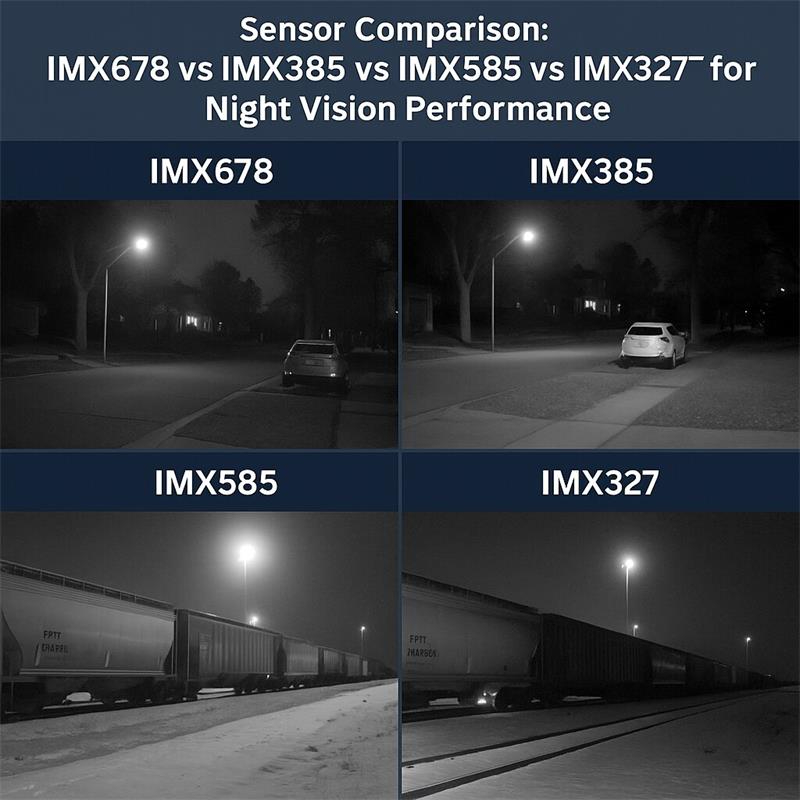
Round 2: Detail in Low Light (Moderate Illumination / IR)
Round 3: Handling Challenging Light (WDR - Wide Dynamic Range)
The Verdict: Which Sensor for Your Night?

Summary Table
|
Feature |
IMX678 |
IMX385 |
IMX585 |
IMX327 |
|
Resolution |
8MP (4K) |
2MP (1080p) |
8MP (4K) |
2MP (1080p) |
|
Sensor Size |
1/1.8" |
1/2.8" |
1/1.2" |
1/2.8" |
|
Pixel Size |
1.56µm (3.12µm binned) |
2.9µm |
2.0µm (4.0µm binned) |
2.31µm |
|
Tech |
STARVIS 2 (Quad Bayer) |
STARVIS 1 |
STARVIS 2 (Quad Bayer) |
STARVIS 1 |
|
Pure Darkness |
Good (binned) |
Excellent |
Excellent (binned) |
Fair |
|
Low-Light Detail |
Very Good |
Fair |
Excellent |
Poor |
|
WDR |
Very Good |
Excellent |
Very Good |
Good |
|
Best For |
Cost-effective 4K |
Ultimate sensitivity |
Best balance detail/sensitivity |
Budget 1080p |
From Sensor Choice to Goobuy Camera Platform
| Buyer Need | Suggested Sensor Direction | Goobuy Camera Platform Direction |
|---|---|---|
| Stable 1080P low-light monitoring | IMX385 / IMX462 / IMX662 | Low-light STARVIS USB camera with M12 or custom lens |
| Compact 4K low-light embedded vision | IMX678 | IMX678 USB2.0 / USB3.0 / HDMI / double-PCB camera |
| Adjustable working distance or inspection bench | IMX678 / IMX585 | Autofocus USB-C camera or CS-lens camera platform |
| High-detail day-night industrial imaging | IMX585 / IMX678 / IMX415 | 4K STARVIS 2 USB / HDMI camera module |
| Outdoor or harsh equipment integration | IMX385 / IMX678 / IMX662 + rugged housing | IP67 / IP69K camera with LEDs, cable and housing customization |
| No visible-light solution is reliable enough | Thermal + STARVIS combination | Micro thermal module or STARVIS + thermal project evaluation |
View Goobuy current ready cameras here
IMX385 low-light USB camera for industrial monitoring
IMX678 CS-lens camera platform
Rugged IP67 / IP69K low-light camera
Thermal camera module for no-light industrial monitoring
Final Thoughts:
There's no single "best" sensor. The IMX585 stands out as the overall leader for combining exceptional low-light sensitivity (thanks to its huge sensor and STARVIS 2 binning) with high 4K resolution, making it ideal for premium applications. The IMX385 remains the pure sensitivity king for the darkest scenarios where resolution is secondary. The IMX678 is a compelling 4K option where the IMX585 might be overkill or too expensive. The IMX327 is a reliable budget choice for basic needs with adequate IR support.
If you are selecting a low-light camera for an existing device, machine, edge AI box, access-control terminal, inspection bench, outdoor enclosure or industrial monitoring system, you do not need to decide by sensor name alone.
Send us your project details:
Goobuy can recommend an existing STARVIS camera platform first, then evaluate lens, cable, housing, firmware and interface customization for your real project.
Send Your STARVIS Camera Requirements
There is no single best STARVIS sensor for every OEM project. IMX385 is strong for clean 1080P low-light visibility, IMX678 is suitable for compact 4K STARVIS 2 camera modules, and IMX585 is better when larger optics, higher cost and premium 4K day-night detail are acceptable. The final choice also depends on lens aperture, FOV, interface, housing, ISP tuning and lighting condition.
Choose IMX385 when pure low-light visibility and clean 1080P video are more important than 4K detail. Choose IMX678 when your system needs 4K resolution, STARVIS 2 performance, USB / HDMI options, compact design or a more modern 4K platform. For real projects, Goobuy can evaluate both sensor direction and camera module structure.
Not always. IMX585 has a larger sensor format and stronger high-end low-light potential, but it may require larger optics, more space and higher cost. IMX678 is often more practical when the project needs compact 4K imaging, easier lens selection, USB / HDMI integration, or a cost-balanced STARVIS 2 camera module.
Night-vision performance depends on the complete camera system, not only the sensor. Lens aperture, IR filter, ISP tuning, exposure strategy, housing glass, heat design, cable stability, host software and lighting condition can all change the final image quality.
Yes. Goobuy provides ready-to-customize STARVIS camera platforms, including IMX385, IMX678 and other Sony STARVIS / STARVIS 2 USB, HDMI, CS-lens, autofocus and rugged camera options. Customers can start from an existing platform and customize lens, FOV, cable, housing, interface, firmware and product identity.
Send the target application, host device, required resolution, frame rate, working distance, FOV, lighting condition, interface, lens size, cable length, enclosure limits, waterproof requirement, sample timeline and estimated quantity. This helps avoid choosing a sensor that looks good on paper but fails in the real system.
Use STARVIS when the system still has usable visible light or IR illumination and needs recognizable image detail. Use thermal imaging when visible light is unreliable, fog, darkness, heat signatures or industrial temperature differences are more important than color image detail. Some projects may need both STARVIS and thermal modules.
For AI edge vision, the best choice depends on image detail, low-light requirement, latency, interface and mechanical space. IMX678-based 4K USB / HDMI modules are practical for compact AI vision and inspection systems, while IMX385 / IMX462 / IMX662-style 2MP cameras may be better for stable low-light video with lower bandwidth.
Follow Me
Address:A615, 6F, Huachuangda Building, No107 Xinghua 1st Road, 43 District, Xinan street, Baoan, shenzhen, China 518101