
Rugged camera heads for conveyor spillage, carryback and chute blockage confirmation are visible or dual-spectrum camera modules used to support remote visual review of material buildup, belt-edge problems, transfer-point blockage and difficult inspection areas in harsh conveyor environments. They do not fix the mechanical root cause, but they can provide a maintenance confirmation layer for operators, integrators and customer host systems
Rugged Camera Heads for Conveyor Spillage, Carryback and Chute Blockage Confirmation
How Visible Cameras Can Become a Maintenance Confirmation Layer in Harsh Conveyor Monitoring
Mining conveyor monitoring is often discussed around fire risk, hot idlers and thermal detection. Those are important topics, but they are not the only problems maintenance teams face.
In many mining, quarry, aggregate, cement and bulk-material handling sites, some of the most common conveyor problems are visual before they are thermal.
Material spills from the belt.
Carryback builds up on the return side.
Chutes become partially blocked.
Dust reduces visibility.
Access around the conveyor becomes harder.
Workers need to inspect transfer points, rollers or buildup areas before deciding what to do next.
These are not always problems that require a thermal camera first. In many cases, the first useful layer is a rugged visible camera head that helps operators confirm what is happening at the conveyor.
The evidence review behind this conveyor monitoring series found strong recurring field pain points around belt mistracking, spillage, carryback, blocked chutes and hazardous manual cleanup. It also emphasized an important boundary: not every conveyor problem is a camera problem, and a camera should not be described as solving the mechanical root cause unless the use case is actually visual confirmation, inspection support or monitoring support.
That is the right way to think about rugged camera heads.
They do not fix the conveyor.
They help the maintenance or operations team see the condition more clearly, from a safer or more convenient location, before deciding what to do next.
1. Why Spillage, Carryback and Blocked Chutes Matter
Conveyor spillage is often dismissed as housekeeping. In reality, it can become a maintenance, safety and downtime issue.
Spillage and fugitive material can block access, increase cleanup workload, create dust, hide components, contaminate rollers, affect belt tracking and make inspection more difficult. Carryback can move material onto the return side of the belt and gradually build up around rollers, pulleys and structures. Blocked chutes or plugged transfer points can interrupt production and force workers to inspect difficult or dusty areas before clearing the problem.
The main issue is not only that material is out of place. The issue is that the maintenance team may not know how bad the condition is until someone goes there.
That creates a practical monitoring question:
Can operators confirm the visual condition remotely before sending people to inspect or clean the area?
This is where rugged visible cameras can have real value.
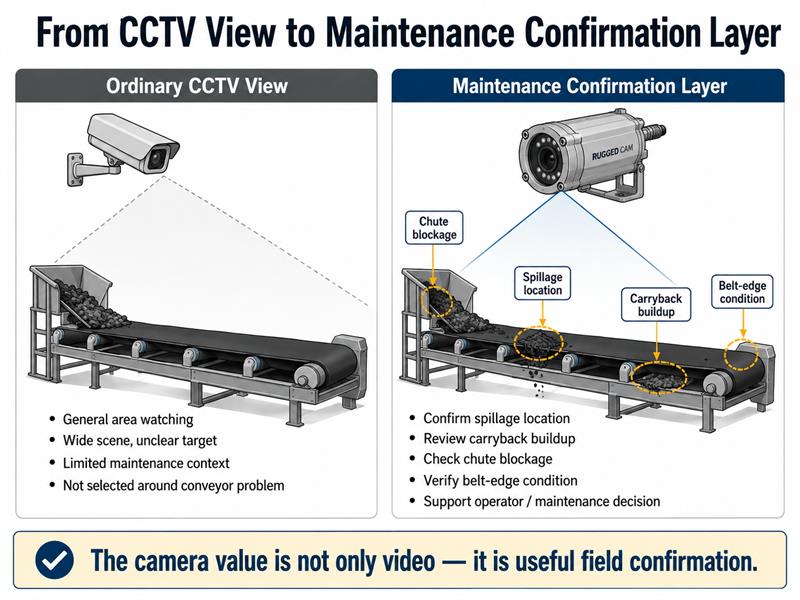
2. From “Watching Video” to “Maintenance Confirmation”
A normal security camera is often installed to watch a general area. A rugged conveyor camera head should be selected for a more specific job.
It should help answer practical maintenance questions:
This is why we prefer the phrase:
maintenance confirmation layer
A visible rugged camera does not replace maintenance work, but it can support maintenance decisions.
For applications where the customer needs a compact visible camera head for a host device, edge box, industrial PC or local monitoring system, Goobuy’s rugged camera platforms such as the USB mining camera can be evaluated as a starting point for sample-to-pilot validation.
3. Spillage Confirmation: Seeing Where Material Escapes
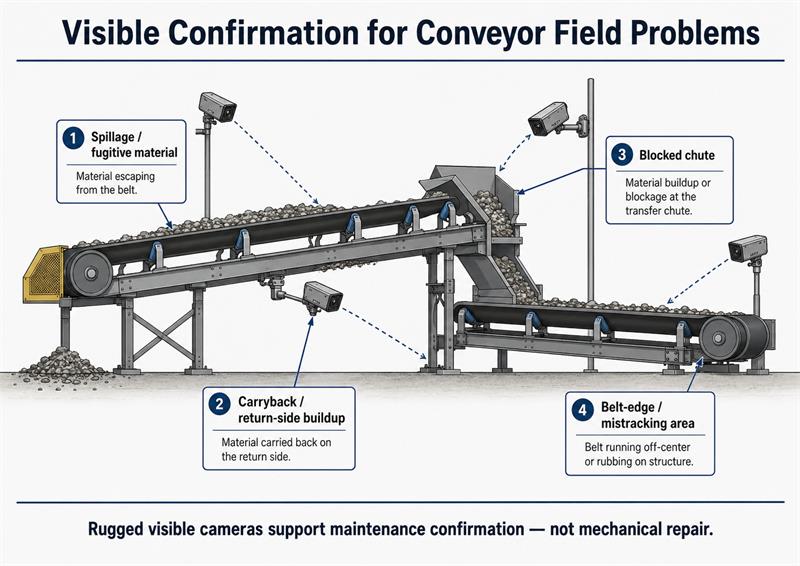
Spillage may happen around loading points, transfer points, skirt areas, belt edges, return sections or discharge points. The visible symptom is usually clear: material appears where it should not be.
A rugged camera head may help confirm:
The camera does not solve the spillage. The root cause may be belt mistracking, poor loading, worn skirting, chute design, belt speed, material flow or belt cleaner performance.
But a camera can help the team see the condition without guessing.
For integrators, this matters because many customers do not simply want video. They want confirmation that helps them decide whether to stop the line, dispatch maintenance or review the problem later.
4. Carryback and Return-Side Buildup Confirmation
Carryback is a strong use case for visible confirmation because it often develops gradually. Material sticks to the belt, travels onto the return side and begins to accumulate around rollers, pulleys, scrapers, frames and floor areas.
A rugged visible camera may support return-side review by showing:
This is not just a camera problem. Carryback must be handled by proper belt cleaning, scraper adjustment, chute management and maintenance. But a visible camera can provide a useful observation layer for locations that are repetitive, remote or difficult to inspect frequently.
The camera also needs to survive the same environment it is observing. Dust, moisture, vibration, lens contamination and cable stress are part of the real integration challenge. This is where a rugged camera head is different from a normal office or security camera.
5. Chute Blockage and Transfer Point Confirmation
Transfer points are often where multiple conveyor problems meet. Material changes direction. Dust is generated. Loading may be uneven. Visibility can be poor. Access can be limited. If a chute starts to plug, the operator may need to confirm the condition quickly.
A visible camera may support chute monitoring by helping confirm:
This is especially useful when the customer already has a sensor, alarm or operator complaint but still needs visual context.
A sensor may say something is wrong.
A rugged camera may help show what the problem looks like.
That is the difference between alarm data and visual confirmation.
6. Why Rugged Camera Heads Matter in Conveyor Environments
A conveyor camera is not only about image resolution.
In harsh conveyor sites, the camera must deal with physical conditions that can make a normal camera unreliable:
A rugged camera head should be selected around the site, not only the datasheet.
Important design questions include:
For many integrators, the real task is not buying a finished CCTV product. It is selecting a camera head that fits into an existing host system or equipment platform.
7. Visible Camera, Thermal Camera or Dual-Spectrum?
Spillage, carryback and chute blockage are usually visible problems. That means a rugged visible camera may be the first layer to evaluate.
However, some conveyor locations involve both visual and thermal concerns. For example:
In these cases, a dual-spectrum camera head may be useful. A visible view shows the scene. A thermal view shows abnormal heat. Together, they can help operators understand whether the issue is only material buildup, or whether there is also a thermal abnormality.
For customers evaluating visible + thermal review in one platform, Goobuy’s dual-spectrum vision platform can be used as a reference point for visible and thermal configuration discussions.
For projects where the customer already has a host system and needs higher-resolution thermal imaging as part of an integration path, Goobuy’s 1280 HD thermal camera module may be relevant for technical review and sample validation.
The key is not to force every conveyor problem into thermal imaging. The right camera layer depends on the field problem:
|
Conveyor Problem |
First Camera Layer to Consider |
|
Spillage |
Visible rugged camera |
|
Carryback |
Visible rugged camera |
|
Chute blockage |
Visible rugged camera |
|
Belt edge position |
Visible rugged camera |
|
Hot idler |
Thermal camera |
|
Bearing overheating |
Thermal camera |
|
Visual + heat context |
Dual-spectrum camera |
|
Dusty or vibrating mounting point |
Rugged housing, cable and connector design |
8. Where Goobuy Fits
Goobuy’s role is not to replace the conveyor OEM, SCADA provider, fire protection contractor or maintenance team.
Our role is more specific:
Goobuy helps OEMs and system integrators select and configure rugged camera heads for harsh industrial equipment.
For conveyor spillage, carryback and chute blockage confirmation, Goobuy usually starts from existing visible, thermal or dual-spectrum camera platforms, then adjusts the configuration around the customer’s host system.
Typical configuration areas include:
This approach is useful for integrators who already have:
In other words, Goobuy is not trying to sell a complete conveyor monitoring system. We provide camera heads and modules that can be tested inside the customer’s own system.
9. What a Rugged Camera Cannot Replace
A credible conveyor camera discussion must also define the boundary.
Rugged cameras do not replace:
This boundary matters. If a supplier claims that a camera “solves” spillage, carryback or chute blockage, the claim is too broad.
A better statement is:
Rugged visible cameras can support confirmation, review and maintenance decision-making for visually observable conveyor problems.
That is practical, accurate and useful.
10. RFQ Checklist for Conveyor Visible Camera Projects
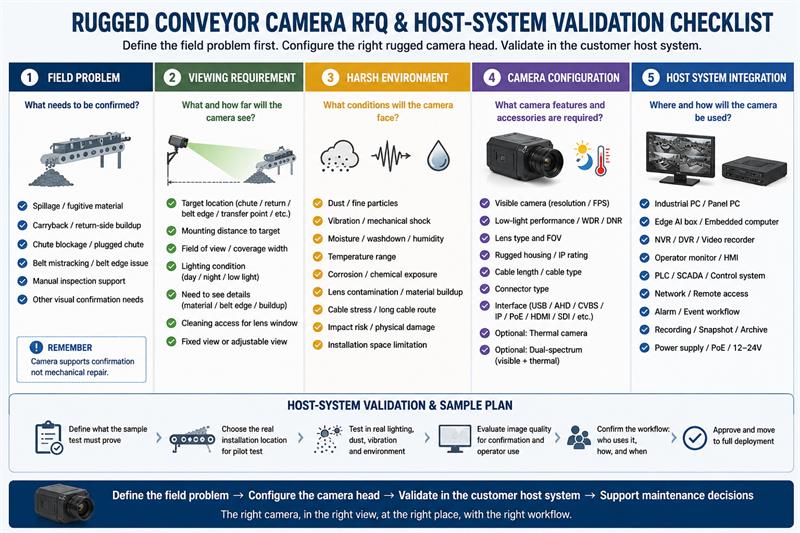
For an integrator or equipment builder, a useful RFQ should describe the field problem before asking for the camera model.
Field Problem
Conveyor Location
Viewing Requirement
Environment
Host System
Interface and Integration
Validation Plan
11. Conclusion
Spillage, carryback and chute blockage are not glamorous conveyor problems, but they are real maintenance problems. They affect cleanup, access, inspection, downtime and operator decision-making.
For these problems, visible rugged camera heads can provide value when they are positioned correctly.
They are not just for “watching video.”
They can become a maintenance confirmation layer.
A properly selected rugged camera head can help operators confirm belt-edge condition, spillage, return-side buildup, chute blockage and difficult inspection areas before maintenance teams are sent to the site.
For more complex conveyor areas, visible cameras may be combined with thermal or dual-spectrum camera heads to add hot-spot awareness around rollers, idlers, bearings or pulley areas.
The best starting point is not the camera specification.
It is the field question:
What conveyor condition needs to be confirmed, where can the camera see it clearly, and how will the customer’s host system use that visual information?
Follow Me
Address:A615, 6F, Huachuangda Building, No107 Xinghua 1st Road, 43 District, Xinan street, Baoan, shenzhen, China 518101