
A STARVIS night vision camera should not be selected by sensor name alone; OEM engineers should evaluate low-light sensitivity, HDR behavior, NIR response, resolution, lens aperture, interface bandwidth, host compatibility, housing, cable, IR filter strategy, and sample-validation path before choosing IMX385, IMX462, IMX662, IMX678, IMX585, IMX335, IMX415, or a custom STARVIS USB camera module.
Need a STARVIS camera that standard modules cannot solve? Read our custom STARVIS2 / STARVIS3 USB camera development guide for funded OEM projects with host, timeline, and NRE readiness. read this blog articles Custom STARVIS USB Cameras: Complete Project Guide(1)
A STARVIS night vision camera should not be selected by sensor name alone.
For an OEM engineer, product manager, system integrator, or device manufacturer, the real question is not simply:
“Which Sony STARVIS sensor has the best night vision?”
The more useful question is:
“Which STARVIS camera module can solve our low-light imaging problem on our real host device, with the right lens, interface, cable, housing, IR strategy, and sample-validation path?”
Sony describes STARVIS, STARVIS 2 and STARVIS 3 as back-illuminated pixel technologies developed for security-camera image sensors, designed to deliver high image quality in visible and near-infrared regions. Sony also positions these sensors for difficult dark and bright conditions, including low noise, high sensitivity, and HDR imaging.
But for real OEM camera projects, the sensor is only one part of the system. Final night-vision performance depends on:
This is why this guide compares STARVIS night-vision sensors from a practical camera-project perspective, not just from a datasheet perspective.
For RK3588 edge-AI camera module projects, the best sensor choice depends on whether the customer needs cost-performance, compact STARVIS 2 validation, or premium low-light image quality.
| Project Need | Better Starting Point | Why |
|---|---|---|
| Mature 4K starlight camera module with lower cost pressure | IMX415 | Mature 4K STARVIS path, suitable when latest STARVIS 2 performance is not mandatory |
| Current 4K STARVIS 2 camera module for RK3588 validation | IMX678 | Strong balance of 4K detail, low-light image quality, platform availability, USB / HDMI / CS lens / autofocus options |
| Premium 4K low-light image quality with larger optics | IMX585 | Better fit when image quality is more important than compact size or cost |
| Autofocus requirement | IMX678 AF platform first | More practical for compact 4K autofocus sample validation |
| Optical zoom or long working distance | CS-lens or custom camera-side review | Zoom and long-distance imaging depend on lens, FOV, mount, housing and mechanical space |
| Price-sensitive 4K edge device | IMX415 or IMX678 standard platform | Start from mature platform before requesting custom design |
Goobuy supports camera-side hardware selection for RK3588-based systems, including sensor, lens/FOV, USB or HDMI output, cable, connector, housing and sample-to-pilot configuration. The RK3588 host board, AI software, BSP, ISP tuning and final system integration should be handled by the customer.
Quick Answer: Which STARVIS Night Vision Camera Should You Evaluate First?
| Real Project Need | Better Starting Point | Why |
|---|---|---|
| 1080P ultra-low-light monitoring with lower bandwidth | IMX462 / IMX662 USB camera module | Strong low-light path for night recording, compact systems, and H.264/USB workflows |
| Mature 2MP low-light security or industrial monitoring | IMX385 USB camera module | Larger 1/2-inch class STARVIS sensor, practical for classic night-vision projects |
| 4K low-light imaging with current STARVIS 2 platform | IMX678 USB / HDMI camera module | Strong balance of 4K detail, STARVIS 2 performance, and platform availability |
| Higher-end 4K low-light image quality | IMX585 USB camera module | Better fit when larger optics and premium low-light quality are acceptable |
| 4K mature STARVIS cost-performance | IMX415 USB+HDMI camera module | Practical 4K option when STARVIS 2 is not required |
| 5MP commercial terminals, kiosks, parking, access control | IMX335 USB3.0 camera module | Good 5MP mixed-light camera for embedded commercial devices |
| HDR ghosting in moving night scenes / future roadmap | IMX908 STARVIS 3 evaluation | Future-facing LOFIC single-exposure HDR direction, not yet a simple mature USB SKU |
| Standard module cannot fit lens/FOV/cable/housing/interface | Custom STARVIS USB Camera Project | Best path for funded OEM projects with defined host, timeline, batch forecast, and NRE readiness |
Many older night-vision comparison articles rank sensors by lux rating. This is useful as a starting point, but it is not enough for professional selection.
A sensor with a lower lux number does not automatically create a better camera. In a real product, night-vision performance can fail because:
So the better selection method is:
Sensor → lens → interface → host → lighting → mechanical fit → sample validation → customization path.
This is exactly where Goobuy should differentiate itself from generic sensor articles.
STARVIS sensors are strongest when the project needs better low-light image quality, low noise, and usable video under weak visible light or near-infrared illumination. Sony’s security-camera sensor lineup emphasizes low-luminosity imaging, high sensitivity, low noise, and the ability to capture scenes under different lighting conditions.
But STARVIS does not solve every imaging problem.
STARVIS is suitable when the main challenge is:
STARVIS may not be the right answer when the main challenge is:
For those motion-related problems, a global shutter USB camera may be more suitable. Goobuy’s own camera-platform guidance makes this distinction clearly: STARVIS is suitable when weak light and low-noise video are the main requirements, while global shutter is better when motion blur, rolling-shutter distortion, or recognition instability from movement is the core issue.
IMX385 is still useful when the customer needs a mature 2MP low-light camera for monitoring, evidence capture, or industrial night-view applications.
It is not the newest sensor, and it is not ideal when the project needs 4K detail or high-resolution image analysis. But for many classic low-light video projects, a 2MP STARVIS camera can still be practical because it reduces bandwidth, lowers processing pressure, and can work well with H.264 or simple USB workflows.
Best-fit applications:
When to avoid IMX385:
Recommended internal anchor:
IMX385 STARVIS USB Camera Module for Low-Light Monitoring
IMX462 and IMX662 are strong choices when the project does not need 4K but needs practical low-light or NIR-assisted video.
For many OEM projects, 1080P is not a weakness. It can be the correct choice when the host device has limited bandwidth, limited CPU, limited storage, or needs continuous night recording. Goobuy’s own OEM camera-platform page states that IMX462 is suitable for low-light 1080P recording with H.264 compression, while IMX678 is better for compact 4K low-light USB, HDMI, CS-lens, or autofocus platforms.
Best-fit applications:
When to avoid IMX462 / IMX662:
Recommended internal anchor:
IMX462 / IMX662 Low-Light USB Camera Module for Night Recording
IMX678 is one of the most important current STARVIS 2 options for 4K low-light USB camera projects. Goobuy’s IMX678 deep-dive page describes it as an 8.29MP, 1/1.8-inch STARVIS 2 sensor for high-sensitivity 4K imaging, dual-exposure HDR, low-noise performance, robotics, AI edge systems, industrial inspection, and challenging lighting environments.
This makes IMX678 a strong “first sample” direction for customers who need 4K low-light imaging now, not just a future sensor forecast.
Goobuy already offers IMX678 camera platforms including USB2.0 UVC, USB3.0, HDMI, autofocus, CS lens, and compact double-PCB designs, with options to customize lens, FOV, cable, housing, interface, and firmware.
Best-fit applications:
When to avoid IMX678:
Recommended internal anchors:
IMX678 4K STARVIS 2 USB Camera Module
IMX678 USB3.0 Camera for 4K Edge AI Image Analysis
IMX678 HDMI Camera Module for Driverless 4K Live View
IMX678 CS-Lens USB Camera for Adjustable Optics
IMX585 is a higher-end STARVIS 2 direction when the project prioritizes stronger 4K low-light image quality and can accept larger optics, higher cost, and a more premium camera design.
It is not always the correct first choice. For many compact products, IMX678 may be easier to validate. But when the customer wants stronger low-light image quality and has enough mechanical space, IMX585 can be a better fit.
Best-fit applications:
When to avoid IMX585:
Recommended internal anchor:
IMX585 STARVIS 2 Low-Light USB Camera Module
IMX415 remains valuable when the customer needs mature 4K STARVIS imaging but does not require the latest STARVIS 2 or STARVIS 3 direction.
It is suitable when the project needs:
Best-fit applications:
When to avoid IMX415:
Recommended internal anchor:
IMX415 4K STARVIS USB+HDMI Camera Module
IMX335 should not be removed from the comparison just because it is not the newest sensor. It can be highly practical for commercial devices that need a 5MP USB3.0 camera, mixed-light usability, and stable integration.
Goobuy’s IMX335 page positions it for self-checkout loss prevention, parking terminals, access-control kiosks, and commercial terminal applications where USB3.0, HDR, UVC compatibility, M12 lens support, and OEM flexibility matter.
Best-fit applications:
When to avoid IMX335:
Recommended internal anchor:
IMX335 USB3.0 HDR Camera for Retail and Access Terminals
The old blog includes GC2053. We can keep it briefly for comparison, but it should not remain a major focus.
GC2053 can be mentioned as a cost-sensitive 2MP option, but professional OEM buyers looking for serious low-light performance, stable customization, and stronger brand trust are more likely to consider Sony STARVIS / STARVIS 2 platforms.
Recommended wording:
GC2053 may be acceptable for basic cost-sensitive 2MP cameras, but it is not the first recommendation for OEM low-light projects where image quality, NIR response, HDR behavior, host validation, and long-term platform support matter.
This avoids wasting traffic on low-end price comparison and keeps the page aligned with Goobuy’s higher-value positioning.
Yes, but carefully.
Sony’s STARVIS 3 IMX908 is important because it introduces a future direction for compact 4K HDR security-oriented sensors. Goobuy’s IMX908 anti-ghosting HDR article explains that IMX908’s key value is not “ending motion blur,” but reducing HDR ghosting caused by multi-exposure stitching through LOFIC-based single-exposure HDR at the sensor level.
This matters in difficult night scenes with:
However, IMX908 should not be positioned as a mature standard USB camera module for every customer today. Goobuy should present it as a future roadmap sensor, while guiding current buyers toward existing STARVIS 2 platforms such as IMX678 and IMX585 for sample validation. Goobuy’s IMX908 article already makes this clear: existing STARVIS 2 modules are often more practical for near-term OEM development, while IMX908 is a future STARVIS 3 anti-ghosting HDR path to monitor.
Recommended internal anchor:
Sony IMX908 STARVIS 3 Anti-Ghosting HDR for Night AI Vision
| Sensor / Platform | Best Role | Main Strength | Main Limitation | Goobuy Recommendation |
|---|---|---|---|---|
| IMX385 | Mature 2MP low-light | Classic STARVIS night monitoring | Not high resolution | Use when 1080P low-light video is enough |
| IMX462 | 1080P low-light / NIR | Good low-light and H.264-friendly path | Not 4K | Use for night recording and lower-bandwidth hosts |
| IMX662 | 1080P STARVIS 2 direction | Modern 2MP low-light path | Less detail than 4K | Use for compact low-light projects |
| IMX678 | 4K STARVIS 2 | Strong current 4K low-light platform | Higher bandwidth than 1080P | Best first choice for 4K low-light validation |
| IMX585 | Premium 4K STARVIS 2 | Larger-sensor low-light quality | Larger optics and higher cost | Use for high-end low-light projects |
| IMX415 | Mature 4K STARVIS | Cost-performance 4K | Older generation | Use when mature 4K USB+HDMI is enough |
| IMX335 | 5MP STARVIS USB3 | Commercial terminal mixed-light camera | Not 4K | Use for kiosks, parking, access control |
| IMX908 | Future STARVIS 3 | LOFIC single-exposure HDR direction | Early ecosystem | Watch for future NRE roadmap |
| GC2053 | Low-cost 2MP | Budget camera option | Not premium low-light | Only for basic cost-sensitive projects |
For night monitoring, the customer should first decide whether they need 1080P, 5MP, or 4K.
Use IMX462 / IMX662 when 1080P low-light video is enough and host bandwidth is limited.
Use IMX678 when 4K low-light detail and STARVIS 2 image quality are required.
Use IMX585 when the project needs a stronger high-end low-light platform and can accept larger optics.
Use IMX415 when mature 4K STARVIS output and cost-performance are more important than the latest generation.
Recommended internal anchors:
These devices often face headlights, lobby lighting, glass reflections, outdoor daylight, indoor backlight, and tight mechanical space.
IMX335 can be a strong first choice for 5MP commercial terminal use. IMX678 is better for 4K premium low-light imaging. IMX415 is practical when the customer needs mature 4K output. IMX908 may become relevant later if the main problem is HDR ghosting with moving subjects and strong highlights.
Recommended internal anchors:
For robotics and Physical AI projects, the camera may be used not only for human viewing but also for recognition, tracking, teleoperation feedback, and data capture.
IMX678 is a strong current choice for 4K STARVIS 2 evaluation. IMX585 is better when premium low-light image quality matters. IMX462 / IMX662 can be used when the project needs 1080P low-light and lower bandwidth.
But if the robot has motion blur, rolling-shutter distortion, or unstable recognition caused by movement, the buyer may need a global shutter camera instead of a STARVIS camera. This distinction should be clearly stated to avoid attracting the wrong customer.
Recommended internal anchors:
Some customers do not need the highest sensor. They need a camera that reduces host CPU pressure.
For these projects, IMX462 with H.264 or a lower-bandwidth 1080P path can be more practical than raw 4K video. This is especially true for small embedded hosts, low-power edge devices, continuous night recording, and systems where storage or CPU load is limited.
Recommended internal anchor:
IMX462 Low-Light H.264 USB Camera Module

A standard module is best for fast sample validation. But a custom STARVIS camera project becomes relevant when the customer already has:
Goobuy’s Custom STARVIS page clearly states that custom development is for OEMs with an existing product, host platform, lighting requirement, mechanical constraints, timeline, batch forecast, and NRE readiness — not for hobby projects, academic experiments, or casual one-board sample shopping.
Recommended internal anchor:
Custom STARVIS USB Cameras: Complete Project Guide
Use this link after the application sections and again before the final CTA.
8. What Customers Should Send Before Asking for a Night-Vision Camera Recommendation
| Information Needed | Why It Matters |
|---|---|
| Target application | Determines whether the camera is for security, robotics, kiosk, inspection, or monitoring |
| Host device | Determines USB2.0, USB3.0, HDMI, UVC, H.264, Linux, Windows, Jetson or IPC path |
| Working distance | Controls lens focal length and focus strategy |
| Required FOV | Prevents wrong lens selection |
| Lighting condition | Determines whether IMX462, IMX678, IMX585, IMX335 or future IMX908 is suitable |
| Visible light or IR illumination | Determines IR-cut, IR-pass, dual-filter, or NIR strategy |
| Motion speed | Helps decide STARVIS vs global shutter |
| Resolution requirement | Avoids choosing 4K when 1080P is enough, or 1080P when detail is insufficient |
| Mechanical space | Determines board size, lens height, cable direction and housing feasibility |
| Cable and connector | Prevents late-stage integration failure |
| Indoor/outdoor use | Affects housing, sealing, lens and thermal design |
| Sample timeline | Separates ready-module evaluation from custom development |
| Batch forecast | Determines whether NRE customization is commercially realistic |
Goobuy STARVIS night-vision camera modules are not the best fit if:
The best-fit customer already has a device or system and needs a camera module to solve a real low-light imaging problem.
Do not choose a STARVIS night-vision camera only by asking:
“Which sensor is best in low light?”
Ask instead:
“Which sensor and camera platform can solve our real low-light problem on our host device, with the right lens, interface, IR strategy, cable, housing, firmware, and validation path?”
Choose IMX462 / IMX662 when you need practical 1080P low-light or NIR-assisted video with lower bandwidth.
Choose IMX385 when you need a mature 2MP STARVIS low-light camera for classic monitoring.
Choose IMX678 when you need a practical 4K STARVIS 2 USB / HDMI platform for current sample validation.
Choose IMX585 when you need stronger premium 4K low-light image quality and can accept larger optics or higher system cost.
Choose IMX415 when you need mature 4K STARVIS cost-performance with USB+HDMI output.
Choose IMX335 when you need a 5MP USB3.0 camera for commercial terminals, kiosks, parking devices, or access-control systems.
Watch IMX908 STARVIS 3 when your future roadmap needs compact 4K single-exposure HDR and reduced HDR ghosting, but validate current projects first with existing STARVIS or STARVIS 2 platforms.
For a faster recommendation, send Goobuy your host device, application scene, lighting condition, working distance, FOV, interface, mechanical space, sample timeline, and expected batch quantity.
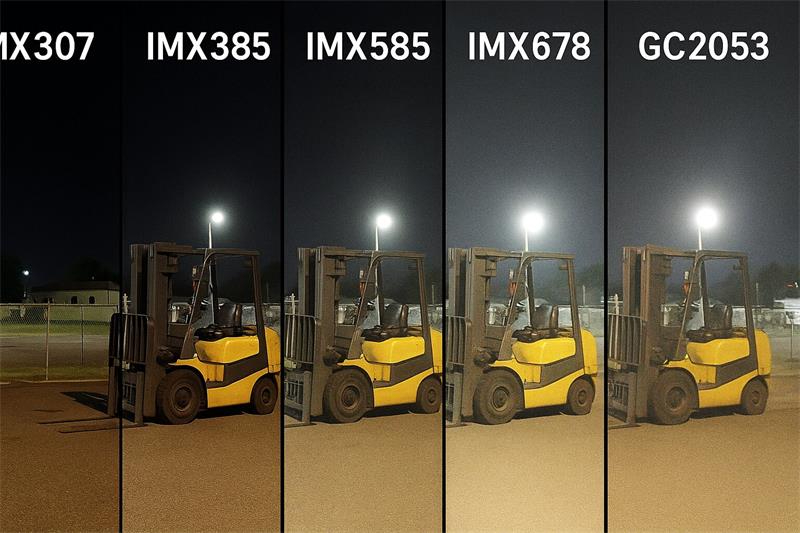
The best Sony STARVIS sensor for a night vision USB camera depends on resolution, lighting, host bandwidth and product size. IMX462 or IMX662 is practical for 1080P low-light recording, IMX678 is a strong 4K STARVIS 2 starting point, IMX585 is better for premium 4K low-light image quality, and IMX335 is often practical for 5MP commercial terminals.
IMX678 is better when the project needs 4K detail, STARVIS 2 performance, and current OEM camera-platform flexibility. IMX385 can still be practical when the project only needs mature 2MP low-light video with lower bandwidth and lower system complexity.
Choose IMX462 when your embedded host needs 1080P low-light video, lower bandwidth, or H.264 compression. Choose IMX678 when the project needs 4K low-light detail, stronger STARVIS 2 performance, or more image data for AI analysis and inspection.
IMX585 can be better when the project prioritizes maximum 4K low-light image quality and can accept larger optics or higher cost. IMX678 is often more practical when the customer needs compact 4K STARVIS 2 sample validation across USB, HDMI, CS-lens, autofocus, or double-PCB camera platforms.
Yes. IMX335 is still useful for 5MP USB3.0 commercial terminal projects, including parking kiosks, access-control devices, retail terminals, visitor systems, and mixed-light embedded devices. It is not the newest STARVIS sensor, but it can be commercially practical when 5MP detail and integration stability matter.
No. Lux rating is only one factor. Real night-vision performance also depends on lens aperture, FOV, exposure time, IR filter, illumination, ISP tuning, noise reduction, interface bandwidth, host processing, housing design, and sample validation under the real lighting condition.
Use a STARVIS camera when weak light, night imaging, NIR response, and low-noise video are the main requirements. Use a global shutter camera when the main problem is motion blur, rolling-shutter distortion, unstable barcode recognition, robotic tracking error, or high-speed inspection.
IMX908 is an important future STARVIS 3 direction for compact 4K HDR and reduced HDR ghosting, but it should not be treated as a mature off-the-shelf USB camera module for every project today. For immediate OEM sample validation, IMX678, IMX585, IMX462, IMX662, IMX335, or IMX415 may be more practical.
Yes. Goobuy can evaluate STARVIS camera customization for qualified OEM projects, including sensor selection, lens/FOV, cable, connector, housing, IR filter, interface, firmware identity, low-light tuning, and sample-validation support. Custom projects are best suited for buyers with a defined product, host platform, timeline, batch forecast, and NRE readiness.
Send your target application, host device, operating system, lighting condition, visible/IR illumination, working distance, required FOV, motion speed, resolution requirement, interface preference, mechanical space, cable requirement, sample timeline, and expected order quantity.
No. A 4K STARVIS camera provides more detail, but it also requires more bandwidth, processing, storage, and optical quality. A 1080P STARVIS camera such as IMX462 or IMX662 may be better when the project needs continuous low-light recording, lower host burden, H.264 compression, or compact embedded integration.
The fastest way is to start with the closest existing Goobuy STARVIS module, test it on the real host device under the real lighting condition, then adjust lens, FOV, cable, connector, housing, IR filter, firmware, or interface only after the first sample validation.
This Article is updated in May 25th, 2026 by Shenzhen Novel electronics limited
Follow Me
Address:A615, 6F, Huachuangda Building, No107 Xinghua 1st Road, 43 District, Xinan street, Baoan, shenzhen, China 518101