
Thermal vs STARVIS camera selection for harsh industrial sites depends on what the equipment must see: STARVIS is best for low-light visible details, labels, color and scene context; thermal imaging is best for heat patterns, hot spots, darkness, fog, smoke and equipment temperature awareness; dual-spectrum vision is best when heavy equipment, oilfield vehicles, port platforms, mobile robots or outdoor industrial systems need both visible context and thermal awareness.
For harsh industrial sites, the real question is not simply “thermal camera vs night vision camera.”
The better engineering question is:
When should industrial equipment use STARVIS, thermal imaging, or both?
U.S. industrial sites often operate in low light, dust, fog, smoke, heat, humidity, vibration, outdoor weather, electrical risk, remote assets, heavy equipment zones and long-duty environments. A normal camera may show a visible image, but it may miss heat. A thermal camera may show heat, but it may not show labels, colors, part numbers, surface details or scene context.
For OEMs, system integrators, equipment builders, oil and gas service companies, energy infrastructure teams, mobile platform manufacturers, industrial robot companies and edge AI hardware providers, the right answer depends on what the system must actually see.
STARVIS, thermal imaging and dual-spectrum cameras solve different problems.
Goobuy provides configurable STARVIS, thermal and harsh-site camera platforms for projects that already have a host device, edge AI box, industrial PC, vehicle platform, rugged enclosure, monitoring terminal or inspection system.
| Harsh-Site Requirement | Best Camera Direction | Why |
|---|---|---|
| Low-light visible detail | STARVIS camera | Shows scene detail, color, labels, objects and equipment condition |
| Night-shift factory monitoring | STARVIS camera | Works better than normal cameras when some light or IR is available |
| Electrical hot-spot detection | Thermal camera module | Shows heat patterns and abnormal temperature areas |
| Pump, motor, bearing or power equipment monitoring | Thermal camera module | Useful for heat-aware visibility |
| Fog, smoke, dust or total darkness | Thermal camera module | Does not depend on visible light |
| Heavy equipment operator awareness | Dual-spectrum camera | Combines visible context and thermal awareness |
| Oilfield vehicle or refinery service platform | Dual-spectrum camera | Helps in low light, heat, dust, fog and changing visibility |
| Port, logistics yard or outdoor industrial site | STARVIS + thermal depending on task | STARVIS for visual scene; thermal for heat or low visibility |
| Edge AI inspection terminal | STARVIS or thermal depending on algorithm input | Choose based on what the AI must detect |
| Harsh mobile robot or autonomous equipment | Dual-spectrum or rugged STARVIS/thermal | Depends on navigation, obstacle, heat and environment needs |
| High-detail fixed visible inspection | 4K STARVIS2 camera | Better for object detail and fixed-FOV visual capture |
| Analog low-latency thermal display | CVBS thermal core | Useful for simple operator-view thermal video |
A STARVIS camera is a low-light visible camera that helps industrial equipment see details when some light or IR illumination is available.
A thermal camera module is an infrared imaging core that helps industrial equipment see heat patterns, hot spots or warm objects in darkness, smoke, fog or low visibility.
A dual-spectrum camera combines visible imaging and thermal imaging so harsh-site equipment can see both scene context and heat-aware information.
Many U.S. industrial buyers search for “night vision camera,” “thermal camera,” “low light camera,” or “rugged camera” as if these are interchangeable.
They are not.
A low-light STARVIS camera and a thermal camera may both be used at night, but they answer different questions.
A STARVIS camera answers:
A thermal camera answers:
A dual-spectrum camera answers:
For harsh industrial sites, the correct camera direction should start from the application, not the sensor name.
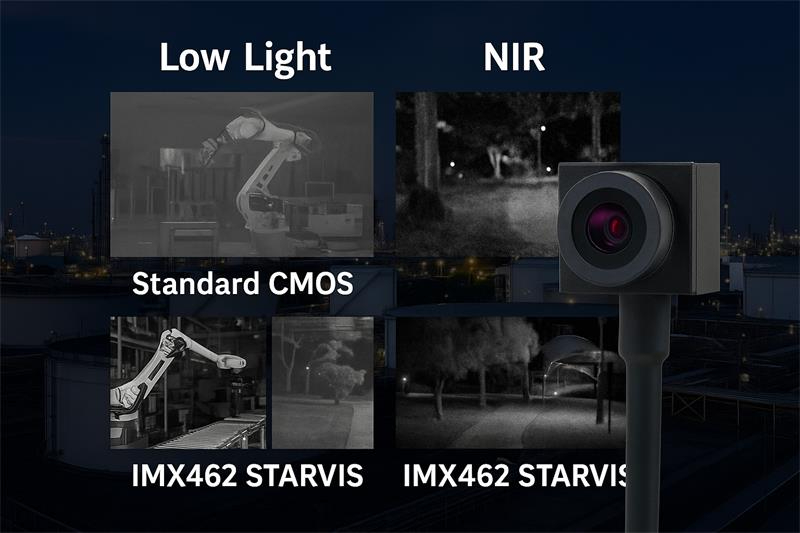
Choose STARVIS when the system needs a better visible image in low light.
STARVIS low-light cameras are useful when there is some ambient light, artificial lighting, machine light, IR illumination or night-shift lighting. They are designed to provide more usable visible images than ordinary cameras in dim scenes.
Typical U.S. industrial applications include:
STARVIS is the better direction when the buyer needs:
For U.S. OEMs and system integrators that need stable 1080P low-light video without moving to a higher-cost 4K sensor, Goobuy provides:
Goobuy UC-535-2MP Housed Sony IMX385 STARVIS Low-Light USB Camera
This camera is built around a housed Sony IMX385 STARVIS sensor and is designed for existing Windows, Linux, Jetson, Raspberry Pi, USB recorder or industrial monitoring terminal projects that need dependable 1080P low-light video.
When the project needs 4K low-light visual detail, CS lens selection, metal housing and USB3 UVC integration, Goobuy provides:
Goobuy IMX585 USB3 CS-Lens Box Camera with Sony 4K STARVIS2
This direction is suitable for fixed-FOV engineering vision, equipment rooms, inspection workstations, machine status panels, optical test benches and commercial AI image capture stations where the customer already has a USB3 host and needs a controlled field of view.
STARVIS is still visible imaging.
It needs some form of light.
A STARVIS camera may not be enough when:
In these situations, thermal imaging may be the better direction.
Choose thermal imaging when the system must see heat.
Thermal camera modules are useful when visible cameras cannot answer the main question. They can provide heat-aware visual information in darkness, smoke, fog, dust, heat-stress areas, electrical cabinets, machine zones and remote industrial environments.
Typical U.S. industrial applications include:
Thermal imaging is the better direction when the buyer needs:
For compact monitoring devices, electrical cabinets, edge AI boxes, industrial inspection terminals or systems needing radiometric data, Goobuy provides:
21×21mm USB-C Radiometric Thermal Camera Module with SDK
This direction is suitable when the host system needs temperature data, thermal video, software-side monitoring or compact OEM integration.
For higher-value industrial monitoring where image detail, target distance or analytics value matters, Goobuy provides:
1280×1024 HD Micro USB Thermal Module for Industrial OEMs
This direction is more suitable when the target is smaller, farther away, or when high-resolution thermal images are important for operator review or thermal analytics.
For systems that already use analog video and need a live thermal image rather than radiometric data, Goobuy provides:
640×512 Ultra-Wide Micro CVBS Thermal Core with 90.3° HFOV
This direction is more suitable for operator-view thermal awareness, wide near-field thermal vision and existing CVBS video paths.

Choose dual-spectrum when the system needs both visible scene context and thermal awareness.
This is often the best direction for harsh-site mobile platforms where conditions change quickly.
A visible camera can show:
A thermal camera can show:
Dual-spectrum is useful when neither STARVIS alone nor thermal alone gives enough context.
Typical U.S. harsh-site applications include:
For harsh-site vehicles and mobile platforms needing visible + thermal awareness, Goobuy provides:
Goobuy Custom Dual Spectrum Vision Platform
This platform is designed for customers who need both visible and thermal vision around harsh-site vehicle or equipment applications. Final configuration should be reviewed according to application, host system, interface, enclosure, field of view and operating environment.
Oilfields, refineries, compressor stations, pipeline areas, pump rooms and service vehicles may need visible video, thermal awareness or both.
Use STARVIS when the system needs visible scene context, vehicle-view video, low-light equipment identification or operator-recognizable images.
Use thermal when the system needs heat-aware information around pumps, motors, electrical cabinets, compressor areas or remote equipment.
Use dual-spectrum when service vehicles, mobile platforms or remote equipment need both visible context and thermal contrast.
High-value search phrases for this application include:
thermal camera for oil and gas monitoring, dual-spectrum camera for oilfield vehicles, thermal camera module for refinery equipment, rugged camera for compressor station, low-light camera for oilfield service vehicle.
Substations, transformers, battery systems, electrical rooms and power electronics may require heat-aware monitoring.
Use STARVIS when visible details, labels, operator review or scene context matter.
Use thermal when hot spots, temperature differences or thermal trend monitoring matter.
Use dual-spectrum when the system needs both visual confirmation and thermal awareness in one monitoring direction.
Search phrases:
thermal camera module for electrical cabinets, thermal imaging for power equipment, STARVIS camera for utility monitoring, thermal camera for battery energy storage, rugged camera for energy infrastructure.
Ports, rail yards, container yards, loading docks and logistics facilities often face mixed lighting, fog, rain, dust, long operating hours and night shifts.
Use STARVIS when the system needs visual context and object recognition under low light.
Use thermal when fog, darkness, smoke or heat awareness is more important.
Use dual-spectrum for vehicles, operator systems, mobile inspection units or outdoor equipment platforms where both visible context and heat awareness matter.
Search phrases:
low-light camera for port equipment, thermal camera for logistics yard, rugged camera for loading dock, dual-spectrum camera for heavy equipment, harsh environment camera for outdoor industrial monitoring.
Heavy equipment works around dust, mud, vibration, low light, heat and mechanical stress.
Use STARVIS when the operator or AI system needs visible context and object details.
Use thermal when heat, darkness, dust or low-visibility conditions are the main challenge.
Use dual-spectrum when mobile equipment needs both scene context and thermal awareness.
Search phrases:
rugged camera for heavy equipment, thermal camera for mining vehicles, dual-spectrum camera for quarry equipment, harsh-site camera solution, rugged vision camera for industrial vehicles.
Robots working in factories, tunnels, utility sites, outdoor yards, oilfield service zones or heavy equipment areas often need more than one type of camera.
Use STARVIS for low-light visible recognition.
Use thermal for heat-aware inspection.
Use dual-spectrum when the robot must operate in changing visibility, dust, fog, night and industrial equipment zones.
Search phrases:
thermal camera for inspection robot, low-light robot vision camera, STARVIS camera for robotics, dual-spectrum robot camera, rugged camera for autonomous inspection platform.
Before choosing STARVIS, thermal or dual-spectrum, define the problem in one sentence.
“We need to see visible details in low light.”
Choose STARVIS.
“We need to see heat, hot spots or warm equipment.”
Choose thermal.
“We need both visible scene context and heat-aware information.”
Choose dual-spectrum.
“Our camera must survive rain, washdown, dust or vibration.”
Camera imaging type is only one part. You must also review enclosure, cable, connector, lens window, mounting and environmental protection.
For broader harsh-site options, review:
Rugged Cameras for Harsh Environments | STARVIS & Thermal Modules
The right imaging type is only half the decision.
The interface must match the host system.
Best for industrial PCs, Windows/Linux systems, Jetson, Raspberry Pi, edge AI boxes and fast sample validation.
Best for analog video systems, low-latency operator display and simple thermal video paths.
Best for Ethernet-based monitoring systems where power and data over one cable are preferred.
Useful when the system needs analog HD video for vehicle displays, mobile equipment or existing AHD monitor chains.
Useful when bandwidth, storage or host processing load must be reduced.
Needed when the project requires special housing, special cable, dual-spectrum layout, rugged vehicle mounting, heating, anti-fog, IP67/IP69K direction or deeper integration.
In harsh-site projects, the interface affects cable routing, bandwidth, host load, latency, reliability and serviceability.
This article is not written for:
Goobuy is a better fit for OEMs, system integrators, industrial equipment builders and edge AI teams that already have a host platform and need a camera direction for harsh-site validation.
For real harsh-site projects, Goobuy can discuss camera-head configuration around:
The goal is not to push the most expensive sensor. The goal is to identify the camera direction that fits the harsh-site environment and existing host system.
For existing USB host systems needing stable 1080P low-light video:
Goobuy UC-535-2MP Housed Sony IMX385 STARVIS Low-Light USB Camera
For 4K low-light fixed-view engineering vision with CS lens selection:
Goobuy IMX585 USB3 CS-Lens Box Camera with Sony 4K STARVIS2
For thermal data, hot-spot monitoring and compact embedded thermal vision:
21×21mm USB-C Radiometric Thermal Camera Module with SDK
For high-detail thermal monitoring and higher-value industrial imaging:
1280×1024 HD Micro USB Thermal Module for Industrial OEMs
For analog operator-view thermal awareness:
640×512 Ultra-Wide Micro CVBS Thermal Core with 90.3° HFOV
For harsh-site vehicles and mobile equipment needing both visible and thermal vision:
Custom Dual Spectrum Vision Platform
Choose a STARVIS low-light camera first when the system must recognize visible details such as equipment shape, labels, panel indicators, surface condition, color, scene context or operator-view video. Choose a thermal camera first when the system must see heat patterns, hot spots, overheated components, warm objects, temperature contrast, smoke/fog visibility or complete-darkness awareness. In harsh industrial sites, STARVIS answers “what is it?” while thermal imaging answers “where is the heat?”
No. A STARVIS camera can improve visible imaging in low-light scenes, but it still needs some light or IR illumination. It cannot detect heat patterns by itself. If the project requires hot-spot detection, equipment overheating awareness, temperature contrast, fire-risk visibility, or thermal monitoring in darkness, a thermal camera module is required. STARVIS is for low-light visual detail; thermal is for heat-aware visibility.
Not always. A thermal camera can show heat patterns, but it cannot show normal visible details such as labels, colors, part numbers, gauge markings, surface defects or full scene context. If the operator or AI system must visually identify what the object is, a STARVIS visible camera may still be required. Thermal is excellent for heat awareness, but STARVIS is better for recognizable visual information.
A U.S. industrial vehicle or heavy equipment platform should consider dual-spectrum vision when it needs both visible scene context and thermal awareness. This is common in oilfield service vehicles, mining support equipment, quarry machines, port equipment, utility vehicles, outdoor inspection platforms and mobile robots where lighting, dust, fog, heat and weather conditions change during operation. Dual-spectrum vision helps the operator or host system see both “what is there” and “where heat exists.”
Use thermal imaging for oil and gas equipment when the target problem is heat-related, such as pump or motor overheating, compressor station temperature awareness, electrical cabinet hot spots, pipeline area thermal contrast, flare stack peripheral awareness or refinery equipment thermal monitoring. Use STARVIS when the system mainly needs low-light visible video for service vehicles, operator view, equipment identification or scene documentation. Use dual-spectrum when both visible context and thermal contrast are needed.、
Yes, thermal imaging is usually the better first choice when the goal is to observe hot spots, overloaded components, abnormal terminals, power electronics heat, transformer area temperature patterns or battery system thermal imbalance. A STARVIS camera may be added when the system also needs to read labels, see switch positions, confirm indicator lights or provide visible scene context. For electrical monitoring, thermal provides the primary heat-aware layer; STARVIS provides visual confirmation.
For port equipment, logistics yards and loading docks, STARVIS is practical when the system needs low-light visible video, object recognition, vehicle surroundings, operator view or container/asset context. Thermal is practical when fog, darkness, smoke, heat, or low-visibility conditions are the main problem. Dual-spectrum is the stronger direction for mobile equipment, port vehicles or outdoor platforms that must operate across day, night, fog, rain and mixed lighting.
Add thermal imaging to an edge AI system when visible images do not capture the key risk or condition. Examples include overheating equipment, hot electrical components, fire-risk awareness, warm-object detection, smoke/fog scenes, total darkness, or industrial assets where temperature contrast is more important than color and shape. Thermal imaging gives the AI system a different sensing layer instead of simply adding another visible camera
It depends more on the application. The correct camera direction should be chosen based on what the system must detect, the lighting condition, target distance, field of view, host platform, environmental exposure, data requirement, mounting position and final use case. Sensor model matters, but it should come after the engineering question: does the system need visible detail, heat awareness, or both?
Send the application, target object, working distance, required field of view, lighting condition, host device, operating system, interface preference, indoor/outdoor environment, dust/water/vibration/heat exposure, need for temperature data, need for visible detail, enclosure requirement, sample schedule and expected pilot quantity. With this information, Goobuy can recommend whether the project should start with STARVIS low-light, thermal imaging or dual-spectrum vision.
This Article is updated in June 20th, 2026 by shenzhen novel electronics limited
Follow Me
Address:A615, 6F, Huachuangda Building, No107 Xinghua 1st Road, 43 District, Xinan street, Baoan, shenzhen, China 518101