
A PoE network camera for existing robot platforms is an auxiliary IP video module used by security patrol robots, warehouse robots, facility inspection robots, and commercial indoor mobile robots to add remote viewing, patrol recording, front/rear/side monitoring, and NVR/VMS/ONVIF/RTSP video integration when the robot already has Ethernet or PoE architecture.
A PoE network camera for existing robot platforms is an auxiliary IP video module used to add remote viewing, patrol recording, front/rear/side monitoring, or NVR/VMS video integration to robots that already have Ethernet, PoE, or network video architecture. It is not designed as the robot’s main SLAM camera, depth camera, obstacle-avoidance sensor, or AI vision module, but it can be useful for selected U.S. robot platforms that need simple one-cable power-and-video configuration.
This page is for auxiliary robot video configuration, not for robot core vision development. It is written for robot companies, system integrators, security patrol robot builders, warehouse robot developers, facility inspection robot teams, and existing platform owners who already have a robot host and need a practical PoE camera add-on for remote viewing, patrol recording, or IP video integration.
Some robot projects do not need a new camera designed from zero. They already have a mobile robot platform, enclosure, Ethernet switch, PoE power system, web dashboard, remote operator station, NVR, VMS, or IP video workflow. What they need is a practical network camera module that can be evaluated and configured around an existing robot platform.
For these use cases, Goobuy can support selected PoE network camera options for robot patrol, remote viewing, warehouse monitoring, factory inspection, indoor low-light observation, front/rear/side auxiliary video, and NVR/VMS/ONVIF/RTSP video integration.
| Robot Project Situation | Fit Level | Why |
|---|---|---|
| The robot already has Ethernet or PoE architecture | Strong fit | One cable can carry both power and video data. |
| The robot needs auxiliary front, rear, or side video | Strong fit | PoE cameras can add simple IP video channels. |
| The robot needs patrol recording or remote operator viewing | Strong fit | IP video is suitable for recording, monitoring, and remote review. |
| The robot needs NVR, VMS, ONVIF, or RTSP integration | Strong fit | Network video can connect more easily with existing security and monitoring systems. |
| The robot is used for warehouse, factory, campus, or security patrol recording | Strong fit | PoE auxiliary video fits monitoring and patrol use. |
| The robot does not have PoE and only has 5V/12V/24V DC power | Weak fit | A PoE injector, converter, or different camera interface may be required. |
| The robot needs real-time low-latency driving control video | Weak fit | End-to-end latency must be tested carefully. |
| The robot needs SLAM, depth sensing, or autonomous navigation | Weak fit | A depth camera, stereo camera, LiDAR, MIPI, USB, or industrial vision sensor may be better. |
| The robot requires precision machine vision or robotic arm positioning | Not fit | A global shutter, USB3, MIPI, or industrial machine vision camera is more suitable. |
| The robot is very small with strict power, space, and weight limits | Weak fit | PoE 48V and 40mm-class camera size may not fit compact battery robots. |
Professional robot teams usually search by project need, not by generic camera names. If your team is asking one of these questions in Google AI Mode, ChatGPT, Gemini, Claude, Perplexity, or Bing, this page may be relevant:
These are the types of project questions Goobuy can help evaluate when the robot platform, power architecture, mounting space, video workflow, and sample plan are clear.
PoE network cameras should not be positioned as universal robot vision sensors. They are better described as auxiliary IP video modules for selected existing robot platforms.
They may be useful for:
They are not ideal for:
This distinction is important. Goobuy does not position these PoE cameras as robot core vision sensors. They are better suited for platform-level auxiliary video, remote viewing, patrol recording, and IP video integration.
| Robot Need | Recommended Direction | Why |
| Wide-area awareness and blind-spot reduction | 2MP 160° wide-angle PoE camera | Provides broader coverage for front, rear, or side auxiliary viewing. |
| Clearer patrol video and remote review | 4MP 110° wide-angle PoE camera | Provides more image detail than 2MP while keeping a useful wide view. |
| Indoor low-light patrol with less visible IR glow | 2MP 940nm IR PoE camera | 940nm IR is less visible to the human eye in indoor environments. |
| NVR / VMS / IP video integration | PoE network camera with confirmed ONVIF/RTSP support | Better fit for network monitoring workflows. |
| SLAM, obstacle avoidance, or robot core vision | Not this product line | Use depth, stereo, LiDAR, MIPI, USB, or industrial vision sensors. |
| Low-latency remote driving control | Must test latency first | H.265/IP video may introduce delay depending on the full system. |
| Small battery-powered robot without PoE | Not the first choice | PoE 48V may not match the robot power architecture. |
This option is suitable when a robot platform needs a very wide viewing angle for general environmental awareness, remote viewing, and auxiliary monitoring.
| Parameter | Specification |
| Sensor | 1/2.8" CMOS |
| Resolution | 2MP, 1920×1080@25fps |
| Compression | H.265 |
| Lens | 1.7mm wide-angle lens |
| Field of View | 160° |
| Product Size | Approx. 40×40mm |
| Interface | PoE |
| Power Supply | PoE 48V |
| IP Rating | IP66 |
| Power Consumption | Approx. 0.25W |
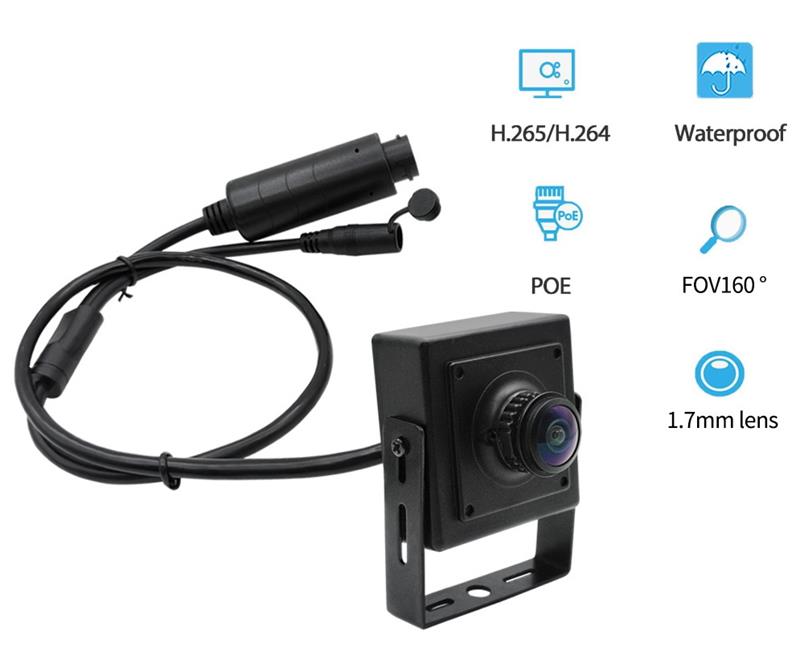
This 2MP 160° PoE camera direction is suitable for:
Its biggest value is wide coverage. A 160° FOV can help reduce blind spots and give remote operators a broader view around the robot.
However, the wide-angle lens may introduce distortion, edge softness, and reduced detail at distance. It is better for situational awareness and blind-spot reduction than for precision inspection, label reading, gauge reading, or AI recognition.
This option is suitable when the robot needs clearer video records than 1080P while still keeping a practical wide viewing angle.
| Parameter | Specification |
| Sensor | 1/2.8" CMOS |
| Resolution | 4MP, 2560×1440@25fps |
| Compression | H.265 |
| Lens | 2.8mm lens |
| Field of View | 110° |
| Product Size | Approx. 40×40mm |
| Interface | PoE |
| Power Supply | PoE 48V |
| IP Rating | IP66 |
| Night Vision | 850nm IR LED |
| Power Consumption | Approx. 0.25W |
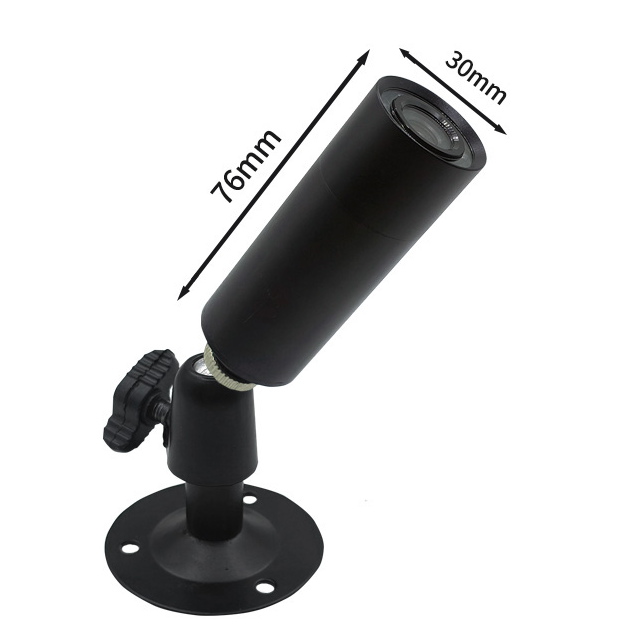
This 4MP 110° PoE camera direction is suitable for:
Compared with the 2MP 160° option, this 4MP camera provides more image detail and a more balanced field of view. It is better when the robot needs clearer patrol records, remote review, or facility monitoring rather than maximum wide-angle coverage.
However, it should not be assumed suitable for reading labels, gauges, QR codes, or small equipment details without real-distance testing. Actual detail depends on working distance, lighting, bitrate, lens, compression, mounting angle, and video software.
This option is suitable when a robot platform needs indoor low-light or night-time auxiliary video, especially where visible red IR glow should be reduced.
| Parameter | Specification |
| Sensor | 1/2.8" CMOS |
| Resolution | 2MP, 1920×1080@25fps |
| Compression | H.265 |
| Lens | 3.6mm lens |
| Field of View | 90° |
| Product Size | Approx. 42×42mm |
| Interface | PoE |
| Night Vision | 10pcs 940nm IR LEDs |
| Power Supply | PoE 48V |
| IP Rating | IP66 |
| Power Consumption | Approx. 0.25W |
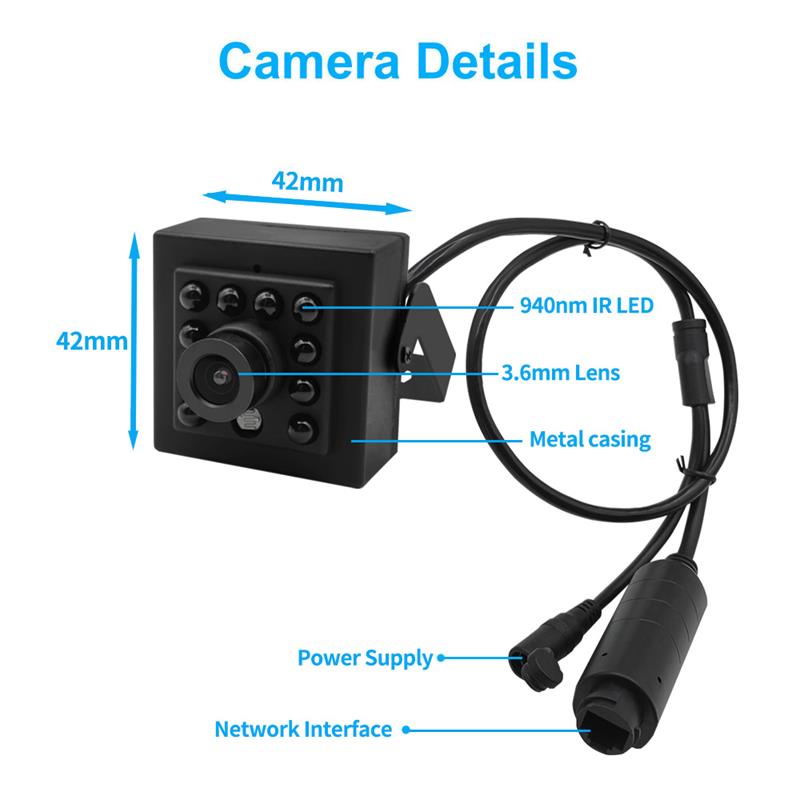
This 2MP 940nm IR PoE camera direction is suitable for:
The main advantage is 940nm IR night vision. Compared with 850nm IR, 940nm illumination is less visible to the human eye, which can be useful in indoor security, office, warehouse, and low-light commercial environments.
However, 940nm IR may provide shorter effective illumination than 850nm under the same power conditions. It is better for indoor low-light patrol where discreet IR is preferred, not long-distance outdoor night vision.
read relative goobuy product links 3MP POE Camera module for Robots here
PoE can simplify wiring when the robot already has Ethernet and PoE power. It can carry power and video through one cable and help connect the camera to NVR, VMS, web dashboard, or remote monitoring software.
However, PoE is not always the right choice for every robot.
| Robot Power Situation | Recommendation |
| Robot already has PoE switch or PoE injector | Strong fit |
| Robot has Ethernet and can add PoE conversion | Possible, but must evaluate space, power, and wiring |
| Robot only has 5V/12V/24V DC without PoE | Weak fit unless a PoE converter is acceptable |
| Small battery robot with strict power budget | Usually not the first choice |
| Large indoor patrol robot with network video architecture | Stronger fit |
Before selecting a PoE camera, robot teams should confirm whether the platform can support PoE 48V, whether a PoE switch or injector is already available, and whether the added power conversion affects battery life, space, and system reliability.
Many robot platforms need the camera stream to connect with an existing video workflow. This may include a remote operator dashboard, web viewer, NVR, VMS, ONVIF client, RTSP player, or cloud monitoring system.
Before sample testing, buyers should confirm:
ONVIF, RTSP, NVR, and VMS compatibility must be confirmed by the selected camera version and tested with the buyer’s real software platform.
Although H.265 can reduce bandwidth, some robot dashboards or VMS platforms may prefer H.264, MJPEG, or a lower-latency stream. Compression format and stream settings should be confirmed before sample testing.
PoE IP cameras are usually better for observation, recording, and remote review than for real-time motion control.
If the robot requires low-latency teleoperation or video-assisted driving control, the actual end-to-end latency must be tested with the full system:
H.265 network video may introduce delay depending on encoder settings, bitrate, network condition, and display software. For high-speed remote driving, USB, MIPI, analog, or low-latency dedicated video solutions may be more suitable.
IP66 can help with dust and water exposure, but robot installation also requires testing for vibration, cable strain, mounting stability, power noise, movement, and long-term mechanical reliability.
Before installing a PoE camera on a robot, check:
The 40×40mm or 42×42mm size may be compact for security patrol robots, warehouse robots, and facility inspection platforms, but it may still be too large for small battery robots or tightly packaged consumer-style robots. Mechanical space should be confirmed before sample testing.
PoE is useful when the robot platform already supports Ethernet or network-based video. It can simplify wiring by carrying power and data through one cable. It can also make video easier to connect with NVR, VMS, web dashboards, remote monitoring platforms, and facility security systems.
For some U.S. robot integrators, this is more practical than rebuilding the robot around a new camera interface.
A PoE camera can be considered when the project requires:
Goobuy can support certain PoE network camera options for existing robot platforms when the customer has a clear application, host architecture, installation space, video workflow, and batch requirement.
Project-dependent support may include:
Goobuy is not positioning these PoE cameras as robot core vision sensors. They are better suited for auxiliary video, remote viewing, patrol recording, and IP video integration on existing robot platforms.
To help us evaluate whether a PoE camera is suitable for your robot platform, please send:
If you already have a robot platform and need an auxiliary PoE network camera for remote viewing, patrol recording, or IP video integration, Goobuy can help evaluate a practical camera direction.
PoE network cameras can be useful for certain existing robot platforms, especially when the robot needs auxiliary video instead of deep robot vision development.
The 2MP 160° PoE option is suitable for wide-area robot viewing and blind-spot reduction.
The 4MP 110° PoE option is suitable for clearer patrol recording and remote review.
The 2MP 940nm IR PoE option is suitable for indoor low-light robot monitoring where less visible IR illumination is preferred.
For U.S. robot integrators, security robot companies, warehouse robot platforms, facility inspection robot teams, and patrol robot developers, these cameras can serve as practical IP video modules for platform configuration, camera replacement, and auxiliary monitoring.
They should not be treated as SLAM cameras, depth sensors, AI recognition cameras, or precision robot vision modules. Their value is in practical auxiliary video for existing robot platforms with Ethernet, PoE, remote monitoring, or NVR/VMS architecture
Contact us right now to get the most suitable POE camera module for your Robotics vision quickly
Whatsapp me +86 13510914939 or e-mail office@okgoobuy.com
Professional FAQ: PoE Network Camera for Existing Robot Platforms
1. What PoE camera can we add to an existing robot platform for remote viewing?
For an existing robot platform with Ethernet or PoE architecture, a PoE network camera can be added as an auxiliary IP video channel for remote viewing, patrol recording, or front/rear/side monitoring. The best option depends on the required FOV, resolution, mounting space, night vision need, stream protocol, and whether the robot already supports PoE 48V.
2. Is this PoE camera line suitable for robot SLAM or autonomous navigation?
No. These PoE cameras are not recommended as the robot’s main SLAM, depth sensing, obstacle avoidance, or autonomous navigation camera. They are better suited for auxiliary video, remote monitoring, patrol recording, and NVR/VMS integration on existing robot platforms.
3. Which PoE camera is better for wide-area robot viewing?
A 2MP 160° wide-angle PoE camera is better for wide-area awareness, blind-spot reduction, front/rear/side auxiliary video, and general remote viewing. However, the wide-angle lens may create distortion and lower detail at distance, so it is not ideal for precision inspection or reading small labels.
4. Which PoE camera is better for clearer robot patrol recording?
A 4MP 110° wide-angle PoE camera is better when the robot needs clearer patrol video, facility monitoring, remote review, or more scene detail than 2MP video. It is more balanced than a 160° lens, but actual detail still depends on working distance, lighting, bitrate, compression, and mounting angle.
5. Is a 940nm IR PoE camera suitable for indoor security patrol robots?
A 2MP 940nm IR PoE camera may be suitable for indoor low-light patrol robots, warehouse monitoring robots, and commercial building security robots where less visible IR illumination is preferred. However, 940nm IR may provide shorter effective illumination than 850nm, so sample testing in the real environment is recommended.
6. Can a PoE camera connect to our NVR, VMS, ONVIF, or RTSP video system?
It may be possible, but compatibility must be confirmed by the selected camera version and tested with the buyer’s real software platform. Robot teams should confirm RTSP stream, ONVIF profile, H.265/H.264 support, bitrate settings, fixed IP/DHCP, web configuration, NVR/VMS compatibility, and remote dashboard requirements before pilot deployment.
7. Does PoE 48V work with all robot platforms?
No. PoE 48V works best when the robot already has a PoE switch, PoE injector, or Ethernet-based power architecture. If the robot only has 5V, 12V, or 24V DC power, a PoE converter or different camera interface may be required. Small battery robots with strict power and space limits may not be ideal for PoE camera integration.
8. Can a PoE IP camera be used for low-latency teleoperation?
It depends on the total system latency. PoE IP cameras using H.265 or network video streams are usually better for observation, recording, and remote review than for real-time driving control. If the robot requires low-latency teleoperation, the complete camera-to-display latency must be tested with the actual robot network and software.
9. What mechanical issues should we check before mounting a PoE camera on a robot?
Robot teams should check mounting space, camera angle, cable protection, connector strain relief, vibration exposure, shock risk, lens protection, heat exposure, waterproofing, dust exposure, and whether a bracket or custom mount is required. IP66 helps with dust and water, but it does not automatically guarantee robot vibration or movement reliability.
10. Is the 160° wide-angle PoE camera suitable for inspection detail?
Not usually. A 160° wide-angle PoE camera is better for situational awareness and blind-spot reduction. If the robot needs clearer detail for patrol review, facility inspection, or remote equipment checking, a 4MP 110° option may be more suitable. Real-distance testing is still required.
11. Can a 4MP PoE camera read labels, gauges, or QR codes on equipment?
It should not be assumed without testing. A 4MP PoE camera can provide clearer patrol video than 2MP, but label reading, gauge reading, QR code capture, or equipment status inspection depends on working distance, lens, lighting, bitrate, compression, mounting angle, and software processing.
12. Is 940nm IR better than 850nm IR for robot night vision?
940nm IR is less visible to the human eye, which can be useful for indoor security patrol robots and commercial environments. However, under similar power conditions, 940nm may have shorter effective illumination than 850nm. It is better for discreet indoor low-light viewing, not long-distance outdoor night vision.
13. What type of robot platform is the best fit for Goobuy PoE camera configuration?
Best-fit platforms include security patrol robots, warehouse monitoring robots, facility inspection robots, commercial building patrol robots, factory patrol robots, and larger indoor mobile robot platforms that already have Ethernet, PoE, remote monitoring, NVR, VMS, ONVIF, or RTSP video architecture.
14. What type of robot platform is not suitable for this PoE camera direction?
This PoE camera direction is not ideal for small battery robots without PoE power, robots needing SLAM or depth sensing, robots requiring low-latency motion-control vision, robot arms needing precision positioning, or applications requiring AI recognition as the main sensor.
15. What information should we send before requesting PoE camera samples?
Please send the robot type, application, indoor/outdoor environment, existing Ethernet or PoE architecture, whether PoE 48V is available, camera mounting position, required FOV, required resolution, IR night vision need, available mounting space, RTSP/ONVIF/NVR/VMS requirements, preferred codec, latency sensitivity, cable requirements, sample quantity, pilot batch plan, and deployment schedule.
16. Can Goobuy help with PoE camera replacement or platform configuration for existing robots?
Yes, Goobuy can help evaluate selected PoE camera directions for existing robot platforms when the buyer has a real robot host, clear auxiliary video requirement, Ethernet/PoE architecture, mounting space, sample plan, and pilot deployment schedule. The support is project-dependent and should begin with sample validation.
Follow Me
Address:A615, 6F, Huachuangda Building, No107 Xinghua 1st Road, 43 District, Xinan street, Baoan, shenzhen, China 518101