
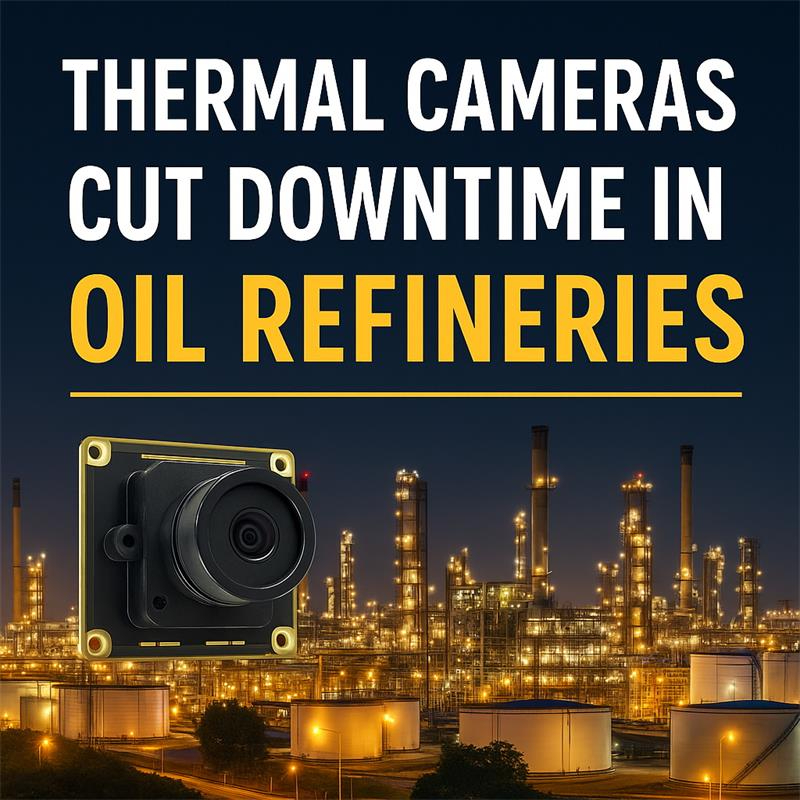
A thermal camera module for oil and gas harsh-site monitoring is an embedded infrared imaging core used to add a thermal visibility layer into refinery equipment zones, compressor stations, pipeline areas, pump rooms, electrical cabinets, flare stack peripheral monitoring, service vehicles and remote industrial monitoring systems.
A thermal camera module for oil and gas harsh-site monitoring is an embedded infrared imaging core used to add a heat-aware visibility layer into refinery equipment zones, compressor stations, pipeline areas, pump rooms, electrical cabinets, flare stack peripheral areas, inspection vehicles, remote monitoring nodes and industrial edge AI systems.
This page is not a downtime-reduction case study.
It does not promise fixed ROI, shutdown prevention, regulatory compliance, leak detection performance or certified safety protection.
Its purpose is more practical:
to help oil and gas OEMs, system integrators, industrial equipment builders and monitoring solution providers decide whether a thermal camera module can become a useful sensing layer inside their own host device, enclosure, platform or monitoring system.
For oil and gas environments, a thermal module is not a complete refinery safety system. It is a camera-side component that may help the customer’s system see heat patterns, abnormal hot areas, thermal contrast and temperature-related visual information where visible cameras alone may not provide enough context.
| Oil & Gas Area | What Thermal Imaging May Help Show | Practical Camera Direction |
|---|---|---|
| Refinery equipment zone | Hot surfaces, abnormal heat patterns, process equipment temperature awareness | USB / HD thermal module inside customer system |
| Compressor station | Motor, bearing, pipe, valve and equipment thermal awareness | Thermal module + rugged enclosure design |
| Pipeline area | Thermal contrast around pipe sections or support equipment | Fixed, mobile or vehicle-mounted thermal platform |
| Pump room | Pump, motor, bearing and electrical hot-spot awareness | Compact thermal module with defined FOV |
| Electrical cabinet | Hot connections, overloaded components, power electronics heat | Radiometric USB-C thermal module |
| Flare stack peripheral area | Remote visual thermal awareness around surrounding equipment | HD thermal or dual-spectrum direction |
| Oilfield vehicle / service platform | Thermal visibility in dust, night, fog or low visibility | Dual-spectrum or rugged thermal platform |
| Remote oil & gas site | Long-duty monitoring and harsh weather | Rugged camera module + local system integration |
| Edge AI monitoring box | Thermal image input for local analytics | USB/UVC thermal or SDK-based module |
| Analog operator-view system | Live thermal video without radiometric analytics | CVBS thermal core |
A thermal visibility layer means the thermal module provides infrared image information to help the customer’s system observe heat patterns.
It does not mean the camera alone can diagnose equipment health, certify safety, replace inspection procedures, or guarantee downtime reduction.
In oil and gas projects, the thermal visibility layer may support:
The final value depends on the customer’s complete system: host hardware, software logic, installation position, calibration, enclosure, maintenance process, alarm rules, site procedures and compliance requirements.
This guide is written for:
The best-fit customer usually already has:
This page is not intended for:
Goobuy focuses on camera modules and project-configurable camera platforms. The customer or system integrator remains responsible for the final enclosure, installation, software, certification, site validation and operating procedure.
Refineries contain many equipment zones where heat patterns may be useful for visual monitoring.
These areas may include:
A thermal camera module can help add infrared visibility to the customer’s monitoring system.
In this application, the most important question is not whether the camera can “reduce downtime.” The better question is:
Can the thermal module provide useful heat-aware image data from the correct distance, field of view, host interface and enclosure position?
For refinery environments, the system designer should define:
If the project needs high thermal detail, a high-resolution module may be considered:
1280×1024 HD Micro USB Thermal Module for Industrial OEMs
This direction is more suitable for high-value industrial monitoring projects where thermal image detail, distance and analytics value justify a higher configuration.
Compressor stations can involve rotating equipment, motors, bearings, lubrication systems, pipework, valves, electrical systems and auxiliary equipment.
A thermal module may provide visual temperature awareness around:
For compressor stations, ruggedization is often as important as the thermal sensor itself.
The final camera system may need to consider:
A thermal module alone is not a complete compressor station monitoring system. It is the imaging core that must be integrated into a complete monitoring architecture.
Pipeline areas and remote oil and gas assets may require visual inspection, remote observation or thermal awareness over wide industrial zones.
Thermal camera modules can be used in systems for:
The right thermal direction depends on:
For simple operator-view systems where only live thermal video is required, a CVBS thermal module may be appropriate.
640×512 Ultra-Wide Micro CVBS Thermal Core with 90.3° HFOV
For digital analytics or temperature data, USB or HD thermal may be more suitable than CVBS.
Pump rooms and motor areas are practical targets for thermal monitoring because heat patterns may appear around:
A compact thermal module can be installed into a monitoring unit, inspection terminal, edge AI box or fixed camera enclosure.
For pump room projects, the integrator should define:
Thermal imaging can support visual awareness, but final fault analysis should depend on the customer’s monitoring logic, maintenance rules and site procedures.
Electrical cabinets are one of the most practical areas for thermal modules in oil and gas environments.
Potential thermal targets include:
If the system needs temperature data, trend records or software alarm logic, a radiometric USB thermal module may be more suitable than a video-only thermal feed.
Recommended starting direction:
21×21mm USB-C Radiometric Thermal Camera Module with SDK
This direction is useful for compact monitoring devices, edge AI boxes, electrical cabinet monitoring, energy equipment and industrial inspection systems where the host needs thermal data.
Before selecting a module, the customer should define:
Flare stack monitoring is a sensitive and site-specific topic.
A thermal camera module should not be presented as a complete flare monitoring solution unless it is part of a fully engineered and validated system.
However, thermal imaging may be considered for peripheral awareness around flare-related infrastructure or nearby equipment zones when the customer’s system needs remote heat-aware observation.
Possible project questions include:
For some vehicle or remote monitoring projects, a visible + thermal direction may be more useful than a thermal-only module.
Custom Dual Spectrum Camera Platform for Mining and Oilfield Vehicles
Dual-spectrum vision can provide both visible scene context and thermal awareness, but the final use must always be reviewed according to site, end-use and compliance requirements.

Oil and gas sites often use service vehicles, inspection platforms, mobile machinery and rugged monitoring equipment.
These platforms may face:
A thermal module or dual-spectrum camera platform can be useful when the vehicle or equipment needs heat-aware visibility.
Important design factors include:
For harsh mobile platforms, the camera should be treated as part of a full system rather than as a stand-alone module.
For broader harsh-site camera directions, customers can review:
Rugged Cameras for Harsh Environments | STARVIS & Thermal Modules
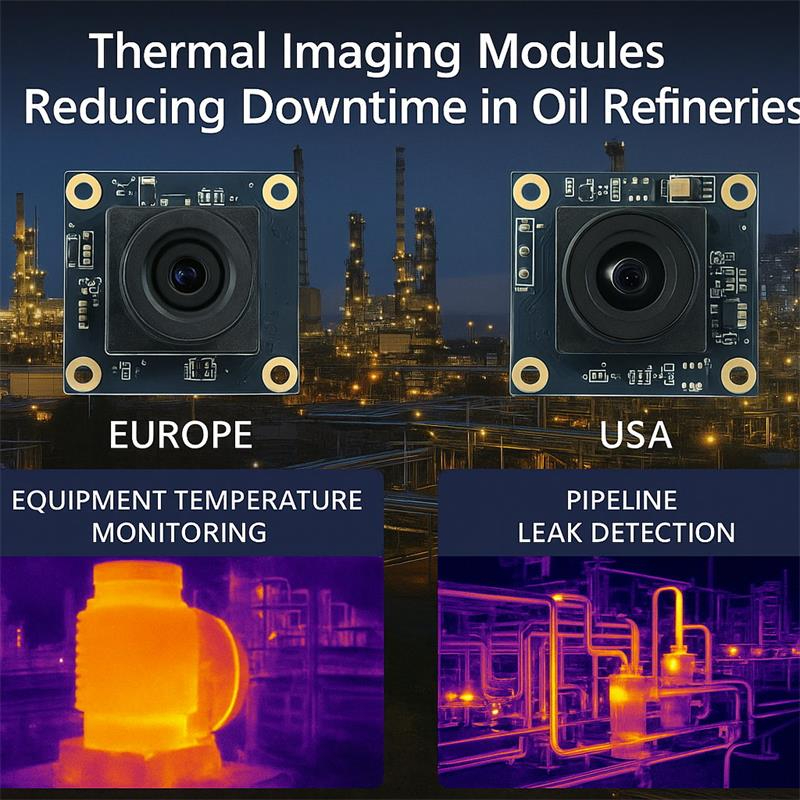
Oil and gas harsh-site monitoring requirements vary by region.
Goobuy’s thermal and rugged camera module directions may be relevant for selected industrial projects in:
The regional value is not the same everywhere.
In Russia / CIS, customers may care more about cold start, rugged supply, vehicle platforms, remote oilfield equipment and non-Western supply-chain flexibility.
In the Middle East, customers may care more about heat, dust, refinery zones, oilfield vehicles, petrochemical facilities and outdoor equipment.
In Latin America, customers may care more about practical integration, service vehicles, refinery support, electrical infrastructure and cost-effective deployment.
In Southeast Asia, customers may care more about humidity, rain, tropical heat, ports, refineries, power equipment and compact system integration.
For all regions, Goobuy focuses on camera modules and configurable camera platforms, not complete site-level certified safety systems.
Recommended direction:
21×21mm USB-C Radiometric Thermal Camera Module
Recommended direction:
1280×1024 HD Micro USB Thermal Module
Recommended direction:
640×512 Ultra-Wide Micro CVBS Thermal Core
Reference direction:
Custom Dual Spectrum Camera Platform for Mining and Oilfield Vehicles
This is a critical point for oil and gas buyers.
A Goobuy thermal camera module is not automatically an ATEX-certified, IECEx-certified or explosion-proof complete camera.
A thermal module is an imaging component.
If the final installation is in a hazardous area, the customer, system integrator, local engineering company or certification partner must handle:
Goobuy can discuss the camera module, lens, interface, video output and project configuration. But final hazardous-area certification must be handled at the complete product or system level.
This boundary should be clearly understood before any oil and gas project starts.
To avoid wrong recommendations, customers should provide:
The clearer the application, the more practical the recommendation.
Goobuy is a good fit when the customer:
Goobuy is not the best fit when the customer:
A thermal camera module for oil and gas harsh-site monitoring is an embedded infrared imaging core that adds heat-aware visual information to refinery equipment zones, compressor stations, pipeline areas, pump rooms, electrical cabinets, service vehicles, remote monitoring nodes or industrial edge AI systems.
No. A thermal camera module does not reduce downtime by itself. It provides a thermal visibility layer. Any operational benefit depends on the complete monitoring system, software logic, maintenance process, installation quality and site response procedures.
Thermal modules may be evaluated for equipment zones, pump areas, motor areas, electrical cabinets, pipe sections, compressor peripherals, service platforms, remote observation points and selected harsh-site monitoring systems.
No. Goobuy mainly provides thermal camera modules and project-configurable camera platforms. If ATEX, IECEx or local hazardous-area certification is required, the final enclosure, installation and certification must be handled at the complete system level.
Radiometric USB thermal is suitable when the host system needs temperature data, thermal records, software alarms, edge AI processing or compact integration into electrical cabinets, equipment monitoring units or inspection terminals.
HD 1280×1024 thermal is useful when the target is smaller, farther away or when higher thermal image detail is valuable for operator review, analytics or high-value industrial monitoring.
CVBS thermal is suitable when the system already uses analog video, the operator only needs live thermal awareness, and radiometric data or advanced digital analysis is not required.
Dual-spectrum cameras combine visible and thermal imaging. They are useful when an oilfield vehicle, service platform or remote industrial system needs both scene context and heat-aware visibility in dust, darkness, fog or changing light conditions.
Thermal and rugged camera modules may be relevant for selected oil and gas projects in Russia / CIS, Middle East, Latin America, Southeast Asia and other industrial regions where heat, dust, humidity, cold, remote assets or harsh-site equipment create monitoring challenges.
Customers should provide application area, target equipment, distance, FOV, host platform, interface, temperature data requirement, environment, enclosure condition, certification requirement, sample schedule, pilot quantity and customization needs.
this article is updated in June 10th, 2026 by shenzhen novel electronics limited
Follow Me
Address:A615, 6F, Huachuangda Building, No107 Xinghua 1st Road, 43 District, Xinan street, Baoan, shenzhen, China 518101